
Device
Garmin Vivoactive vs Forerunner: Which Should You Buy?
Garmin Vivoactive vs Forerunner: Which Should You Buy?

Garmin makes two distinct families of fitness smartwatches that often get compared: the Vivoactive line, designed as an all-around lifestyle and fitness watch, and the Forerunner line, built primarily for runners and triathletes. Both use AMOLED displays, sync to Garmin Connect, and share most health tracking features. The differences are in the details, and they matter depending on how you train.
The current comparison comes down to the Garmin Vivoactive 6 ($299) and the Garmin Forerunner 165 ($249.99). The Vivoactive 6 costs $50 more, adds a compass, gyroscope, animated workout coaching, and a Smart Alarm feature. The Forerunner 165 costs less, adds a barometric altimeter for elevation tracking, and goes deeper on running-specific metrics like training load, training effect, and race predictor. Neither is strictly better; they're designed for different priorities.
This guide breaks down which watch wins in each category and gives you a clear decision framework for your specific situation.
Key Takeaways
The Vivoactive 6 ($299) is the better all-around lifestyle smartwatch: it has animated workout coaching, a compass, Smart Alarm, and a more polished design for daily wear. The Forerunner 165 ($249.99) is better for dedicated runners who want a barometric altimeter and deeper training analytics at a lower price.
Both watches share the same AMOLED display size (1.2 inches), battery life (11 days smartwatch / ~17-21 hours GPS), Garmin Pay, offline music, and sleep and health tracking suite. The core experience is nearly identical.
Choose Vivoactive 6 if you want a watch that does everything well without being running-centric. Choose Forerunner 165 if running is your primary sport and you want elevation tracking and training load tools at a slightly lower price.
Quick Verdict
Garmin Vivoactive 6: Best for fitness enthusiasts who want a stylish daily watch with broad sports coverage, animated coaching, and smart features beyond running.
Garmin Forerunner 165: Best for runners who want a dedicated running tool with altitude tracking and training analysis at a lower price point.
Garmin Vivoactive 6 Overview
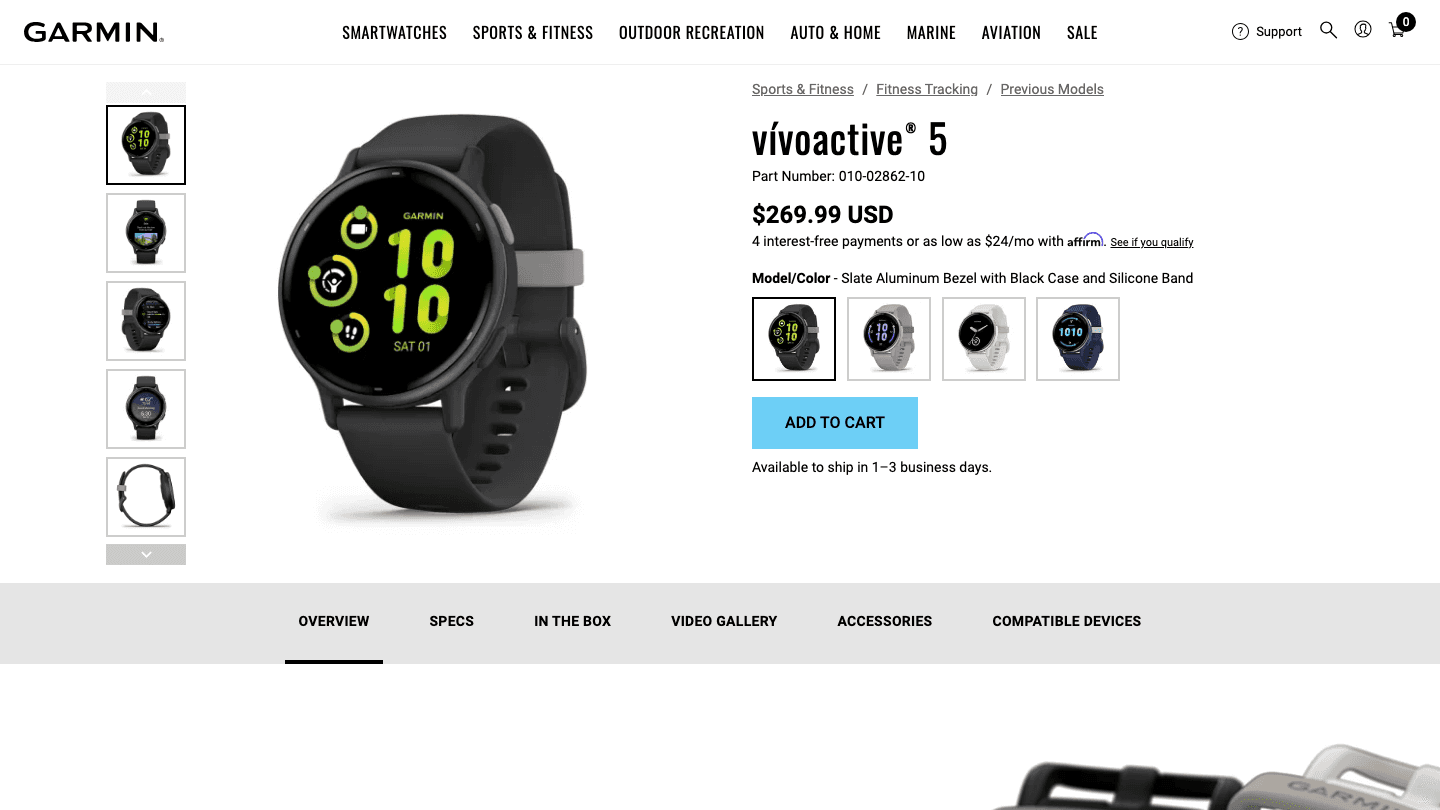
The Vivoactive 6 launched in April 2025 as the successor to the popular Vivoactive 5. It keeps the same 42mm AMOLED design but bumps internal storage to 8GB, increases display brightness, adds a compass and gyroscope (missing from Vivoactive 5), and introduces Garmin's new Smart Alarm feature. The Smart Alarm wakes you at the optimal point in your sleep cycle within a set window, which is a genuinely useful daily-wear feature.
The anodized aluminum bezel gives it a polished look that works as well in a meeting as on a trail. The two-button and touchscreen navigation is more intuitive for non-runners than the Forerunner's five-button layout. It covers over 70 sports activities, animated workout coaching with on-screen guidance, Garmin Pay, and offline music, plus the full Garmin health suite including Body Battery, HRV Status, sleep staging, and SpO2.
What it doesn't have: a barometric altimeter, which means elevation data comes from GPS rather than air pressure. For stair climbing, hiking with significant elevation gain, or trail running with altitude accuracy needs, this matters. For street running and gym workouts, it doesn't. For how the Vivoactive line compares across generations, see our Vivoactive 5 vs 6 comparison.
1.2-inch AMOLED, 390x390, touchscreen + 2 physical buttons
11-day battery (smartwatch mode), 21h GPS
42mm case, 36g, anodized aluminum bezel
Compass, gyroscope, thermometer, ambient light sensor
No barometric altimeter
8GB storage, Garmin Pay, multi-GNSS, Smart Alarm
70+ sports modes, animated workout coaching
What Works
Polished design that works as a daily watch, not just a workout device
Smart Alarm is a practical feature for anyone who cares about sleep quality
8GB storage is the most in this price range (2x the Forerunner 165's 4GB)
Compass and animated coaching make it better for outdoor adventures and beginners
Limitations
$50 more than the Forerunner 165 despite having fewer running-specific tools
No barometric altimeter; elevation data is GPS-based and less accurate on trails
Less detailed training analysis compared to the Forerunner line
Price: $299
Best for: All-around fitness users, beginners to Garmin, outdoor enthusiasts who want broad sports coverage
Garmin Forerunner 165 Overview
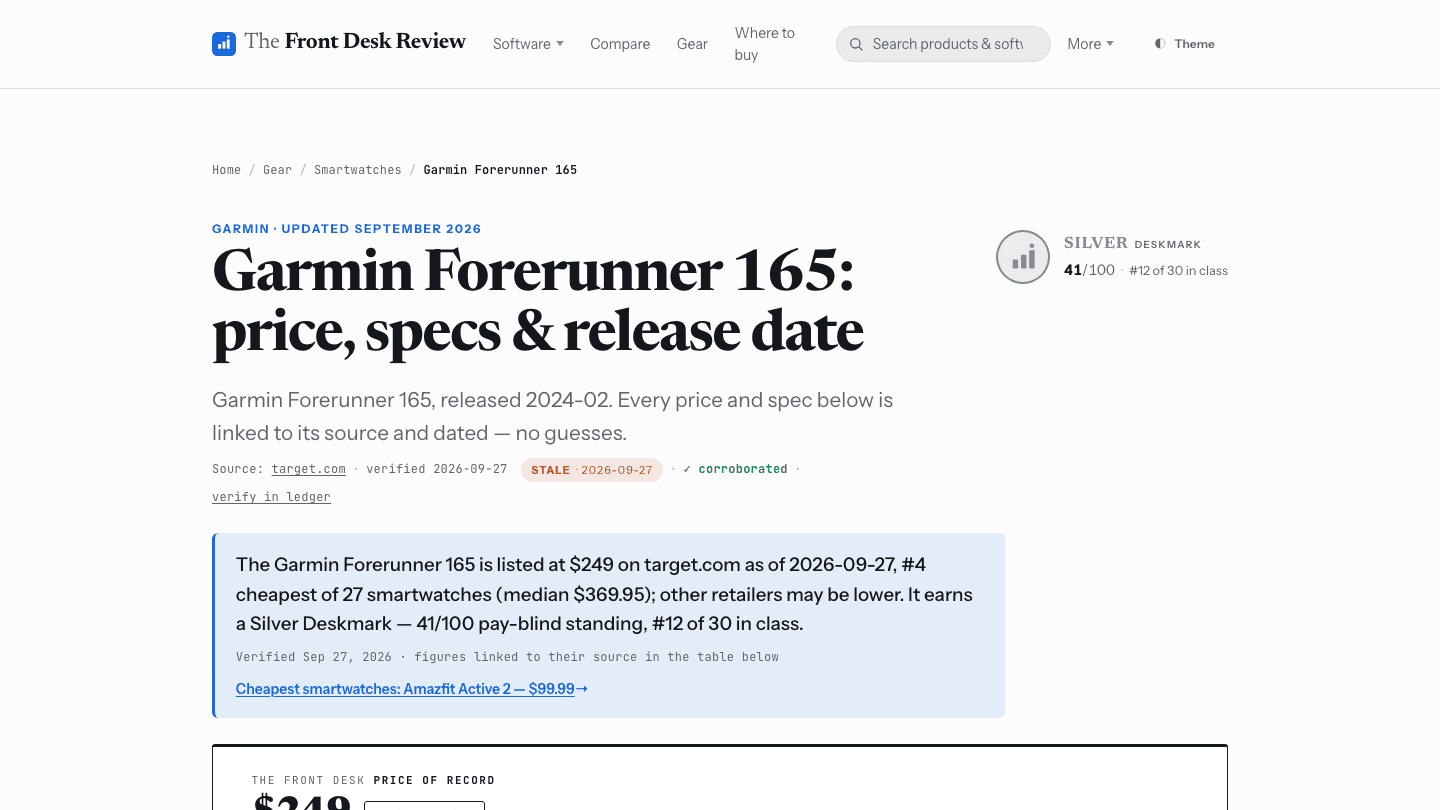
The Forerunner 165 is Garmin's entry point into serious running watch territory. At $249.99, it brings an AMOLED display, daily suggested workouts powered by your recent training load, Training Effect labeling (how each workout impacts your aerobic vs. anaerobic fitness), a race predictor, PacePro pacing, and a barometric altimeter for accurate elevation tracking. It launched in early 2024 and remains one of the best value running watches in Garmin's lineup.
The five-button layout feels purposeful during workouts: you can navigate data screens, start and stop GPS, and set lap markers without taking your eyes off the road. The display is the same 1.2-inch AMOLED as the Vivoactive 6, equally bright and sharp. Where the Forerunner earns its name is in the coaching depth: the training load analysis adjusts daily workout suggestions based on how recovered you are, reducing injury risk from overtraining. For a direct comparison within the Forerunner family, see our Forerunner 55 vs 165 breakdown.
The music edition ($299.99) adds 8GB of offline music storage; the base model has 4GB for apps and music. If you plan to leave your phone at home on runs, the music edition is worth the $50 premium to match the Vivoactive 6's storage.
1.2-inch AMOLED, 390x390, 5 physical buttons
11-day battery (smartwatch mode), 19h GPS
43mm case, 39g
Barometric altimeter, no compass or gyroscope
4GB storage (8GB Music edition at $299.99), Garmin Pay
Training Effect, race predictor, PacePro, daily suggested workouts
Morning Report, HRV Status, VO2 Max, Training Readiness
What Works
$50 cheaper than the Vivoactive 6 with more running-specific tools
Barometric altimeter provides accurate elevation on hilly runs and trails
Training Effect and race predictor are genuinely useful for runners chasing PRs
Five-button layout is easy to use during workouts with gloves or sweaty hands
Limitations
No compass or gyroscope (available on the Vivoactive 6)
Only 4GB base storage (8GB requires the $299.99 Music edition)
Five-button interface feels clunky for non-workout daily navigation
Utilitarian design is less suited for formal daily wear
Price: $249.99 (base), $299.99 (Music edition)
Best for: Dedicated runners, those who train with plans or target races, hikers who need accurate elevation
Head-to-Head: Vivoactive vs Forerunner
Running features: Forerunner 165 wins. Training Effect, race predictor, PacePro, and training load-adjusted daily suggestions are more advanced than what the Vivoactive 6 provides. If you follow a training plan or care about VO2 Max trends, the Forerunner is the more useful tool.
Altitude tracking: Forerunner 165 wins. The barometric altimeter produces accurate floor-by-floor elevation data and precise altitude on trails. The Vivoactive 6 uses GPS-derived elevation, which is less accurate on hilly terrain.
Smart features: Vivoactive 6 wins. Smart Alarm, animated workout coaching, compass for navigation, and a cleaner touchscreen interface give it a broader everyday appeal beyond training.
Design: Vivoactive 6 wins for daily wear. The anodized aluminum bezel and cleaner interface work better as an all-day watch. The Forerunner's design is purposefully utilitarian.
Storage: Vivoactive 6 wins with 8GB base storage vs. the Forerunner 165's 4GB. Though the Forerunner Music edition ($299.99) matches it.
Battery: Comparable. Vivoactive 6 gets 21 hours GPS; Forerunner 165 gets 19 hours. Both last 11 days in smartwatch mode.
Price: Forerunner 165 wins at $249.99 vs $299 for the Vivoactive 6. For context on how these two compare to Garmin's wider lineup, see our Garmin Venu vs Vivoactive comparison and the full guide to Garmin sleep tracking to understand what both watches provide for overnight health monitoring.
Which Should You Choose?
Get the Vivoactive 6 if:
You want a watch that looks good all day and adapts to many sports without feeling running-specific
Smart Alarm and animated workout coaching appeal to you
You do outdoor activities (hiking, cycling) where compass accuracy matters
You want 8GB storage for a large offline music library
Get the Forerunner 165 if:
Running is your primary sport and you want training load analysis and a race predictor
You run trails or hilly routes and want accurate elevation from a barometric altimeter
You want the best running watch at the lowest possible price from Garmin
A $50 saving matters and you don't need Smart Alarm or the compass
For the Forerunner line's fuller history and how the 165 compares to older models, see the Vivoactive 6 in-depth review.
Getting More from Your Garmin Data
Both the Vivoactive 6 and Forerunner 165 surface Body Battery scores, sleep data, and stress readings that reflect how recovered you are each day. Using that data to adjust your daily schedule is where the real value shows up. Lifestack is an AI scheduler that builds your day around your energy levels, protecting your peak-energy hours for demanding work and filling lower-energy slots with admin and meetings. Connect your Garmin data to your calendar through energy-aware scheduling and the numbers stop being informational and start being actionable.
Frequently Asked Questions
What is the difference between Garmin Vivoactive and Forerunner?
The Vivoactive line is designed as an all-around lifestyle smartwatch with broad sports coverage, polished design for daily wear, and smart features like animated coaching and Smart Alarm. The Forerunner line focuses specifically on running and multisport training with deeper analytics: training load, race predictor, PacePro, and a barometric altimeter for accurate elevation. Both share the same health tracking platform (Garmin Connect, Body Battery, sleep staging) but differ in their training depth and design priority.
Is the Garmin Vivoactive 6 better than the Forerunner 165 for running?
No. The Forerunner 165 is the better running watch. It has a barometric altimeter for accurate elevation, training load analysis, Training Effect labeling, and a race predictor. The Vivoactive 6 tracks runs well but doesn't provide the same depth of running analytics. If running is your main sport, the Forerunner 165 is the better choice at a lower price.
Does the Garmin Vivoactive 6 have a barometric altimeter?
No. The Vivoactive 6 uses GPS-derived elevation instead of a barometric altimeter. This is less accurate on trails and in environments where air pressure can be used for elevation measurement. The Forerunner 165 has a barometric altimeter for precise elevation tracking.
Which is cheaper, Vivoactive 6 or Forerunner 165?
The Forerunner 165 at $249.99 is $50 cheaper than the Vivoactive 6 at $299. The Forerunner 165 Music edition at $299.99 costs the same as the Vivoactive 6 but adds 8GB offline music storage. At base price, the Forerunner 165 offers more running-specific value for less money.
Can I use a Garmin Forerunner as a daily smartwatch?
Yes, but it's less suited for it than the Vivoactive 6. The Forerunner 165's five-button navigation is functional but more deliberate than a touchscreen. The design is more utilitarian. Both watches handle smartwatch functions (notifications, weather, Garmin Pay, music control), but the Vivoactive 6's interface and aesthetic are designed with all-day wear in mind.
Garmin makes two distinct families of fitness smartwatches that often get compared: the Vivoactive line, designed as an all-around lifestyle and fitness watch, and the Forerunner line, built primarily for runners and triathletes. Both use AMOLED displays, sync to Garmin Connect, and share most health tracking features. The differences are in the details, and they matter depending on how you train.
The current comparison comes down to the Garmin Vivoactive 6 ($299) and the Garmin Forerunner 165 ($249.99). The Vivoactive 6 costs $50 more, adds a compass, gyroscope, animated workout coaching, and a Smart Alarm feature. The Forerunner 165 costs less, adds a barometric altimeter for elevation tracking, and goes deeper on running-specific metrics like training load, training effect, and race predictor. Neither is strictly better; they're designed for different priorities.
This guide breaks down which watch wins in each category and gives you a clear decision framework for your specific situation.
Key Takeaways
The Vivoactive 6 ($299) is the better all-around lifestyle smartwatch: it has animated workout coaching, a compass, Smart Alarm, and a more polished design for daily wear. The Forerunner 165 ($249.99) is better for dedicated runners who want a barometric altimeter and deeper training analytics at a lower price.
Both watches share the same AMOLED display size (1.2 inches), battery life (11 days smartwatch / ~17-21 hours GPS), Garmin Pay, offline music, and sleep and health tracking suite. The core experience is nearly identical.
Choose Vivoactive 6 if you want a watch that does everything well without being running-centric. Choose Forerunner 165 if running is your primary sport and you want elevation tracking and training load tools at a slightly lower price.
Quick Verdict
Garmin Vivoactive 6: Best for fitness enthusiasts who want a stylish daily watch with broad sports coverage, animated coaching, and smart features beyond running.
Garmin Forerunner 165: Best for runners who want a dedicated running tool with altitude tracking and training analysis at a lower price point.
Garmin Vivoactive 6 Overview
The Vivoactive 6 launched in April 2025 as the successor to the popular Vivoactive 5. It keeps the same 42mm AMOLED design but bumps internal storage to 8GB, increases display brightness, adds a compass and gyroscope (missing from Vivoactive 5), and introduces Garmin's new Smart Alarm feature. The Smart Alarm wakes you at the optimal point in your sleep cycle within a set window, which is a genuinely useful daily-wear feature.
The anodized aluminum bezel gives it a polished look that works as well in a meeting as on a trail. The two-button and touchscreen navigation is more intuitive for non-runners than the Forerunner's five-button layout. It covers over 70 sports activities, animated workout coaching with on-screen guidance, Garmin Pay, and offline music, plus the full Garmin health suite including Body Battery, HRV Status, sleep staging, and SpO2.
What it doesn't have: a barometric altimeter, which means elevation data comes from GPS rather than air pressure. For stair climbing, hiking with significant elevation gain, or trail running with altitude accuracy needs, this matters. For street running and gym workouts, it doesn't. For how the Vivoactive line compares across generations, see our Vivoactive 5 vs 6 comparison.
1.2-inch AMOLED, 390x390, touchscreen + 2 physical buttons
11-day battery (smartwatch mode), 21h GPS
42mm case, 36g, anodized aluminum bezel
Compass, gyroscope, thermometer, ambient light sensor
No barometric altimeter
8GB storage, Garmin Pay, multi-GNSS, Smart Alarm
70+ sports modes, animated workout coaching
What Works
Polished design that works as a daily watch, not just a workout device
Smart Alarm is a practical feature for anyone who cares about sleep quality
8GB storage is the most in this price range (2x the Forerunner 165's 4GB)
Compass and animated coaching make it better for outdoor adventures and beginners
Limitations
$50 more than the Forerunner 165 despite having fewer running-specific tools
No barometric altimeter; elevation data is GPS-based and less accurate on trails
Less detailed training analysis compared to the Forerunner line
Price: $299
Best for: All-around fitness users, beginners to Garmin, outdoor enthusiasts who want broad sports coverage
Garmin Forerunner 165 Overview
The Forerunner 165 is Garmin's entry point into serious running watch territory. At $249.99, it brings an AMOLED display, daily suggested workouts powered by your recent training load, Training Effect labeling (how each workout impacts your aerobic vs. anaerobic fitness), a race predictor, PacePro pacing, and a barometric altimeter for accurate elevation tracking. It launched in early 2024 and remains one of the best value running watches in Garmin's lineup.
The five-button layout feels purposeful during workouts: you can navigate data screens, start and stop GPS, and set lap markers without taking your eyes off the road. The display is the same 1.2-inch AMOLED as the Vivoactive 6, equally bright and sharp. Where the Forerunner earns its name is in the coaching depth: the training load analysis adjusts daily workout suggestions based on how recovered you are, reducing injury risk from overtraining. For a direct comparison within the Forerunner family, see our Forerunner 55 vs 165 breakdown.
The music edition ($299.99) adds 8GB of offline music storage; the base model has 4GB for apps and music. If you plan to leave your phone at home on runs, the music edition is worth the $50 premium to match the Vivoactive 6's storage.
1.2-inch AMOLED, 390x390, 5 physical buttons
11-day battery (smartwatch mode), 19h GPS
43mm case, 39g
Barometric altimeter, no compass or gyroscope
4GB storage (8GB Music edition at $299.99), Garmin Pay
Training Effect, race predictor, PacePro, daily suggested workouts
Morning Report, HRV Status, VO2 Max, Training Readiness
What Works
$50 cheaper than the Vivoactive 6 with more running-specific tools
Barometric altimeter provides accurate elevation on hilly runs and trails
Training Effect and race predictor are genuinely useful for runners chasing PRs
Five-button layout is easy to use during workouts with gloves or sweaty hands
Limitations
No compass or gyroscope (available on the Vivoactive 6)
Only 4GB base storage (8GB requires the $299.99 Music edition)
Five-button interface feels clunky for non-workout daily navigation
Utilitarian design is less suited for formal daily wear
Price: $249.99 (base), $299.99 (Music edition)
Best for: Dedicated runners, those who train with plans or target races, hikers who need accurate elevation
Head-to-Head: Vivoactive vs Forerunner
Running features: Forerunner 165 wins. Training Effect, race predictor, PacePro, and training load-adjusted daily suggestions are more advanced than what the Vivoactive 6 provides. If you follow a training plan or care about VO2 Max trends, the Forerunner is the more useful tool.
Altitude tracking: Forerunner 165 wins. The barometric altimeter produces accurate floor-by-floor elevation data and precise altitude on trails. The Vivoactive 6 uses GPS-derived elevation, which is less accurate on hilly terrain.
Smart features: Vivoactive 6 wins. Smart Alarm, animated workout coaching, compass for navigation, and a cleaner touchscreen interface give it a broader everyday appeal beyond training.
Design: Vivoactive 6 wins for daily wear. The anodized aluminum bezel and cleaner interface work better as an all-day watch. The Forerunner's design is purposefully utilitarian.
Storage: Vivoactive 6 wins with 8GB base storage vs. the Forerunner 165's 4GB. Though the Forerunner Music edition ($299.99) matches it.
Battery: Comparable. Vivoactive 6 gets 21 hours GPS; Forerunner 165 gets 19 hours. Both last 11 days in smartwatch mode.
Price: Forerunner 165 wins at $249.99 vs $299 for the Vivoactive 6. For context on how these two compare to Garmin's wider lineup, see our Garmin Venu vs Vivoactive comparison and the full guide to Garmin sleep tracking to understand what both watches provide for overnight health monitoring.
Which Should You Choose?
Get the Vivoactive 6 if:
You want a watch that looks good all day and adapts to many sports without feeling running-specific
Smart Alarm and animated workout coaching appeal to you
You do outdoor activities (hiking, cycling) where compass accuracy matters
You want 8GB storage for a large offline music library
Get the Forerunner 165 if:
Running is your primary sport and you want training load analysis and a race predictor
You run trails or hilly routes and want accurate elevation from a barometric altimeter
You want the best running watch at the lowest possible price from Garmin
A $50 saving matters and you don't need Smart Alarm or the compass
For the Forerunner line's fuller history and how the 165 compares to older models, see the Vivoactive 6 in-depth review.
Getting More from Your Garmin Data
Both the Vivoactive 6 and Forerunner 165 surface Body Battery scores, sleep data, and stress readings that reflect how recovered you are each day. Using that data to adjust your daily schedule is where the real value shows up. Lifestack is an AI scheduler that builds your day around your energy levels, protecting your peak-energy hours for demanding work and filling lower-energy slots with admin and meetings. Connect your Garmin data to your calendar through energy-aware scheduling and the numbers stop being informational and start being actionable.
Frequently Asked Questions
What is the difference between Garmin Vivoactive and Forerunner?
The Vivoactive line is designed as an all-around lifestyle smartwatch with broad sports coverage, polished design for daily wear, and smart features like animated coaching and Smart Alarm. The Forerunner line focuses specifically on running and multisport training with deeper analytics: training load, race predictor, PacePro, and a barometric altimeter for accurate elevation. Both share the same health tracking platform (Garmin Connect, Body Battery, sleep staging) but differ in their training depth and design priority.
Is the Garmin Vivoactive 6 better than the Forerunner 165 for running?
No. The Forerunner 165 is the better running watch. It has a barometric altimeter for accurate elevation, training load analysis, Training Effect labeling, and a race predictor. The Vivoactive 6 tracks runs well but doesn't provide the same depth of running analytics. If running is your main sport, the Forerunner 165 is the better choice at a lower price.
Does the Garmin Vivoactive 6 have a barometric altimeter?
No. The Vivoactive 6 uses GPS-derived elevation instead of a barometric altimeter. This is less accurate on trails and in environments where air pressure can be used for elevation measurement. The Forerunner 165 has a barometric altimeter for precise elevation tracking.
Which is cheaper, Vivoactive 6 or Forerunner 165?
The Forerunner 165 at $249.99 is $50 cheaper than the Vivoactive 6 at $299. The Forerunner 165 Music edition at $299.99 costs the same as the Vivoactive 6 but adds 8GB offline music storage. At base price, the Forerunner 165 offers more running-specific value for less money.
Can I use a Garmin Forerunner as a daily smartwatch?
Yes, but it's less suited for it than the Vivoactive 6. The Forerunner 165's five-button navigation is functional but more deliberate than a touchscreen. The design is more utilitarian. Both watches handle smartwatch functions (notifications, weather, Garmin Pay, music control), but the Vivoactive 6's interface and aesthetic are designed with all-day wear in mind.



FOLLOW ON
FOLLOW ON
FOLLOW ON


Copyright 2026 © Lifestack. All rights reserved
Copyright 2026 © Lifestack. All rights reserved

