
Tips
How to Stay Organized: 8 Strategies That Actually Work
How to Stay Organized: 8 Strategies That Actually Work

Most people who feel disorganized are not lazy or forgetful. They are working without a system. Staying organized is not a personality trait; it is a set of habits and structures that either exist in your life or they do not. When they do, keeping up feels almost automatic. When they do not, even small amounts of work create chaos.
The strategies in this guide work across work and personal life. Some are about your physical environment, some are about how you manage information, and some are about how you structure your time. You do not need all eight of them. Start with the two or three that address your biggest pain points and build from there.
Key Takeaways
Organization is a system problem, not a willpower problem. If you are always disorganized, the system is missing, not the motivation.
Capture and process are the two most important habits: capture everything that needs attention and process it regularly into the right place.
A weekly review is the single most effective habit for staying organized over time because it catches what slips through everything else.
Strategy 1: Capture Everything in One Place
The most common source of disorganization is not forgetting things: it is having too many places where things live. Tasks in five different apps, notes in three different notebooks, commitments stored only in memory. Nothing connects, nothing gets processed, and things fall through the gaps constantly.
The fix is a single capture system. One place where everything goes when it enters your awareness: a task app, a notes inbox, a paper notebook, or a combination. The specific tool matters less than the consistency. The goal is that when you think of something, you can capture it immediately and trust it will be there when you come back to process it.
Brain dumping is a useful technique for clearing the mental backlog: set a timer and write down everything that is taking up space in your head. This gets you to a clean starting point. From there, the capture habit prevents the pile from rebuilding.
Strategy 2: Process Your Inbox Daily
Capture is step one. Processing is step two, and most people skip it. An overflowing inbox, a growing list of unread messages, and a task list full of "I should do this someday" items all stem from capturing without processing.
Processing means making a decision about each item: do it now if it takes less than two minutes, schedule it for a specific time if it needs more, delegate it if someone else should handle it, or archive/delete it if it turns out not to matter. The goal is not to do everything in the inbox; it is to make a conscious decision about each item so nothing sits indefinitely in an unprocessed state.
A daily 10-15 minute inbox processing habit is more effective than weekly deep-dive sessions because the decisions stay fresh and the backlog never builds to the point of feeling overwhelming.
Strategy 3: Use a Calendar for Time Commitments
Your calendar should contain everything that happens at a specific time. Meetings, appointments, deadlines, events, and time blocks you have set aside for specific work. If it has a time, it lives on the calendar. If it does not have a time, it lives on a task list.
Most disorganized people use their calendar only for external commitments (meetings other people schedule). But your own work needs calendar time too, or it gets crowded out by whatever appears in front of you. Scheduling focus blocks for your most important work, the way you would schedule a meeting, is how you make sure it actually happens.
Digital planner apps that integrate calendar and task management make this easier by showing both in the same view, so you can see your commitments and your work list together rather than consulting two separate systems.
Strategy 4: Do Weekly Reviews
This is the most important habit on this list. A weekly review is a structured session, usually 30-60 minutes, where you look back at the week that passed and look forward at the one ahead. You capture anything that did not get captured, process what needs processing, update your task lists, and plan the next week at a high level.
The reason weekly reviews are so effective at staying organized is that they serve as a safety net for everything the daily habits miss. You clear your physical desk, empty your inboxes, review your project lists, and look at next week's calendar. What comes out of this session is a clear head and a reliable plan, rather than the low-level anxiety of knowing there are things you are forgetting.
Getting the review to happen consistently is the challenge. Most people find a specific day and time (Friday afternoon or Sunday morning) works better than trying to do it whenever. Block it in your calendar and treat it as a commitment.
Strategy 5: Organize by Area, Not by Project
Most people organize their tasks and notes by project (one folder per project, one list per project). The problem is that projects multiply faster than your organizational system can keep up, and cross-project information has no obvious home.
A better approach is organizing by area of responsibility: work, personal, health, finances, family. Projects live within areas. When a project ends, the area remains, and you do not need to restructure your whole system. The PARA method (Projects, Areas, Resources, Archive) is the most widely used framework for this kind of organization and works across any combination of apps and tools.
Strategy 6: Batch Similar Tasks Together
Context switching between different types of work is expensive. Moving from email to deep writing to an administrative task to a call and back to email means your brain is constantly shifting gears, which is slower and more draining than staying in one mode for longer stretches.
Task batching solves this by grouping similar tasks into dedicated time blocks. All email gets handled in one 30-minute window. All calls happen in one afternoon slot. All administrative tasks happen Friday morning. The result is less context switching, faster execution of each task type, and a schedule that does not feel like random chaos.
Strategy 7: Keep Your Physical Space Clear
Physical clutter creates mental clutter. A clear desk does not guarantee a clear mind, but a chaotic desk makes focused work significantly harder. The research on this is consistent: visual disorder increases cognitive load and makes it harder to direct attention to the task at hand.
The system that works is a combination of a clearing habit and permanent homes for everything. Every physical object in your workspace should have a place it lives when not in use. At the end of each day, spend five minutes returning things to their places. This sounds trivial but dramatically reduces the morning friction of starting work in chaos.
Strategy 8: Reduce the Number of Decisions You Make
Staying organized is partly an attention management problem. Every decision you make, including small ones about where something goes or what to do next, uses cognitive resources that are better spent on actual work. Organizations systems that require constant small decisions will always eventually collapse.
The fix is to reduce decisions by building defaults. Same tool for all tasks. Same place for all notes. Same time each day for email. Meal prep on the same day each week. Routines that run on autopilot rather than requiring active choice. The fewer decisions your organizational system requires, the more reliably it works when you are tired, stressed, or distracted. This connects directly to planning effectively: a good plan eliminates the small decisions so you can make the important ones.
The Best Tool for Staying Organized
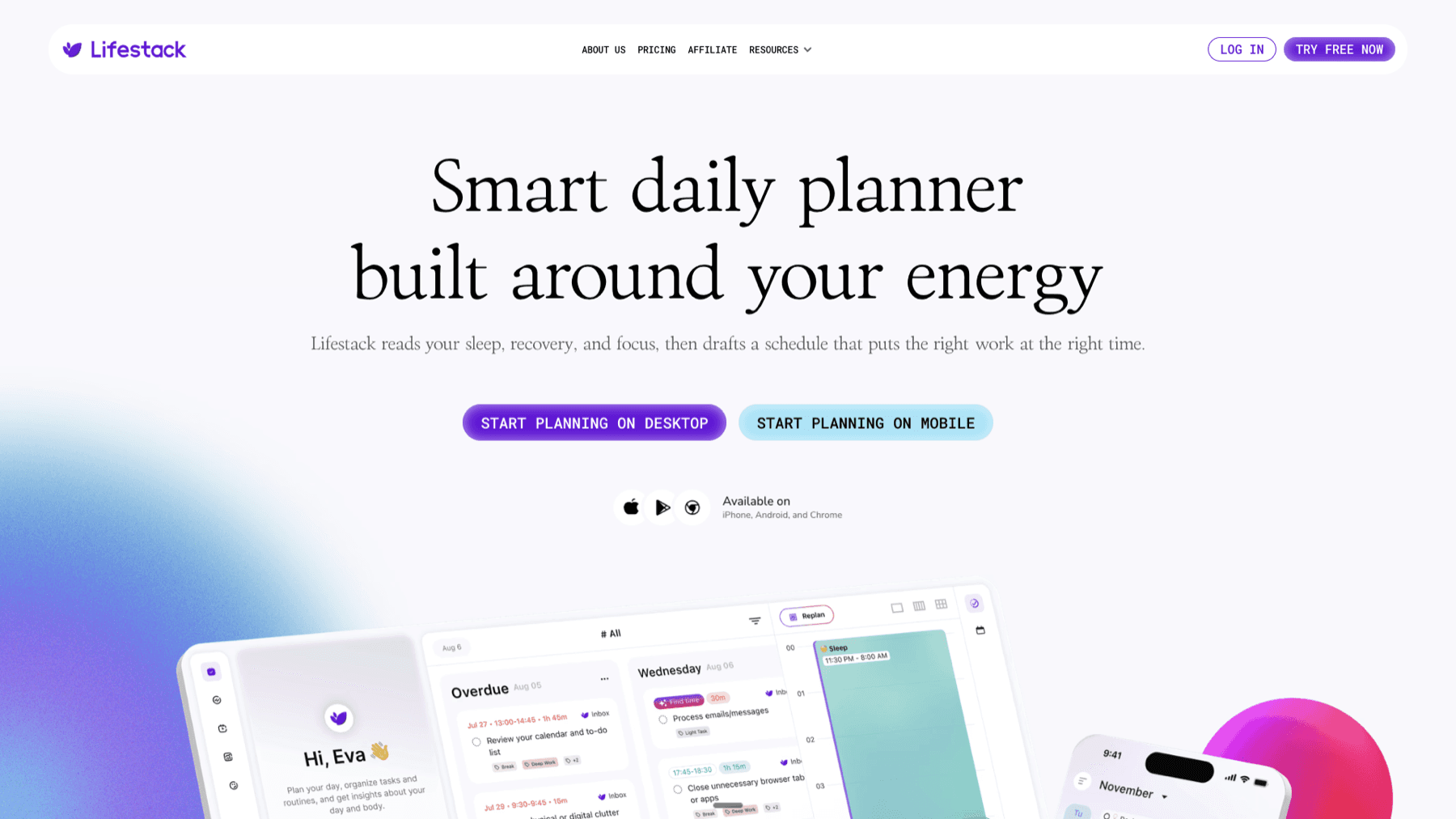
Systems and habits are the foundation, but the right tool makes them easier to maintain. Lifestack is the scheduling layer that connects your capture system to your calendar in a way that accounts for your energy levels. Instead of ending up with a list of tasks and no plan for when to do them, Lifestack places your work in your calendar during the hours when you are actually able to do it well.
For people who have the capture and process habits down but still feel like their day runs away from them, energy-based scheduling is usually the missing piece. Tasks do not get done just because they are on a list; they get done because you schedule them at the right time and protect that time. Lifestack is $7/month or $50/year with a 7-day free trial. Learn more in the Lifestack introduction.
Frequently Asked Questions
How do I stay organized when I am busy?
When you are busy is exactly when the system matters most. Two things: capture everything immediately (a task app, a voice memo, a sticky note) so nothing stays in your head, and keep a daily 10-minute end-of-day review to process what came in. These two habits alone prevent the spiral where busyness creates disorganization which creates more busyness.
What is the most effective way to stay organized at work?
A trusted capture system plus a weekly review. Everything that needs attention goes into one place. Once a week, you process and plan. Between those two practices, most of the work organization problems that people struggle with are solved or at least managed.
How do I stay organized with ADHD?
ADHD makes sustained organization significantly harder because it disrupts the executive function skills that organization requires. The most effective ADHD-specific strategies are externalizing everything (if it is not written down and visible, it does not exist), using body doubling for processing sessions, and building routines at fixed times so the habits do not require active initiation. See our guide to improving organizational skills for more on this.
How do I stay organized with a busy family?
Shared systems matter more than personal organization when multiple people need to stay coordinated. A shared digital calendar is the minimum. Dedicated inboxes for household items that need action (mail, forms, receipts) prevent paper chaos. Weekly family check-ins, even just 15 minutes on Sunday evening, catch what is coming up and what needs coordination.
What is the best app for staying organized?
It depends on what you need. For capturing and managing tasks, Todoist or TickTick. For connecting your tasks to your calendar intelligently, Lifestack. For notes and knowledge management, Notion or Obsidian. For most people, starting with a reliable task app and a calendar they use consistently is more important than finding the perfect tool.
Most people who feel disorganized are not lazy or forgetful. They are working without a system. Staying organized is not a personality trait; it is a set of habits and structures that either exist in your life or they do not. When they do, keeping up feels almost automatic. When they do not, even small amounts of work create chaos.
The strategies in this guide work across work and personal life. Some are about your physical environment, some are about how you manage information, and some are about how you structure your time. You do not need all eight of them. Start with the two or three that address your biggest pain points and build from there.
Key Takeaways
Organization is a system problem, not a willpower problem. If you are always disorganized, the system is missing, not the motivation.
Capture and process are the two most important habits: capture everything that needs attention and process it regularly into the right place.
A weekly review is the single most effective habit for staying organized over time because it catches what slips through everything else.
Strategy 1: Capture Everything in One Place
The most common source of disorganization is not forgetting things: it is having too many places where things live. Tasks in five different apps, notes in three different notebooks, commitments stored only in memory. Nothing connects, nothing gets processed, and things fall through the gaps constantly.
The fix is a single capture system. One place where everything goes when it enters your awareness: a task app, a notes inbox, a paper notebook, or a combination. The specific tool matters less than the consistency. The goal is that when you think of something, you can capture it immediately and trust it will be there when you come back to process it.
Brain dumping is a useful technique for clearing the mental backlog: set a timer and write down everything that is taking up space in your head. This gets you to a clean starting point. From there, the capture habit prevents the pile from rebuilding.
Strategy 2: Process Your Inbox Daily
Capture is step one. Processing is step two, and most people skip it. An overflowing inbox, a growing list of unread messages, and a task list full of "I should do this someday" items all stem from capturing without processing.
Processing means making a decision about each item: do it now if it takes less than two minutes, schedule it for a specific time if it needs more, delegate it if someone else should handle it, or archive/delete it if it turns out not to matter. The goal is not to do everything in the inbox; it is to make a conscious decision about each item so nothing sits indefinitely in an unprocessed state.
A daily 10-15 minute inbox processing habit is more effective than weekly deep-dive sessions because the decisions stay fresh and the backlog never builds to the point of feeling overwhelming.
Strategy 3: Use a Calendar for Time Commitments
Your calendar should contain everything that happens at a specific time. Meetings, appointments, deadlines, events, and time blocks you have set aside for specific work. If it has a time, it lives on the calendar. If it does not have a time, it lives on a task list.
Most disorganized people use their calendar only for external commitments (meetings other people schedule). But your own work needs calendar time too, or it gets crowded out by whatever appears in front of you. Scheduling focus blocks for your most important work, the way you would schedule a meeting, is how you make sure it actually happens.
Digital planner apps that integrate calendar and task management make this easier by showing both in the same view, so you can see your commitments and your work list together rather than consulting two separate systems.
Strategy 4: Do Weekly Reviews
This is the most important habit on this list. A weekly review is a structured session, usually 30-60 minutes, where you look back at the week that passed and look forward at the one ahead. You capture anything that did not get captured, process what needs processing, update your task lists, and plan the next week at a high level.
The reason weekly reviews are so effective at staying organized is that they serve as a safety net for everything the daily habits miss. You clear your physical desk, empty your inboxes, review your project lists, and look at next week's calendar. What comes out of this session is a clear head and a reliable plan, rather than the low-level anxiety of knowing there are things you are forgetting.
Getting the review to happen consistently is the challenge. Most people find a specific day and time (Friday afternoon or Sunday morning) works better than trying to do it whenever. Block it in your calendar and treat it as a commitment.
Strategy 5: Organize by Area, Not by Project
Most people organize their tasks and notes by project (one folder per project, one list per project). The problem is that projects multiply faster than your organizational system can keep up, and cross-project information has no obvious home.
A better approach is organizing by area of responsibility: work, personal, health, finances, family. Projects live within areas. When a project ends, the area remains, and you do not need to restructure your whole system. The PARA method (Projects, Areas, Resources, Archive) is the most widely used framework for this kind of organization and works across any combination of apps and tools.
Strategy 6: Batch Similar Tasks Together
Context switching between different types of work is expensive. Moving from email to deep writing to an administrative task to a call and back to email means your brain is constantly shifting gears, which is slower and more draining than staying in one mode for longer stretches.
Task batching solves this by grouping similar tasks into dedicated time blocks. All email gets handled in one 30-minute window. All calls happen in one afternoon slot. All administrative tasks happen Friday morning. The result is less context switching, faster execution of each task type, and a schedule that does not feel like random chaos.
Strategy 7: Keep Your Physical Space Clear
Physical clutter creates mental clutter. A clear desk does not guarantee a clear mind, but a chaotic desk makes focused work significantly harder. The research on this is consistent: visual disorder increases cognitive load and makes it harder to direct attention to the task at hand.
The system that works is a combination of a clearing habit and permanent homes for everything. Every physical object in your workspace should have a place it lives when not in use. At the end of each day, spend five minutes returning things to their places. This sounds trivial but dramatically reduces the morning friction of starting work in chaos.
Strategy 8: Reduce the Number of Decisions You Make
Staying organized is partly an attention management problem. Every decision you make, including small ones about where something goes or what to do next, uses cognitive resources that are better spent on actual work. Organizations systems that require constant small decisions will always eventually collapse.
The fix is to reduce decisions by building defaults. Same tool for all tasks. Same place for all notes. Same time each day for email. Meal prep on the same day each week. Routines that run on autopilot rather than requiring active choice. The fewer decisions your organizational system requires, the more reliably it works when you are tired, stressed, or distracted. This connects directly to planning effectively: a good plan eliminates the small decisions so you can make the important ones.
The Best Tool for Staying Organized
Systems and habits are the foundation, but the right tool makes them easier to maintain. Lifestack is the scheduling layer that connects your capture system to your calendar in a way that accounts for your energy levels. Instead of ending up with a list of tasks and no plan for when to do them, Lifestack places your work in your calendar during the hours when you are actually able to do it well.
For people who have the capture and process habits down but still feel like their day runs away from them, energy-based scheduling is usually the missing piece. Tasks do not get done just because they are on a list; they get done because you schedule them at the right time and protect that time. Lifestack is $7/month or $50/year with a 7-day free trial. Learn more in the Lifestack introduction.
Frequently Asked Questions
How do I stay organized when I am busy?
When you are busy is exactly when the system matters most. Two things: capture everything immediately (a task app, a voice memo, a sticky note) so nothing stays in your head, and keep a daily 10-minute end-of-day review to process what came in. These two habits alone prevent the spiral where busyness creates disorganization which creates more busyness.
What is the most effective way to stay organized at work?
A trusted capture system plus a weekly review. Everything that needs attention goes into one place. Once a week, you process and plan. Between those two practices, most of the work organization problems that people struggle with are solved or at least managed.
How do I stay organized with ADHD?
ADHD makes sustained organization significantly harder because it disrupts the executive function skills that organization requires. The most effective ADHD-specific strategies are externalizing everything (if it is not written down and visible, it does not exist), using body doubling for processing sessions, and building routines at fixed times so the habits do not require active initiation. See our guide to improving organizational skills for more on this.
How do I stay organized with a busy family?
Shared systems matter more than personal organization when multiple people need to stay coordinated. A shared digital calendar is the minimum. Dedicated inboxes for household items that need action (mail, forms, receipts) prevent paper chaos. Weekly family check-ins, even just 15 minutes on Sunday evening, catch what is coming up and what needs coordination.
What is the best app for staying organized?
It depends on what you need. For capturing and managing tasks, Todoist or TickTick. For connecting your tasks to your calendar intelligently, Lifestack. For notes and knowledge management, Notion or Obsidian. For most people, starting with a reliable task app and a calendar they use consistently is more important than finding the perfect tool.



FOLLOW ON
FOLLOW ON
FOLLOW ON


Copyright 2026 © Lifestack. All rights reserved
Copyright 2026 © Lifestack. All rights reserved

