
Tips
Mental Health Leave of Absence
Mental Health Leave of Absence

Taking time off for mental health used to feel like something people did quietly, without naming the reason. That's changing. More employers have explicit mental health leave policies, awareness of burnout and anxiety as genuine medical conditions has increased, and the legal protections that allow for mental health leave have existed in the US for decades, even if they weren't well known.
If you're considering a mental health leave of absence, the most important thing to know is that you may have more protection and more options than you think. This guide covers what a mental health leave actually is, what you're legally entitled to, how to request one, and how to use the time productively to come back in a better position.
Key Takeaways
Mental health conditions qualify for leave protections under FMLA, ADA, and state laws in the US
You do not have to disclose a specific diagnosis to your employer; you only need to establish that you have a qualifying condition through a healthcare provider
Using leave time intentionally, with structure and recovery goals, produces significantly better outcomes than unstructured time off
What Is a Mental Health Leave of Absence?
A mental health leave of absence is a period away from work taken to address a mental health condition. This includes depression, anxiety disorders, burnout, PTSD, bipolar disorder, OCD, eating disorders, and other conditions that genuinely impair your ability to work. It can be a few days, a few weeks, or several months depending on the situation and what protections apply.
There are two main types: intermittent leave (taking time off on an as-needed basis, such as for therapy appointments or bad days) and continuous leave (a single extended period away from work). FMLA, the main US federal protection, allows for both. Many people don't realize that intermittent leave is an option, which can allow someone to continue working reduced hours or take specific days off without using a formal extended leave.
Your Legal Protections
In the United States, the Family and Medical Leave Act (FMLA) is the primary federal protection. It allows eligible employees to take up to 12 weeks of unpaid, job-protected leave per year for a serious health condition. Mental health conditions explicitly qualify as serious health conditions under FMLA. To be eligible, you must work for an employer with 50 or more employees, have worked there for at least 12 months, and have worked at least 1,250 hours in the past year.
The Americans with Disabilities Act (ADA) is a separate protection that applies to mental health conditions that substantially limit one or more major life activities. Under the ADA, employers with 15 or more employees are required to provide reasonable accommodations, which can include a leave of absence, modified schedules, or other adjustments. You don't need a formal disability designation to request an ADA accommodation.
Many states have their own leave laws that are more generous than federal protections, covering shorter tenure requirements, smaller employers, or paid leave. California, New York, New Jersey, and Washington state, among others, have state disability and paid family leave programs that can be accessed for mental health conditions. Checking your specific state's Department of Labor website is worth doing before you assume only federal protections apply.
How to Request a Mental Health Leave of Absence
The first step is to speak with your healthcare provider. You'll need a certification from a physician, psychiatrist, therapist, or other licensed mental health professional confirming that you have a serious health condition and that leave is medically necessary. You don't need to tell your employer what the condition is, only that you have one that qualifies for leave.
Next, contact your HR department. Many people avoid this step out of fear, but HR's role is to handle exactly this kind of request, and qualified people making medical leave requests are legally protected from retaliation. Ask about your company's leave policy, whether there's a short-term disability program that provides pay during leave, and whether your benefits continue during the leave period (they typically do under FMLA for the first 12 weeks).
You generally don't need to provide advance notice when a mental health crisis is urgent, though for planned leave (like step-down treatment programs) 30 days notice is standard. If you feel stuck deciding how to approach the conversation, writing out what you want to communicate before the meeting can help significantly.
What to Tell Your Employer
Under FMLA, you only need to inform your employer that you need leave due to a serious health condition. You are not required to disclose a diagnosis. "I have a medical condition that my doctor has determined requires time off for treatment" is legally sufficient. Your employer cannot require you to share more than that for FMLA purposes.
Some employers will ask more questions out of curiosity or poor training, not legal obligation. You can politely decline to share specifics and point to your healthcare provider's certification as the relevant documentation. If your direct manager is involved in the conversation, HR should typically handle the formal process rather than leaving you to navigate it directly with your boss.
One practical note: if you have a supportive manager and a comfortable relationship, some people find that being more open about the reason for leave reduces the stress of the whole process and makes the transition back to work smoother. This is a personal judgment call, not a requirement.
Financial Preparation
FMLA leave is job-protected but unpaid at the federal level. This is one of the main barriers for people who need leave but can't afford to lose income for weeks. Before requesting leave, check whether your employer has a short-term disability (STD) policy, which typically pays 50 to 70 percent of your salary during medical leave. Mental health conditions qualify for STD in most policies.
If your state has a paid leave program, determine how to file a claim. In states like California and New York, state disability insurance covers a significant portion of your income during leave and can run concurrently with FMLA. Some employers also allow using accrued paid time off (PTO or sick leave) to receive pay during an otherwise unpaid leave period.
Building a rough financial picture before you leave, covering your baseline expenses versus what you'll receive, removes a significant source of anxiety during the leave itself. Unresolved financial uncertainty is one of the things that makes mental health leave less restorative than it should be.
How to Use Your Leave Productively
Unstructured time doesn't automatically produce recovery. People who return from mental health leave having improved tend to have used the time with some intentionality: consistent therapy or treatment, light structure to the day, gradual re-engagement with activities they enjoy, and deliberate rest without guilt.
A few practices that consistently help: keeping a regular sleep and wake time, which anchors your circadian rhythm and significantly affects mood; getting outside daily, even briefly; attending therapy consistently (this is the primary work of the leave); and avoiding the trap of using leave time to catch up on every other responsibility in your life rather than focusing on recovery.
A light morning routine during leave, simpler than your work-day one, can provide structure without pressure. Periodic brain dumps help clear the mental clutter that often accumulates when you're not in routine and can give you a better picture of what actually needs attention versus what you're ruminating on unnecessarily.
Returning to Work After Mental Health Leave
The transition back is often the part people plan least. A phased return, where you start with reduced hours and gradually increase over a few weeks, is worth requesting if your employer can accommodate it. It's a reasonable ADA accommodation in many cases and significantly eases the transition compared to going from full absence to full schedule overnight.
Before you return, it's worth being intentional about what the first weeks back will look like. What triggers or work patterns contributed to the mental health crisis in the first place? Are those conditions still present, or has something changed? Going back into the same environment with the same patterns and expecting a different outcome is common and preventable.
Building structure around your energy and capacity rather than just your calendar is one of the most practical things you can do in those first weeks. Planning with intention during the re-entry period, rather than defaulting to maximum capacity immediately, makes a real difference in whether the recovery holds. Work-life balance tools can help establish guardrails if overcommitment was part of what led to the leave in the first place.
Best Tool for Returning to Work After Leave
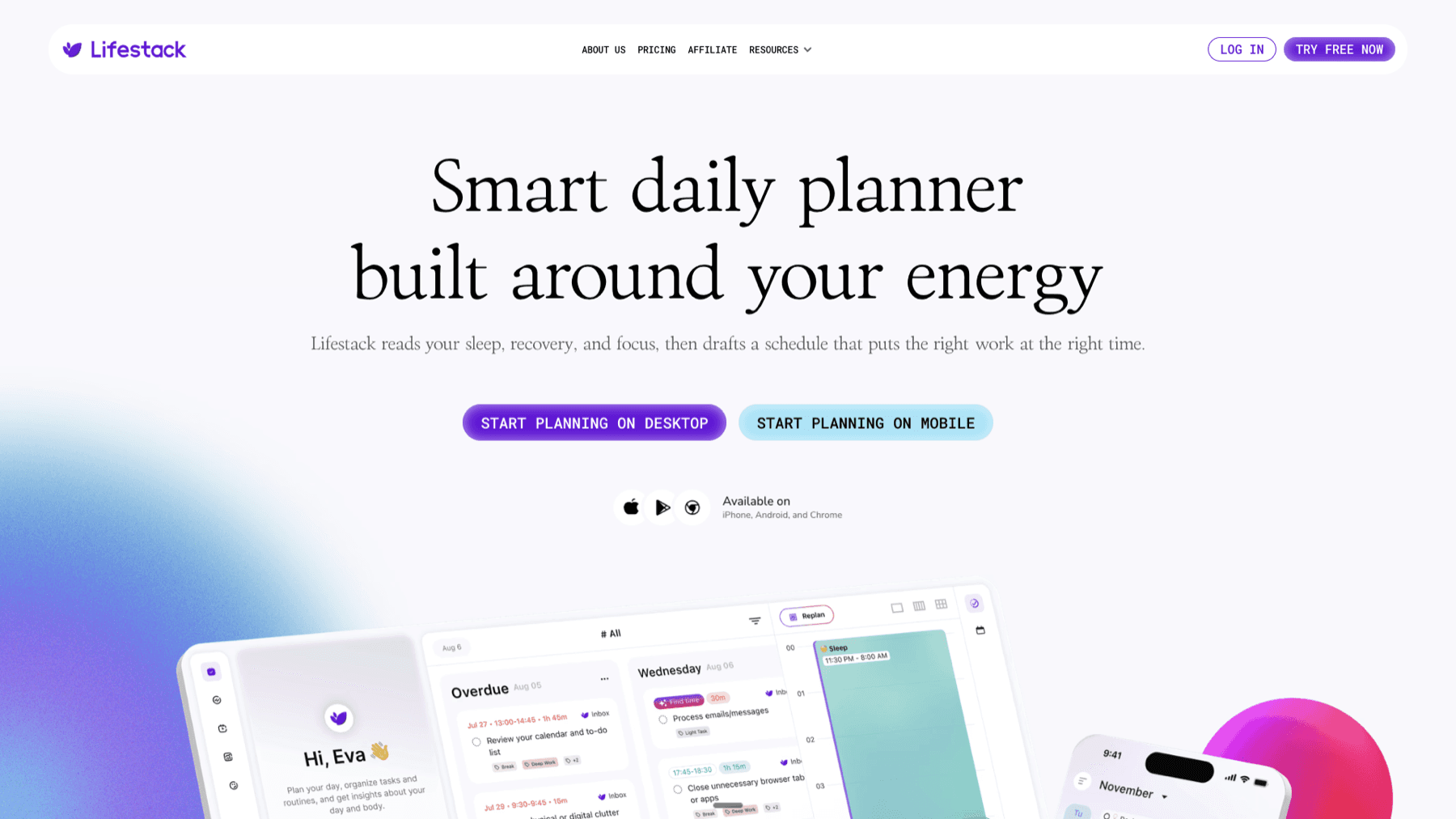
When you return from a mental health leave, one of the easiest traps is immediately reverting to the same overloaded schedule that contributed to the crisis. Lifestack helps with this by scheduling your tasks around your actual energy capacity rather than just filling every available hour. In the first weeks back, this means demanding work goes in your peak hours and you're not double-booking yourself at the cost of recovery.
The energy calendar approach is particularly relevant after a mental health leave because recovery is not linear, and your capacity will vary day to day more than it might in a steady state. A schedule that adapts to your energy rather than demanding a fixed output each day is more sustainable. Learn more in the Lifestack introduction. Lifestack costs $7/month or $50/year, with a 7-day free trial on the annual plan.
FAQ
Can I take a mental health leave of absence from work?
Yes. Mental health conditions qualify as serious health conditions under FMLA in the US, which provides up to 12 weeks of job-protected leave per year for eligible employees. Many states have additional or more generous protections. You need documentation from a healthcare provider, but you don't need to disclose your specific diagnosis to your employer.
Do I get paid during a mental health leave of absence?
Federal FMLA leave is unpaid. However, many employers have short-term disability insurance that pays a portion of your salary during medical leave. Several states also have paid disability programs. You can also use accrued paid time off concurrently with FMLA leave in most cases. Check your employer's HR documents and your state's disability insurance programs for your specific situation.
Can I be fired for taking a mental health leave?
FMLA-eligible leave is job-protected, meaning your employer must restore you to your same or equivalent position when you return. Firing or demoting someone for taking protected FMLA leave is illegal. The ADA provides additional anti-retaliation protections. If you believe you've faced retaliation for a mental health leave, the Department of Labor and the EEOC handle complaints related to FMLA and ADA violations respectively.
How long can a mental health leave of absence be?
Under FMLA, up to 12 weeks per year. Under some state laws and short-term disability programs, longer periods are possible. ADA accommodations can also extend leave in some cases. The specific duration depends on medical need, your employer's policies, and what protections apply to your situation.
What do I do if I'm not FMLA-eligible?
If you work for a small employer (fewer than 50 employees) or haven't met the tenure or hours requirements, federal FMLA may not apply. However, state leave laws may still cover you, and the ADA applies to employers with 15 or more employees. Many employers also have their own leave policies beyond what the law requires. It's worth having a direct conversation with HR about what's available before assuming no options exist.
How do I know if I need a mental health leave of absence?
There's no single threshold. Signs that leave may be warranted include persistent inability to function at work despite treatment, a mental health crisis requiring intensive outpatient or inpatient care, or a situation where continuing to work is actively worsening the condition. A mental health professional is the right person to help make this call. If you're unsure whether what you're experiencing justifies leave, it's worth asking your therapist or psychiatrist directly rather than trying to assess it yourself under duress.
Taking time off for mental health used to feel like something people did quietly, without naming the reason. That's changing. More employers have explicit mental health leave policies, awareness of burnout and anxiety as genuine medical conditions has increased, and the legal protections that allow for mental health leave have existed in the US for decades, even if they weren't well known.
If you're considering a mental health leave of absence, the most important thing to know is that you may have more protection and more options than you think. This guide covers what a mental health leave actually is, what you're legally entitled to, how to request one, and how to use the time productively to come back in a better position.
Key Takeaways
Mental health conditions qualify for leave protections under FMLA, ADA, and state laws in the US
You do not have to disclose a specific diagnosis to your employer; you only need to establish that you have a qualifying condition through a healthcare provider
Using leave time intentionally, with structure and recovery goals, produces significantly better outcomes than unstructured time off
What Is a Mental Health Leave of Absence?
A mental health leave of absence is a period away from work taken to address a mental health condition. This includes depression, anxiety disorders, burnout, PTSD, bipolar disorder, OCD, eating disorders, and other conditions that genuinely impair your ability to work. It can be a few days, a few weeks, or several months depending on the situation and what protections apply.
There are two main types: intermittent leave (taking time off on an as-needed basis, such as for therapy appointments or bad days) and continuous leave (a single extended period away from work). FMLA, the main US federal protection, allows for both. Many people don't realize that intermittent leave is an option, which can allow someone to continue working reduced hours or take specific days off without using a formal extended leave.
Your Legal Protections
In the United States, the Family and Medical Leave Act (FMLA) is the primary federal protection. It allows eligible employees to take up to 12 weeks of unpaid, job-protected leave per year for a serious health condition. Mental health conditions explicitly qualify as serious health conditions under FMLA. To be eligible, you must work for an employer with 50 or more employees, have worked there for at least 12 months, and have worked at least 1,250 hours in the past year.
The Americans with Disabilities Act (ADA) is a separate protection that applies to mental health conditions that substantially limit one or more major life activities. Under the ADA, employers with 15 or more employees are required to provide reasonable accommodations, which can include a leave of absence, modified schedules, or other adjustments. You don't need a formal disability designation to request an ADA accommodation.
Many states have their own leave laws that are more generous than federal protections, covering shorter tenure requirements, smaller employers, or paid leave. California, New York, New Jersey, and Washington state, among others, have state disability and paid family leave programs that can be accessed for mental health conditions. Checking your specific state's Department of Labor website is worth doing before you assume only federal protections apply.
How to Request a Mental Health Leave of Absence
The first step is to speak with your healthcare provider. You'll need a certification from a physician, psychiatrist, therapist, or other licensed mental health professional confirming that you have a serious health condition and that leave is medically necessary. You don't need to tell your employer what the condition is, only that you have one that qualifies for leave.
Next, contact your HR department. Many people avoid this step out of fear, but HR's role is to handle exactly this kind of request, and qualified people making medical leave requests are legally protected from retaliation. Ask about your company's leave policy, whether there's a short-term disability program that provides pay during leave, and whether your benefits continue during the leave period (they typically do under FMLA for the first 12 weeks).
You generally don't need to provide advance notice when a mental health crisis is urgent, though for planned leave (like step-down treatment programs) 30 days notice is standard. If you feel stuck deciding how to approach the conversation, writing out what you want to communicate before the meeting can help significantly.
What to Tell Your Employer
Under FMLA, you only need to inform your employer that you need leave due to a serious health condition. You are not required to disclose a diagnosis. "I have a medical condition that my doctor has determined requires time off for treatment" is legally sufficient. Your employer cannot require you to share more than that for FMLA purposes.
Some employers will ask more questions out of curiosity or poor training, not legal obligation. You can politely decline to share specifics and point to your healthcare provider's certification as the relevant documentation. If your direct manager is involved in the conversation, HR should typically handle the formal process rather than leaving you to navigate it directly with your boss.
One practical note: if you have a supportive manager and a comfortable relationship, some people find that being more open about the reason for leave reduces the stress of the whole process and makes the transition back to work smoother. This is a personal judgment call, not a requirement.
Financial Preparation
FMLA leave is job-protected but unpaid at the federal level. This is one of the main barriers for people who need leave but can't afford to lose income for weeks. Before requesting leave, check whether your employer has a short-term disability (STD) policy, which typically pays 50 to 70 percent of your salary during medical leave. Mental health conditions qualify for STD in most policies.
If your state has a paid leave program, determine how to file a claim. In states like California and New York, state disability insurance covers a significant portion of your income during leave and can run concurrently with FMLA. Some employers also allow using accrued paid time off (PTO or sick leave) to receive pay during an otherwise unpaid leave period.
Building a rough financial picture before you leave, covering your baseline expenses versus what you'll receive, removes a significant source of anxiety during the leave itself. Unresolved financial uncertainty is one of the things that makes mental health leave less restorative than it should be.
How to Use Your Leave Productively
Unstructured time doesn't automatically produce recovery. People who return from mental health leave having improved tend to have used the time with some intentionality: consistent therapy or treatment, light structure to the day, gradual re-engagement with activities they enjoy, and deliberate rest without guilt.
A few practices that consistently help: keeping a regular sleep and wake time, which anchors your circadian rhythm and significantly affects mood; getting outside daily, even briefly; attending therapy consistently (this is the primary work of the leave); and avoiding the trap of using leave time to catch up on every other responsibility in your life rather than focusing on recovery.
A light morning routine during leave, simpler than your work-day one, can provide structure without pressure. Periodic brain dumps help clear the mental clutter that often accumulates when you're not in routine and can give you a better picture of what actually needs attention versus what you're ruminating on unnecessarily.
Returning to Work After Mental Health Leave
The transition back is often the part people plan least. A phased return, where you start with reduced hours and gradually increase over a few weeks, is worth requesting if your employer can accommodate it. It's a reasonable ADA accommodation in many cases and significantly eases the transition compared to going from full absence to full schedule overnight.
Before you return, it's worth being intentional about what the first weeks back will look like. What triggers or work patterns contributed to the mental health crisis in the first place? Are those conditions still present, or has something changed? Going back into the same environment with the same patterns and expecting a different outcome is common and preventable.
Building structure around your energy and capacity rather than just your calendar is one of the most practical things you can do in those first weeks. Planning with intention during the re-entry period, rather than defaulting to maximum capacity immediately, makes a real difference in whether the recovery holds. Work-life balance tools can help establish guardrails if overcommitment was part of what led to the leave in the first place.
Best Tool for Returning to Work After Leave
When you return from a mental health leave, one of the easiest traps is immediately reverting to the same overloaded schedule that contributed to the crisis. Lifestack helps with this by scheduling your tasks around your actual energy capacity rather than just filling every available hour. In the first weeks back, this means demanding work goes in your peak hours and you're not double-booking yourself at the cost of recovery.
The energy calendar approach is particularly relevant after a mental health leave because recovery is not linear, and your capacity will vary day to day more than it might in a steady state. A schedule that adapts to your energy rather than demanding a fixed output each day is more sustainable. Learn more in the Lifestack introduction. Lifestack costs $7/month or $50/year, with a 7-day free trial on the annual plan.
FAQ
Can I take a mental health leave of absence from work?
Yes. Mental health conditions qualify as serious health conditions under FMLA in the US, which provides up to 12 weeks of job-protected leave per year for eligible employees. Many states have additional or more generous protections. You need documentation from a healthcare provider, but you don't need to disclose your specific diagnosis to your employer.
Do I get paid during a mental health leave of absence?
Federal FMLA leave is unpaid. However, many employers have short-term disability insurance that pays a portion of your salary during medical leave. Several states also have paid disability programs. You can also use accrued paid time off concurrently with FMLA leave in most cases. Check your employer's HR documents and your state's disability insurance programs for your specific situation.
Can I be fired for taking a mental health leave?
FMLA-eligible leave is job-protected, meaning your employer must restore you to your same or equivalent position when you return. Firing or demoting someone for taking protected FMLA leave is illegal. The ADA provides additional anti-retaliation protections. If you believe you've faced retaliation for a mental health leave, the Department of Labor and the EEOC handle complaints related to FMLA and ADA violations respectively.
How long can a mental health leave of absence be?
Under FMLA, up to 12 weeks per year. Under some state laws and short-term disability programs, longer periods are possible. ADA accommodations can also extend leave in some cases. The specific duration depends on medical need, your employer's policies, and what protections apply to your situation.
What do I do if I'm not FMLA-eligible?
If you work for a small employer (fewer than 50 employees) or haven't met the tenure or hours requirements, federal FMLA may not apply. However, state leave laws may still cover you, and the ADA applies to employers with 15 or more employees. Many employers also have their own leave policies beyond what the law requires. It's worth having a direct conversation with HR about what's available before assuming no options exist.
How do I know if I need a mental health leave of absence?
There's no single threshold. Signs that leave may be warranted include persistent inability to function at work despite treatment, a mental health crisis requiring intensive outpatient or inpatient care, or a situation where continuing to work is actively worsening the condition. A mental health professional is the right person to help make this call. If you're unsure whether what you're experiencing justifies leave, it's worth asking your therapist or psychiatrist directly rather than trying to assess it yourself under duress.



FOLLOW ON
FOLLOW ON
FOLLOW ON


Copyright 2026 © Lifestack. All rights reserved
Copyright 2026 © Lifestack. All rights reserved

