
Tips
Nervous vs. Anxious: What's the Difference?
Nervous vs. Anxious: What's the Difference?

Most people use "nervous" and "anxious" to mean the same thing. Both describe an unpleasant, anticipatory feeling in your chest before something difficult. But there is a meaningful difference between them, one that matters for understanding your own experience and knowing when worry is normal versus when it's worth taking more seriously.
The short version: nervousness is a normal, temporary response to a specific stressor. Anxiety is a pattern of worry that often persists beyond or independent of any specific trigger. The two overlap significantly in how they feel, which is why the distinction gets blurred in everyday language. But they diverge in duration, cause, severity, and what helps.
Key Takeaways
Nervousness is tied to a specific cause and resolves once that cause passes; anxiety often persists without a clear trigger
The physical sensations of both are largely identical because both activate the same stress response
Anxiety becomes clinically significant when it's persistent, difficult to control, and interferes with daily functioning
What Does "Nervous" Mean?
Nervousness is an emotional response to an identifiable upcoming event or situation. Job interview, first date, public speech, big game, medical procedure. The feeling has a clear cause in the near future, and it typically resolves once that event passes. In the meantime, nervousness can feel very physical: butterflies in the stomach, faster heart rate, dry mouth, jitteriness.
This is your autonomic nervous system activating in response to a perceived challenge. Specifically, the sympathetic nervous system triggers what's commonly called the fight-or-flight response, releasing adrenaline and cortisol to prepare your body for action. This is adaptive. A little nervousness before a performance or an important conversation sharpens attention and primes you for action. Athletes, performers, and public speakers often describe optimal nervousness as something they manage and use rather than eliminate.
The key features of nervousness: there's a clear cause, the feeling is proportionate to the situation, it's time-limited, and it doesn't significantly impair your ability to function before or after the event.
What Does "Anxious" Mean?
Anxiety shares many of the same physical sensations as nervousness, including racing heart, tension, and a sense of unease. Where it differs is in its relationship to cause and time. Anxiety doesn't always have a clear trigger. It can be a generalized sense of dread that isn't attached to anything specific. It can also be a response to a trigger that's disproportionately large relative to the actual risk involved.
Anxiety also tends to be more persistent. It doesn't necessarily resolve when a stressful event passes, because the worry isn't anchored to that event. Instead, it can cycle through different concerns, always finding something new to focus on. The mind keeps scanning for threats even when no specific threat is present.
In clinical terms, anxiety disorders are characterized by excessive, uncontrollable worry that persists over time and interferes with daily life. Generalized Anxiety Disorder (GAD), social anxiety, panic disorder, and OCD all fall under this umbrella. But anxiety doesn't need to meet the threshold of a clinical disorder to be worth paying attention to.
The Physical Experience: Similar but Different
Both nervousness and anxiety activate the same physiological response: the sympathetic nervous system increases heart rate, tightens muscles, sharpens the senses, and redirects blood flow toward the limbs. This is why the physical experience of both can feel so similar, including sweaty palms, tight chest, and rapid breathing.
The difference shows up in timing and context. Nervousness produces this response in clear proportion to an identifiable situation and typically fades once the situation resolves. Anxiety can produce these physical symptoms without any obvious trigger, at rest, during the night, or in low-stakes situations that shouldn't feel threatening. Chronic anxiety also often produces ongoing physical symptoms like chronic muscle tension, headaches, fatigue, and digestive issues that nervousness alone doesn't typically cause.
Some physical symptoms associated with anxiety, particularly fatigue and difficulty concentrating, are also common in conditions like ADHD and sleep problems. This can make self-diagnosis tricky. Persistent difficulty focusing and what's actually behind it is often more complex than a single cause.
When Nervousness Is Healthy
Nervousness gets a bad reputation because the experience is uncomfortable, but it's not inherently a problem. The physiological activation it produces can improve performance on tasks that require focus, physical readiness, or social engagement. The optimal amount varies by person and task, and learning to work with nervousness rather than fighting it is a skill that most high-performers develop.
Reframing nervousness as excitement is a surprisingly well-supported technique in psychology research. The physiological states of nervous and excited are nearly identical. Telling yourself "I'm excited" before a challenging situation has been shown in studies to improve performance compared to trying to calm down, because it works with the activated state rather than against it.
Nervousness also carries information. If you're nervous about a presentation, that nervousness often contains real signal about what you need to prepare or practice. Ignoring it entirely means ignoring the feedback. The goal isn't to eliminate nervousness before challenging situations; it's to keep it at a level that serves you rather than impairs you.
When Anxiety Becomes a Problem
Anxiety becomes problematic when it's persistent, difficult to control, and starts interfering with daily life. Some useful indicators: worry that's disproportionate to the actual risk involved, worry that switches subjects but doesn't resolve, physical symptoms of anxiety (tension, fatigue, sleep problems) that occur outside of clearly stressful situations, and avoidance of situations or activities to prevent the feeling.
Avoidance is one of the clearest signs that anxiety has moved past normal nervousness. Nervousness typically doesn't make you avoid things that matter to you; it makes you uncomfortable while doing them. Anxiety, particularly at clinical levels, can produce avoidance that restricts what you do, who you see, and what you're willing to try.
Decision paralysis is a specific manifestation worth mentioning: the inability to make decisions because of excessive worry about getting them wrong. It's a common anxiety symptom that often looks like procrastination or indecisiveness from the outside but is driven by something different underneath.
If anxiety is significantly affecting your daily functioning, relationships, or mental health, talking to a therapist or psychiatrist is the most direct path to effective help. Evidence-based treatments, particularly cognitive behavioral therapy (CBT), have strong track records for anxiety disorders. In more severe cases, medication can be an important part of treatment. If work-related anxiety has reached the point of impairing your ability to do your job, it's worth knowing that a mental health leave of absence may be an option.
Practical Ways to Manage Day-to-Day Anxiety
For anxiety that's present but not at a clinical level, several practices help significantly. Regular physical activity is one of the most consistent and well-researched interventions. Exercise reduces cortisol, increases endorphins, and produces measurable improvements in anxiety over time. It doesn't need to be intense; consistent, moderate movement is more effective than occasional intense exercise.
Sleep has an outsized effect on anxiety. Poor sleep significantly amplifies anxiety the next day, and chronic sleep deprivation can produce anxiety symptoms in people who wouldn't otherwise experience them. Addressing sleep quality is often one of the highest-return changes available. Low energy and anxiety often travel together, and improving sleep quality addresses both simultaneously.
Reducing cognitive load helps too. Brain dumping worry lists or task lists onto paper removes them from active working memory, which reduces the background anxiety that comes from trying to hold everything mentally. This is partly why journaling and lists have a long history as anxiety management tools; they externalize what the anxious mind is trying to hold internally.
Best Tool for Managing Mental Load
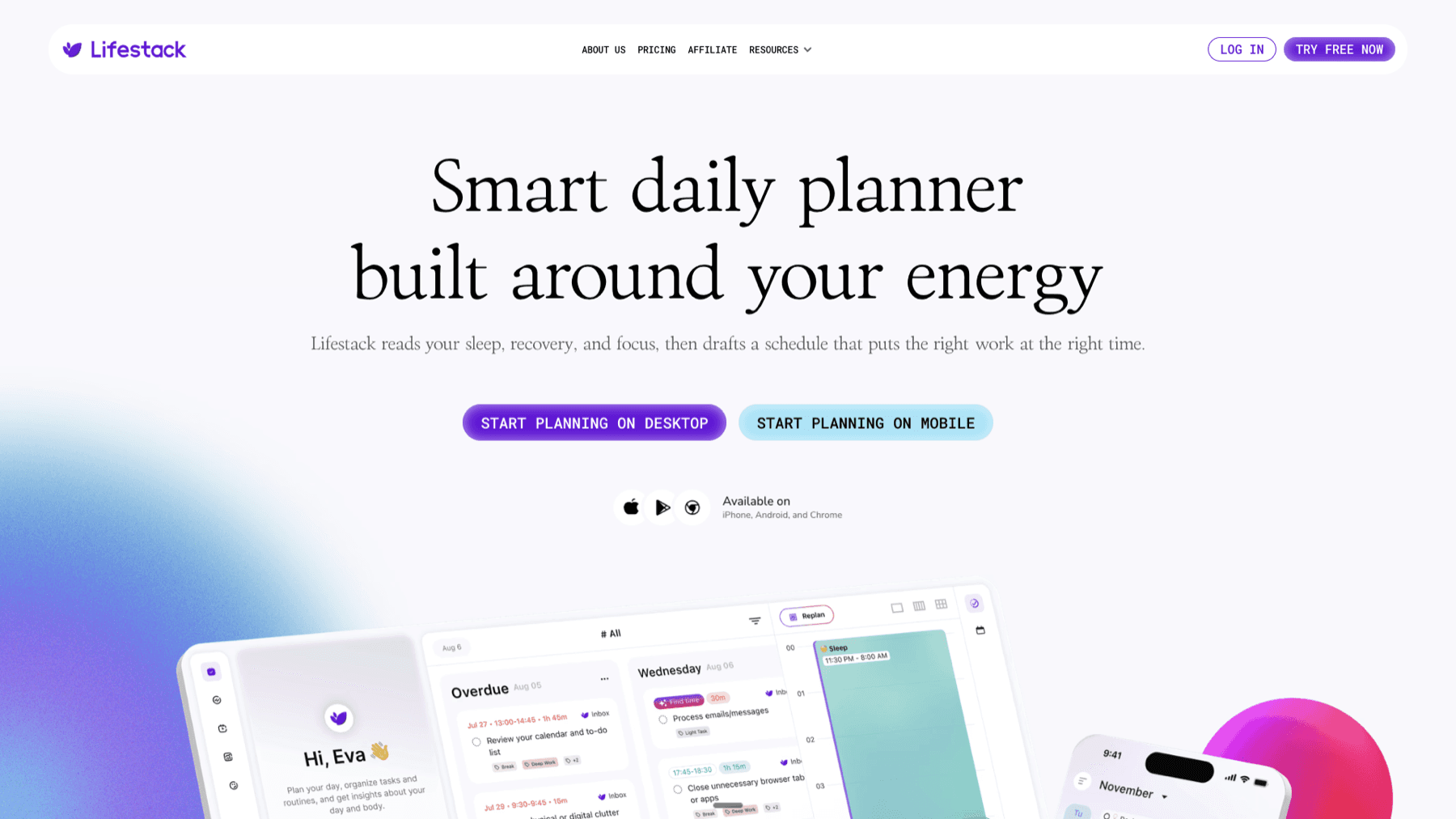
One underappreciated source of background anxiety is the feeling of having too much to do with no clear plan for when it will happen. That low-level overwhelm is not clinical anxiety, but it amplifies it. Lifestack helps by automatically scheduling your tasks into your calendar based on your energy levels, so you have a clear picture of when things will actually happen rather than a pile of items that might or might not get done.
The reduction in cognitive load that comes from having a trusted schedule is real. When your tasks are in the calendar at times when you can actually do them, the background hum of "what am I forgetting, when will I do this" quiets down. Learn more in the Lifestack introduction, and see how the energy calendar approach works in practice. Lifestack costs $7/month or $50/year, with a 7-day free trial.
FAQ
Is it normal to be anxious all the time?
Frequent background anxiety that's hard to control and interferes with your ability to function is not something you have to accept as normal. It's common, but common isn't the same as inevitable. It's worth talking to a mental health professional if anxiety is persistent and affecting your quality of life.
Can you be nervous without being anxious?
Yes. Nervousness is a normal response to specific situations. You can feel nervous before a job interview, do the thing, and have the feeling resolve completely without any ongoing anxiety pattern. Nervousness without anxiety is the typical experience for most people most of the time.
What's the fastest way to calm down when you're nervous?
Slow, controlled breathing has the most immediate effect on the nervous system. Breathing out longer than you breathe in (e.g., 4 counts in, 6 counts out) activates the parasympathetic nervous system and reduces the physiological arousal that produces the nervous feeling. Physical movement also helps by burning off some of the adrenaline that's been released.
Can anxiety look like anger?
Yes. Anxiety doesn't always present as worry or fear. Irritability, frustration, and a short fuse are common anxiety presentations, particularly in children and men. When anxiety manifests as reactivity rather than visible worry, it can be easy to miss the underlying anxiety driving it.
Is anxiety a sign of weakness?
No. Anxiety disorders are among the most common mental health conditions and affect people across every personality type, profession, and background. High-performing people in demanding fields have anxiety at the same rates as anyone else, sometimes higher. The biology of anxiety has nothing to do with character or strength.
What's the difference between anxiety and an anxiety disorder?
Anxiety is a normal human emotion. An anxiety disorder is a clinical condition characterized by anxiety that is persistent, difficult to control, and significantly impairs daily functioning. The distinction isn't sharp, but the clinical threshold is roughly: does the anxiety prevent you from living the life you want to live? If yes, professional support is appropriate regardless of whether a formal diagnosis applies.
Most people use "nervous" and "anxious" to mean the same thing. Both describe an unpleasant, anticipatory feeling in your chest before something difficult. But there is a meaningful difference between them, one that matters for understanding your own experience and knowing when worry is normal versus when it's worth taking more seriously.
The short version: nervousness is a normal, temporary response to a specific stressor. Anxiety is a pattern of worry that often persists beyond or independent of any specific trigger. The two overlap significantly in how they feel, which is why the distinction gets blurred in everyday language. But they diverge in duration, cause, severity, and what helps.
Key Takeaways
Nervousness is tied to a specific cause and resolves once that cause passes; anxiety often persists without a clear trigger
The physical sensations of both are largely identical because both activate the same stress response
Anxiety becomes clinically significant when it's persistent, difficult to control, and interferes with daily functioning
What Does "Nervous" Mean?
Nervousness is an emotional response to an identifiable upcoming event or situation. Job interview, first date, public speech, big game, medical procedure. The feeling has a clear cause in the near future, and it typically resolves once that event passes. In the meantime, nervousness can feel very physical: butterflies in the stomach, faster heart rate, dry mouth, jitteriness.
This is your autonomic nervous system activating in response to a perceived challenge. Specifically, the sympathetic nervous system triggers what's commonly called the fight-or-flight response, releasing adrenaline and cortisol to prepare your body for action. This is adaptive. A little nervousness before a performance or an important conversation sharpens attention and primes you for action. Athletes, performers, and public speakers often describe optimal nervousness as something they manage and use rather than eliminate.
The key features of nervousness: there's a clear cause, the feeling is proportionate to the situation, it's time-limited, and it doesn't significantly impair your ability to function before or after the event.
What Does "Anxious" Mean?
Anxiety shares many of the same physical sensations as nervousness, including racing heart, tension, and a sense of unease. Where it differs is in its relationship to cause and time. Anxiety doesn't always have a clear trigger. It can be a generalized sense of dread that isn't attached to anything specific. It can also be a response to a trigger that's disproportionately large relative to the actual risk involved.
Anxiety also tends to be more persistent. It doesn't necessarily resolve when a stressful event passes, because the worry isn't anchored to that event. Instead, it can cycle through different concerns, always finding something new to focus on. The mind keeps scanning for threats even when no specific threat is present.
In clinical terms, anxiety disorders are characterized by excessive, uncontrollable worry that persists over time and interferes with daily life. Generalized Anxiety Disorder (GAD), social anxiety, panic disorder, and OCD all fall under this umbrella. But anxiety doesn't need to meet the threshold of a clinical disorder to be worth paying attention to.
The Physical Experience: Similar but Different
Both nervousness and anxiety activate the same physiological response: the sympathetic nervous system increases heart rate, tightens muscles, sharpens the senses, and redirects blood flow toward the limbs. This is why the physical experience of both can feel so similar, including sweaty palms, tight chest, and rapid breathing.
The difference shows up in timing and context. Nervousness produces this response in clear proportion to an identifiable situation and typically fades once the situation resolves. Anxiety can produce these physical symptoms without any obvious trigger, at rest, during the night, or in low-stakes situations that shouldn't feel threatening. Chronic anxiety also often produces ongoing physical symptoms like chronic muscle tension, headaches, fatigue, and digestive issues that nervousness alone doesn't typically cause.
Some physical symptoms associated with anxiety, particularly fatigue and difficulty concentrating, are also common in conditions like ADHD and sleep problems. This can make self-diagnosis tricky. Persistent difficulty focusing and what's actually behind it is often more complex than a single cause.
When Nervousness Is Healthy
Nervousness gets a bad reputation because the experience is uncomfortable, but it's not inherently a problem. The physiological activation it produces can improve performance on tasks that require focus, physical readiness, or social engagement. The optimal amount varies by person and task, and learning to work with nervousness rather than fighting it is a skill that most high-performers develop.
Reframing nervousness as excitement is a surprisingly well-supported technique in psychology research. The physiological states of nervous and excited are nearly identical. Telling yourself "I'm excited" before a challenging situation has been shown in studies to improve performance compared to trying to calm down, because it works with the activated state rather than against it.
Nervousness also carries information. If you're nervous about a presentation, that nervousness often contains real signal about what you need to prepare or practice. Ignoring it entirely means ignoring the feedback. The goal isn't to eliminate nervousness before challenging situations; it's to keep it at a level that serves you rather than impairs you.
When Anxiety Becomes a Problem
Anxiety becomes problematic when it's persistent, difficult to control, and starts interfering with daily life. Some useful indicators: worry that's disproportionate to the actual risk involved, worry that switches subjects but doesn't resolve, physical symptoms of anxiety (tension, fatigue, sleep problems) that occur outside of clearly stressful situations, and avoidance of situations or activities to prevent the feeling.
Avoidance is one of the clearest signs that anxiety has moved past normal nervousness. Nervousness typically doesn't make you avoid things that matter to you; it makes you uncomfortable while doing them. Anxiety, particularly at clinical levels, can produce avoidance that restricts what you do, who you see, and what you're willing to try.
Decision paralysis is a specific manifestation worth mentioning: the inability to make decisions because of excessive worry about getting them wrong. It's a common anxiety symptom that often looks like procrastination or indecisiveness from the outside but is driven by something different underneath.
If anxiety is significantly affecting your daily functioning, relationships, or mental health, talking to a therapist or psychiatrist is the most direct path to effective help. Evidence-based treatments, particularly cognitive behavioral therapy (CBT), have strong track records for anxiety disorders. In more severe cases, medication can be an important part of treatment. If work-related anxiety has reached the point of impairing your ability to do your job, it's worth knowing that a mental health leave of absence may be an option.
Practical Ways to Manage Day-to-Day Anxiety
For anxiety that's present but not at a clinical level, several practices help significantly. Regular physical activity is one of the most consistent and well-researched interventions. Exercise reduces cortisol, increases endorphins, and produces measurable improvements in anxiety over time. It doesn't need to be intense; consistent, moderate movement is more effective than occasional intense exercise.
Sleep has an outsized effect on anxiety. Poor sleep significantly amplifies anxiety the next day, and chronic sleep deprivation can produce anxiety symptoms in people who wouldn't otherwise experience them. Addressing sleep quality is often one of the highest-return changes available. Low energy and anxiety often travel together, and improving sleep quality addresses both simultaneously.
Reducing cognitive load helps too. Brain dumping worry lists or task lists onto paper removes them from active working memory, which reduces the background anxiety that comes from trying to hold everything mentally. This is partly why journaling and lists have a long history as anxiety management tools; they externalize what the anxious mind is trying to hold internally.
Best Tool for Managing Mental Load
One underappreciated source of background anxiety is the feeling of having too much to do with no clear plan for when it will happen. That low-level overwhelm is not clinical anxiety, but it amplifies it. Lifestack helps by automatically scheduling your tasks into your calendar based on your energy levels, so you have a clear picture of when things will actually happen rather than a pile of items that might or might not get done.
The reduction in cognitive load that comes from having a trusted schedule is real. When your tasks are in the calendar at times when you can actually do them, the background hum of "what am I forgetting, when will I do this" quiets down. Learn more in the Lifestack introduction, and see how the energy calendar approach works in practice. Lifestack costs $7/month or $50/year, with a 7-day free trial.
FAQ
Is it normal to be anxious all the time?
Frequent background anxiety that's hard to control and interferes with your ability to function is not something you have to accept as normal. It's common, but common isn't the same as inevitable. It's worth talking to a mental health professional if anxiety is persistent and affecting your quality of life.
Can you be nervous without being anxious?
Yes. Nervousness is a normal response to specific situations. You can feel nervous before a job interview, do the thing, and have the feeling resolve completely without any ongoing anxiety pattern. Nervousness without anxiety is the typical experience for most people most of the time.
What's the fastest way to calm down when you're nervous?
Slow, controlled breathing has the most immediate effect on the nervous system. Breathing out longer than you breathe in (e.g., 4 counts in, 6 counts out) activates the parasympathetic nervous system and reduces the physiological arousal that produces the nervous feeling. Physical movement also helps by burning off some of the adrenaline that's been released.
Can anxiety look like anger?
Yes. Anxiety doesn't always present as worry or fear. Irritability, frustration, and a short fuse are common anxiety presentations, particularly in children and men. When anxiety manifests as reactivity rather than visible worry, it can be easy to miss the underlying anxiety driving it.
Is anxiety a sign of weakness?
No. Anxiety disorders are among the most common mental health conditions and affect people across every personality type, profession, and background. High-performing people in demanding fields have anxiety at the same rates as anyone else, sometimes higher. The biology of anxiety has nothing to do with character or strength.
What's the difference between anxiety and an anxiety disorder?
Anxiety is a normal human emotion. An anxiety disorder is a clinical condition characterized by anxiety that is persistent, difficult to control, and significantly impairs daily functioning. The distinction isn't sharp, but the clinical threshold is roughly: does the anxiety prevent you from living the life you want to live? If yes, professional support is appropriate regardless of whether a formal diagnosis applies.



FOLLOW ON
FOLLOW ON
FOLLOW ON


Copyright 2026 © Lifestack. All rights reserved
Copyright 2026 © Lifestack. All rights reserved

