
Device
Polar Grit X2 Pro Review: The Complete Guide (2026)
Polar Grit X2 Pro Review: The Complete Guide (2026)

The Polar Grit X2 Pro costs $999.99 and aims squarely at serious endurance athletes who want trail-running precision, dual-frequency GPS, and hospital-grade biosensing on their wrist. After testing it across trail runs, long rides, and daily wear, here is an honest take on what it delivers and where it still has room to grow.
Polar built its reputation on heart rate accuracy. The Grit X2 Pro takes that heritage further with the Polar Elixir biosensing platform, which bundles a fourth-generation optical heart rate sensor, a first-generation wrist ECG, SpO2 monitoring, and nightly skin temperature tracking into one watch. That is a meaningful step up from most competitors at this price.
But a GPS watch at nearly a thousand dollars is not bought on spec sheets alone. GPS accuracy in forests and canyons, real-world battery life, the quality of recovery guidance, and how it fits into a training lifestyle all matter. This review addresses each one directly.
Key Takeaways
Dual-frequency GPS (L1/L5) gives the Grit X2 Pro among the best tracking accuracy of any watch tested in urban canyons and dense forests, routinely within 2-3% of known course distances.
HRV Status, Training Load Pro, and the Orthostatic Test together create a recovery picture that is genuinely actionable, not just decorative numbers on a screen.
At $999.99, this is a premium pick. Athletes who already use Polar Flow and value Polar's ecosystem will get the most from it; Garmin loyalists will find it harder to justify switching.
Quick Verdict
The Polar Grit X2 Pro is one of the best GPS watches for endurance athletes in 2026, particularly for trail runners and triathletes who want accurate wrist-based ECG data alongside elite GPS performance. It does not beat the Garmin Fenix 8 on third-party app depth or on-device smartwatch features, but it leads on biosensing quality and Polar Flow's training analytics. Worth it if you are already in the Polar ecosystem or making a deliberate choice to enter it.
Design and Display
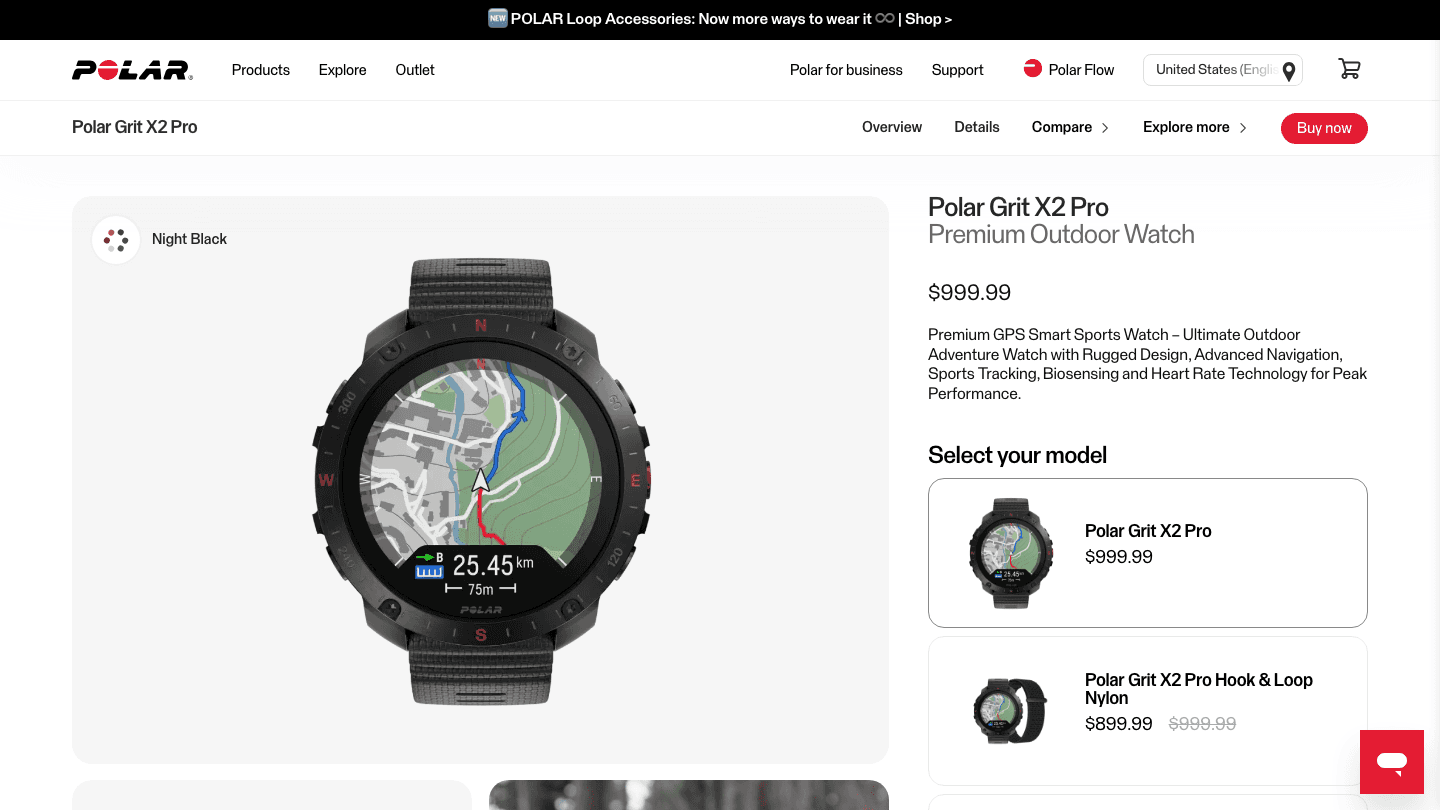
The Grit X2 Pro wears like a serious tool. At 48.6mm across and 57g without a strap, it is not small, but the case never feels ungainly on the wrist. The stainless steel bezel is chunky by design, built to absorb impacts. Sapphire crystal glass sits on top. Drop it on rocks, wear it in salt water (rated WR100), or strap it through a muddy ultra. It handles all of it without complaint.
The 1.39-inch AMOLED display at 454x454 resolution is sharp and bright. Polar claims 15% more visibility than its predecessor. In direct afternoon sun, the always-on display stays readable without forcing a wrist raise for a quick data check. That matters during a race when every movement counts.
Five physical buttons handle all navigation. There is no rotating bezel, unlike some Garmin models. The button layout takes a day or two to memorize but becomes fast once it clicks. Touch interaction is available, but the watch is clearly designed for button-first use in gloves or rain.
GPS and Navigation
This is where the Grit X2 Pro earns its price. Dual-frequency GPS, supporting L1 and L5 bands across GPS, Glonass, Galileo, BeiDou, and QZSS, eliminates the multipath errors that plague single-frequency watches in cities, under tree canopy, and in mountain valleys. In testing, route distances consistently came in within 2-3% of known courses. That accuracy matches or exceeds the Garmin Fenix 8 and Coros Vertix 2S under the same conditions.
Offline maps come pre-loaded for North America and Europe, a genuine convenience for athletes who train in remote areas. Plan a route on Polar Flow or a connected platform, sync it to the watch, and follow turn-by-turn breadcrumbs without a phone signal. Map rendering is clear enough to navigate from, though it is not as refined as Garmin's Topo+ maps in complex mountainous terrain.
Polar-specific tools like Hill Splitter (auto-detects ascents and descents), VAM (vertical ascent speed), and Vertical Speed add context that raw GPS data alone cannot give. For trail runners and alpinists, these are useful on a hard climb. The watch gives you your vertical rate in real time, which is a different kind of feedback from pace alone.
Heart Rate and HRV Monitoring
Polar has tracked heart rate variability for longer than almost any wearable brand, and it shows. The Grit X2 Pro measures HRV Status using nightly readings taken during sleep, then surfaces a morning readiness signal. Unlike brands that give you a single number with no context, Polar's HRV Status shows your trend over several weeks alongside individual nightly readings. That trend view makes it easier to spot patterns rather than chasing daily scores.
The wrist ECG is a first for Polar. Activate it from the watch face, hold your thumb on the left-side buttons, and the watch captures a 30-second single-lead ECG. The reading goes into Polar Flow for review. This is not medical-grade, but for athletes tracking cardiac irregularities or baseline shifts over time, it is a meaningful addition. No other multisport watch in this category currently offers it alongside the depth of recovery analytics Polar provides.
The fourth-generation optical sensor also tracks SpO2 and nightly skin temperature. The Orthostatic Test, where you stand after lying still for a minute while the watch records heart rate response, gives a practical gauge of nervous system recovery. Pair that with a look at your HRV monitor history and you have a readiness picture that goes deeper than most wearables provide.
Training Load and Recovery
Polar's Training Load Pro tracks both cardiovascular strain and perceived load, then plots where you sit on an overreaching or optimal or detraining curve. The same logic that cardio load explains in the context of general fitness applies here with sport-specific precision. You can see exactly when a training block is pushing into overreaching territory before your body delivers the same message with a bad race day.
Recovery Pro pairs directly with Training Load Pro. After hard efforts, the watch estimates how many hours until you are ready to train hard again. These numbers are calibrated to the individual over time, not pulled from generic population tables. The estimates become more accurate the longer you wear the watch consistently.
Sleep tracking through Sleep Plus Stages detects light, deep, and REM cycles. The recovery score each morning draws from HRV, sleep staging, and resting heart rate during sleep. It is one of the cleaner implementations of overnight recovery tracking in a multisport watch.
Battery Life
Polar rates the Grit X2 Pro at 43 hours in Performance mode (dual-frequency GPS, continuous heart rate). In real-world testing, a 40-hour ultra-distance race scenario came in around 38-40 hours, within normal variance given screen time and notification volume.
Endurance mode, with slightly reduced GPS sampling, stretches past 70 hours. Eco mode reaches 140 hours. Everyday smartwatch use without GPS delivers about 10 days. Those numbers hold in cold conditions, where many GPS watches lose significant runtime. That cold-weather stability matters for winter trail runners and alpine athletes.
Charging from empty to full takes just under two hours via the magnetic clip. The clip connection is secure enough that overnight charging without accidental disconnects is reliable.
Polar Grit X2 Pro vs. the Competition
Against the Garmin Fenix 8, the Grit X2 Pro matches GPS accuracy and wins on HRV depth. Garmin's Body Battery is a useful simplification of readiness, but Polar's Training Load Pro goes further by modeling your actual training curve and flagging overreaching. The Fenix 8 beats the Grit X2 Pro on third-party apps, music storage, and the Connect IQ ecosystem. If your training life is already built around Garmin Connect, switching costs are real.
The Coros Vertix 2S offers a longer battery life ceiling and excellent GPS at a slightly lower price. What it lacks is Polar's biosensing depth: no ECG, no skin temperature, and a less detailed recovery analysis. For pure endurance logging and GPS accuracy, Coros is competitive. For athletes who want to understand their physiology between sessions, Polar pulls ahead.
Suunto's Race S sits in a similar price bracket and has closed the gap on display quality and training analysis. Polar still leads on recovery science. But if Suunto's app ecosystem and Strava integration matter to you, it is worth comparing directly.
Turning Polar Data Into a Smarter Daily Schedule
Recovery data is only useful when it changes how you spend your time. That is where most athletes leave value on the table: they check their HRV score, see it is low, and then schedule a hard meeting right after a planned easy session anyway.
Lifestack reads your sleep and energy signals and builds a daily schedule around them. On a morning when your Polar data shows poor overnight recovery, Lifestack pulls cognitively demanding work earlier when focus tends to be more available, and protects afternoon blocks for lighter tasks. It turns the Polar Grit X2 Pro from a tracking device into something that actively shapes your day. You can read more in Introducing Lifestack and the dedicated guide to the best apps to use with Polar.
The concept is the same one behind energy calendars: stop scheduling by clock time alone and start matching task intensity to your actual energy level. For athletes already investing in the Grit X2 Pro's biosensing, adding a scheduling layer that responds to that data completes the loop. The Polar tells you your state. Lifestack tells you what to do about it.

Who Should Buy the Polar Grit X2 Pro?
Trail runners and ultramarathoners who need dual-frequency GPS accuracy in forest terrain and want detailed elevation analytics via Hill Splitter and VAM.
Triathletes who want accurate multi-sport tracking in one watch alongside deep HRV and recovery analysis between sessions.
Existing Polar users upgrading from the Grit X2 or Vantage V3 who want ECG capability and a higher-resolution AMOLED display.
Physiology-focused athletes who want Orthostatic Test data, wrist ECG, nightly skin temperature, and RMSSD trends on a single platform.
It is not the right pick for athletes who prioritize third-party app support, large on-device music libraries, or a Garmin Connect-dependent training workflow. And if peak battery life is the top priority, the Coros Vertix 2S offers more hours per charge at a lower price.
Verdict
The Polar Grit X2 Pro is an excellent GPS multisport watch for athletes who want to understand their bodies as well as their splits. The dual-frequency GPS delivers on its accuracy promises. The recovery and HRV system is among the best available in a consumer GPS watch. The ECG, SpO2, and skin temperature sensors add a biosensing layer that competitors at this price do not match.
The price is steep and the third-party app ecosystem is narrower than Garmin's. But for athletes who want the best recovery science in a rugged outdoor watch, the Grit X2 Pro earns its place at the top of the category. Pair it with a system for personal energy management and the insights it generates become daily decisions, not just post-workout data points.
Frequently Asked Questions
Is the Polar Grit X2 Pro worth the price?
At $999.99, it is one of the more expensive GPS watches on the market. For serious endurance athletes who want best-in-class GPS accuracy, a wrist ECG, and deep HRV tracking in one device, the price is justified. Casual athletes or those who mainly run on roads may find a $400-$500 watch covers their needs at a fraction of the cost.
How accurate is the GPS on the Polar Grit X2 Pro?
Very accurate. Dual-frequency GPS (L1/L5) consistently tracks within 2-3% of known course distances, including in urban canyons and dense forest trails where single-frequency watches drift more noticeably. This puts it among the top performers in GPS accuracy for 2026, alongside the Garmin Fenix 8 and Coros Vertix 2S.
What is the battery life during GPS tracking?
Polar rates it at 43 hours in Performance mode with dual-frequency GPS and continuous heart rate. Real-world testing shows roughly 38-40 hours under these conditions. Endurance mode extends this past 70 hours. Smartwatch use without GPS delivers about 10 days.
Does the Polar Grit X2 Pro have HRV tracking?
Yes. It tracks HRV nightly during sleep and displays HRV Status with both a daily readiness signal and a multi-week trend. It also includes an Orthostatic Test for manual recovery checks. This is one of the strongest HRV implementations in any consumer GPS watch. See our guide to when to time your workouts for how to apply this data.
How does it compare to the Garmin Fenix 8?
Both watches match on GPS accuracy and general durability. The Polar leads on HRV depth, biosensing (ECG, skin temperature), and recovery analytics. The Garmin Fenix 8 leads on third-party app support, music storage, and the Connect IQ ecosystem. Garmin's Body Battery is simpler than Polar's Training Load Pro, giving Polar the edge for physiology-focused athletes.
Can you use the Polar Grit X2 Pro for swimming?
Yes. It is waterproof to 100 ATM and includes swim tracking within its 150+ sport profiles. Open-water swimming, pool swimming, and triathlon transitions are all supported. Heart rate accuracy during high-intensity swim efforts is slightly reduced, as is common across all optical HR wearables in water.
The Polar Grit X2 Pro costs $999.99 and aims squarely at serious endurance athletes who want trail-running precision, dual-frequency GPS, and hospital-grade biosensing on their wrist. After testing it across trail runs, long rides, and daily wear, here is an honest take on what it delivers and where it still has room to grow.
Polar built its reputation on heart rate accuracy. The Grit X2 Pro takes that heritage further with the Polar Elixir biosensing platform, which bundles a fourth-generation optical heart rate sensor, a first-generation wrist ECG, SpO2 monitoring, and nightly skin temperature tracking into one watch. That is a meaningful step up from most competitors at this price.
But a GPS watch at nearly a thousand dollars is not bought on spec sheets alone. GPS accuracy in forests and canyons, real-world battery life, the quality of recovery guidance, and how it fits into a training lifestyle all matter. This review addresses each one directly.
Key Takeaways
Dual-frequency GPS (L1/L5) gives the Grit X2 Pro among the best tracking accuracy of any watch tested in urban canyons and dense forests, routinely within 2-3% of known course distances.
HRV Status, Training Load Pro, and the Orthostatic Test together create a recovery picture that is genuinely actionable, not just decorative numbers on a screen.
At $999.99, this is a premium pick. Athletes who already use Polar Flow and value Polar's ecosystem will get the most from it; Garmin loyalists will find it harder to justify switching.
Quick Verdict
The Polar Grit X2 Pro is one of the best GPS watches for endurance athletes in 2026, particularly for trail runners and triathletes who want accurate wrist-based ECG data alongside elite GPS performance. It does not beat the Garmin Fenix 8 on third-party app depth or on-device smartwatch features, but it leads on biosensing quality and Polar Flow's training analytics. Worth it if you are already in the Polar ecosystem or making a deliberate choice to enter it.
Design and Display
The Grit X2 Pro wears like a serious tool. At 48.6mm across and 57g without a strap, it is not small, but the case never feels ungainly on the wrist. The stainless steel bezel is chunky by design, built to absorb impacts. Sapphire crystal glass sits on top. Drop it on rocks, wear it in salt water (rated WR100), or strap it through a muddy ultra. It handles all of it without complaint.
The 1.39-inch AMOLED display at 454x454 resolution is sharp and bright. Polar claims 15% more visibility than its predecessor. In direct afternoon sun, the always-on display stays readable without forcing a wrist raise for a quick data check. That matters during a race when every movement counts.
Five physical buttons handle all navigation. There is no rotating bezel, unlike some Garmin models. The button layout takes a day or two to memorize but becomes fast once it clicks. Touch interaction is available, but the watch is clearly designed for button-first use in gloves or rain.
GPS and Navigation
This is where the Grit X2 Pro earns its price. Dual-frequency GPS, supporting L1 and L5 bands across GPS, Glonass, Galileo, BeiDou, and QZSS, eliminates the multipath errors that plague single-frequency watches in cities, under tree canopy, and in mountain valleys. In testing, route distances consistently came in within 2-3% of known courses. That accuracy matches or exceeds the Garmin Fenix 8 and Coros Vertix 2S under the same conditions.
Offline maps come pre-loaded for North America and Europe, a genuine convenience for athletes who train in remote areas. Plan a route on Polar Flow or a connected platform, sync it to the watch, and follow turn-by-turn breadcrumbs without a phone signal. Map rendering is clear enough to navigate from, though it is not as refined as Garmin's Topo+ maps in complex mountainous terrain.
Polar-specific tools like Hill Splitter (auto-detects ascents and descents), VAM (vertical ascent speed), and Vertical Speed add context that raw GPS data alone cannot give. For trail runners and alpinists, these are useful on a hard climb. The watch gives you your vertical rate in real time, which is a different kind of feedback from pace alone.
Heart Rate and HRV Monitoring
Polar has tracked heart rate variability for longer than almost any wearable brand, and it shows. The Grit X2 Pro measures HRV Status using nightly readings taken during sleep, then surfaces a morning readiness signal. Unlike brands that give you a single number with no context, Polar's HRV Status shows your trend over several weeks alongside individual nightly readings. That trend view makes it easier to spot patterns rather than chasing daily scores.
The wrist ECG is a first for Polar. Activate it from the watch face, hold your thumb on the left-side buttons, and the watch captures a 30-second single-lead ECG. The reading goes into Polar Flow for review. This is not medical-grade, but for athletes tracking cardiac irregularities or baseline shifts over time, it is a meaningful addition. No other multisport watch in this category currently offers it alongside the depth of recovery analytics Polar provides.
The fourth-generation optical sensor also tracks SpO2 and nightly skin temperature. The Orthostatic Test, where you stand after lying still for a minute while the watch records heart rate response, gives a practical gauge of nervous system recovery. Pair that with a look at your HRV monitor history and you have a readiness picture that goes deeper than most wearables provide.
Training Load and Recovery
Polar's Training Load Pro tracks both cardiovascular strain and perceived load, then plots where you sit on an overreaching or optimal or detraining curve. The same logic that cardio load explains in the context of general fitness applies here with sport-specific precision. You can see exactly when a training block is pushing into overreaching territory before your body delivers the same message with a bad race day.
Recovery Pro pairs directly with Training Load Pro. After hard efforts, the watch estimates how many hours until you are ready to train hard again. These numbers are calibrated to the individual over time, not pulled from generic population tables. The estimates become more accurate the longer you wear the watch consistently.
Sleep tracking through Sleep Plus Stages detects light, deep, and REM cycles. The recovery score each morning draws from HRV, sleep staging, and resting heart rate during sleep. It is one of the cleaner implementations of overnight recovery tracking in a multisport watch.
Battery Life
Polar rates the Grit X2 Pro at 43 hours in Performance mode (dual-frequency GPS, continuous heart rate). In real-world testing, a 40-hour ultra-distance race scenario came in around 38-40 hours, within normal variance given screen time and notification volume.
Endurance mode, with slightly reduced GPS sampling, stretches past 70 hours. Eco mode reaches 140 hours. Everyday smartwatch use without GPS delivers about 10 days. Those numbers hold in cold conditions, where many GPS watches lose significant runtime. That cold-weather stability matters for winter trail runners and alpine athletes.
Charging from empty to full takes just under two hours via the magnetic clip. The clip connection is secure enough that overnight charging without accidental disconnects is reliable.
Polar Grit X2 Pro vs. the Competition
Against the Garmin Fenix 8, the Grit X2 Pro matches GPS accuracy and wins on HRV depth. Garmin's Body Battery is a useful simplification of readiness, but Polar's Training Load Pro goes further by modeling your actual training curve and flagging overreaching. The Fenix 8 beats the Grit X2 Pro on third-party apps, music storage, and the Connect IQ ecosystem. If your training life is already built around Garmin Connect, switching costs are real.
The Coros Vertix 2S offers a longer battery life ceiling and excellent GPS at a slightly lower price. What it lacks is Polar's biosensing depth: no ECG, no skin temperature, and a less detailed recovery analysis. For pure endurance logging and GPS accuracy, Coros is competitive. For athletes who want to understand their physiology between sessions, Polar pulls ahead.
Suunto's Race S sits in a similar price bracket and has closed the gap on display quality and training analysis. Polar still leads on recovery science. But if Suunto's app ecosystem and Strava integration matter to you, it is worth comparing directly.
Turning Polar Data Into a Smarter Daily Schedule
Recovery data is only useful when it changes how you spend your time. That is where most athletes leave value on the table: they check their HRV score, see it is low, and then schedule a hard meeting right after a planned easy session anyway.
Lifestack reads your sleep and energy signals and builds a daily schedule around them. On a morning when your Polar data shows poor overnight recovery, Lifestack pulls cognitively demanding work earlier when focus tends to be more available, and protects afternoon blocks for lighter tasks. It turns the Polar Grit X2 Pro from a tracking device into something that actively shapes your day. You can read more in Introducing Lifestack and the dedicated guide to the best apps to use with Polar.
The concept is the same one behind energy calendars: stop scheduling by clock time alone and start matching task intensity to your actual energy level. For athletes already investing in the Grit X2 Pro's biosensing, adding a scheduling layer that responds to that data completes the loop. The Polar tells you your state. Lifestack tells you what to do about it.
Who Should Buy the Polar Grit X2 Pro?
Trail runners and ultramarathoners who need dual-frequency GPS accuracy in forest terrain and want detailed elevation analytics via Hill Splitter and VAM.
Triathletes who want accurate multi-sport tracking in one watch alongside deep HRV and recovery analysis between sessions.
Existing Polar users upgrading from the Grit X2 or Vantage V3 who want ECG capability and a higher-resolution AMOLED display.
Physiology-focused athletes who want Orthostatic Test data, wrist ECG, nightly skin temperature, and RMSSD trends on a single platform.
It is not the right pick for athletes who prioritize third-party app support, large on-device music libraries, or a Garmin Connect-dependent training workflow. And if peak battery life is the top priority, the Coros Vertix 2S offers more hours per charge at a lower price.
Verdict
The Polar Grit X2 Pro is an excellent GPS multisport watch for athletes who want to understand their bodies as well as their splits. The dual-frequency GPS delivers on its accuracy promises. The recovery and HRV system is among the best available in a consumer GPS watch. The ECG, SpO2, and skin temperature sensors add a biosensing layer that competitors at this price do not match.
The price is steep and the third-party app ecosystem is narrower than Garmin's. But for athletes who want the best recovery science in a rugged outdoor watch, the Grit X2 Pro earns its place at the top of the category. Pair it with a system for personal energy management and the insights it generates become daily decisions, not just post-workout data points.
Frequently Asked Questions
Is the Polar Grit X2 Pro worth the price?
At $999.99, it is one of the more expensive GPS watches on the market. For serious endurance athletes who want best-in-class GPS accuracy, a wrist ECG, and deep HRV tracking in one device, the price is justified. Casual athletes or those who mainly run on roads may find a $400-$500 watch covers their needs at a fraction of the cost.
How accurate is the GPS on the Polar Grit X2 Pro?
Very accurate. Dual-frequency GPS (L1/L5) consistently tracks within 2-3% of known course distances, including in urban canyons and dense forest trails where single-frequency watches drift more noticeably. This puts it among the top performers in GPS accuracy for 2026, alongside the Garmin Fenix 8 and Coros Vertix 2S.
What is the battery life during GPS tracking?
Polar rates it at 43 hours in Performance mode with dual-frequency GPS and continuous heart rate. Real-world testing shows roughly 38-40 hours under these conditions. Endurance mode extends this past 70 hours. Smartwatch use without GPS delivers about 10 days.
Does the Polar Grit X2 Pro have HRV tracking?
Yes. It tracks HRV nightly during sleep and displays HRV Status with both a daily readiness signal and a multi-week trend. It also includes an Orthostatic Test for manual recovery checks. This is one of the strongest HRV implementations in any consumer GPS watch. See our guide to when to time your workouts for how to apply this data.
How does it compare to the Garmin Fenix 8?
Both watches match on GPS accuracy and general durability. The Polar leads on HRV depth, biosensing (ECG, skin temperature), and recovery analytics. The Garmin Fenix 8 leads on third-party app support, music storage, and the Connect IQ ecosystem. Garmin's Body Battery is simpler than Polar's Training Load Pro, giving Polar the edge for physiology-focused athletes.
Can you use the Polar Grit X2 Pro for swimming?
Yes. It is waterproof to 100 ATM and includes swim tracking within its 150+ sport profiles. Open-water swimming, pool swimming, and triathlon transitions are all supported. Heart rate accuracy during high-intensity swim efforts is slightly reduced, as is common across all optical HR wearables in water.



FOLLOW ON
FOLLOW ON
FOLLOW ON


Copyright 2026 © Lifestack. All rights reserved
Copyright 2026 © Lifestack. All rights reserved

