
Tips
Sunsama Planner Pricing: Plans and Alternatives
Sunsama Planner Pricing: Plans and Alternatives

Sunsama is one of the more premium daily planners available right now. At $22/month billed monthly, or $17/month on an annual plan, it costs more than most task apps and calendar tools in the same category. The company is upfront about this. Their view is that a higher price creates higher expectations from customers, and higher expectations produce a better product.
That logic works if Sunsama delivers for your specific use case. If you are researching the Sunsama planner pricing before committing, this breakdown covers exactly what you are paying for, where the costs add up over a year, and how the price compares to the alternatives doing similar work.
No fluff, no estimates. All prices are pulled directly from Sunsama's current pricing page.
Key Takeaways
Sunsama charges $22/month billed monthly or $17/month billed annually ($204/year); no free plan, but a 14-day trial requires no credit card
The Pro plan covers unlimited integrations, AI features, MCP support, and Zapier; Enterprise adds SSO, SCIM, and custom data privacy for organizations
If the price does not match your budget, alternatives like Sunsama alternatives offer similar daily planning features at a lower cost
Sunsama Pricing Plans at a Glance
Sunsama currently offers two plans: Pro for individual users and Enterprise for organizations with specialized requirements.
Pro (monthly): $22/month, billed month to month, full access to all features
Pro (annual): $17/month billed as $204/year, a 20% discount versus monthly
Enterprise: Custom pricing; contact Sunsama directly for teams needing SSO, SCIM, audit logs, and custom privacy controls
Free trial: 14 days, no credit card required, full Pro access
There is no permanent free tier. Once the trial ends, you either subscribe or lose access.
What the Sunsama Pro Plan Includes
The Pro plan is the only individual option. Here is what it covers:
Unlimited integrations with tools like Asana, Todoist, Linear, GitHub, Notion, Jira, Slack, and Google Calendar
AI-assisted planning features and MCP (model context protocol) support for AI agents
Zapier integration for custom automations
The Sunsama daily planning ritual: morning planning session, task prioritization, and end-of-day shutdown checklist
Mobile apps on iOS and Android
What it does not include: any awareness of your energy levels or focus windows, sleep or wearable device integration, or automatic task scheduling. You place tasks on your calendar manually.
Annual vs. Monthly: The Real Cost Difference
The gap between monthly and annual billing is $60/year. Monthly subscribers pay $264/year; annual subscribers pay $204/year. If you are confident Sunsama fits your workflow, the annual plan pays off in month five.
Sunsama does not offer a lifetime deal. They have been explicit about this: their pricing model is designed to fund ongoing product development, and a one-time payment would conflict with that commitment. This is worth knowing if you are comparing it to tools like Lifestack, which offers a $120 lifetime option alongside its monthly and annual plans.
The 14-Day Free Trial
Sunsama's free trial gives you full Pro access for 14 days with no credit card required. That is enough time to run one genuine week of daily planning and see whether the ritual fits your schedule.
During the trial, focus on the integrations that matter most to your workflow. If you use Asana or Linear, connect them on day one and see how well the task import and syncing work in practice. The Sunsama planning ritual (the morning planning session and shutdown checklist) is the core product, and two weeks is enough to know whether it changes how you work or just adds steps.
Who Sunsama Is Worth It For
Sunsama fits a specific kind of knowledge worker: someone who uses three or more project tools daily, wants a single place to see and plan all their tasks, and values a structured planning ritual.
It works well for professionals who manage tasks across tools like Asana, Notion, and Linear and who find themselves switching between apps to figure out what to work on next. The daily planning session forces a prioritization moment that a lot of people find valuable once the habit is built.
It is less compelling for solo users who already have a clear workflow, people who work primarily from a single task app, or anyone on a tighter budget who cannot justify $204/year for a planning layer on top of tools they already pay for.
Where Sunsama Falls Short for the Price
At $17 to $22/month, Sunsama competes directly with tools that auto-schedule tasks, track energy, and integrate with wearables. Sunsama does none of these.
You still decide when each task gets done. If you have a packed calendar or unpredictable energy across the week, the manual placement becomes friction rather than a feature. The time-blocking approach Sunsama uses works best when you have reliable energy patterns and can accurately predict how long tasks will take.
For people who struggle with time blindness or inconsistent focus windows, a planner that does not adapt to your energy is not solving the hardest part of the problem. It is still on you to notice that today is a low-energy day and adjust your plan accordingly.
Best Sunsama Alternatives by Value
If the Sunsama planner pricing does not fit your budget, or the feature set does not match what you need, these are the alternatives worth looking at.
Lifestack: Best Value for Energy-Aware Planning
Lifestack does what Sunsama does not: it reads your sleep and recovery data from wearables and auto-schedules your tasks during your actual focus peaks. You capture your tasks, and Lifestack places them on your calendar based on energy level, deadline, and estimated duration.
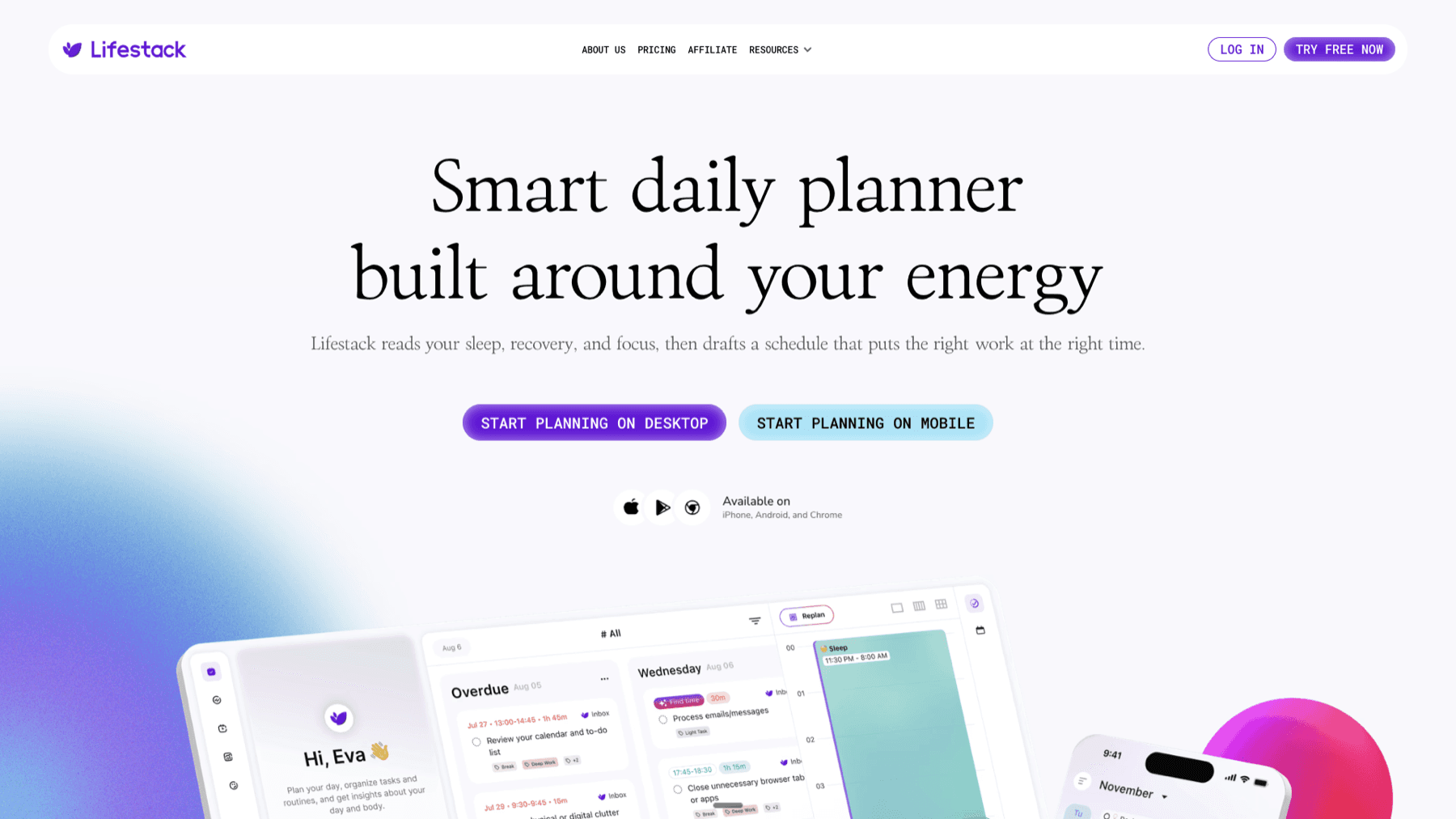
Pricing is $7/month, $50/year (7-day free trial on annual), or $120 lifetime. Compared to Sunsama's $204/year, the annual plan is less than a quarter of the cost. For most solo users who want daily planning without the premium price, this is the more practical option. Read more on the best AI planner apps for a fuller comparison.
Motion: Best for Fully Automated Scheduling
Motion takes a more aggressive approach to automation: it schedules every task and meeting automatically and reshuffles your calendar when priorities change. See Motion's pricing breakdown for the current cost. It is higher than Sunsama but does more scheduling work automatically.
Akiflow: Best for Habit-Based Planners
Akiflow sits closest to Sunsama in philosophy. It is a ritual-based daily planner with strong integrations. It has a steeper learning curve and a command-palette driven interface that suits keyboard-heavy workflows. See Akiflow alternatives for context on where it fits versus similar tools.
Why Energy-Aware Planning Beats Manual Time Blocking
Sunsama's core mechanism is the daily planning ritual: you review your tasks each morning, decide what to work on today, and drop them into time slots. The habit is the product.
The limitation is that it assumes your energy is consistent enough to make those placements accurate. For many people, it is not. A deep-focus task scheduled at 3 PM on a low-sleep day does not go well, and Sunsama cannot know that. Tools that read wearable data and adjust automatically close that gap. The case for energy-based planning over time blocking is strongest for anyone whose daily energy varies significantly.
Frequently Asked Questions
How much is Sunsama per month?
Sunsama costs $22/month on the monthly plan or $17/month when billed annually ($204/year). There is no free plan, but a 14-day trial with no credit card required gives you full access before you commit.
Does Sunsama have a free version?
No. Sunsama offers a 14-day free trial with no credit card required, but there is no permanent free tier. After the trial, you need to subscribe or lose access to the product.
What is included in the Sunsama Pro plan?
The Pro plan includes unlimited integrations (Asana, Todoist, Linear, Notion, Jira, Slack, Google Calendar, and more), AI planning features, MCP support, Zapier, mobile apps on iOS and Android, and the Sunsama daily planning ritual with morning session and end-of-day shutdown checklist.
What does Sunsama Enterprise cost?
Enterprise pricing is custom. It adds SSO and SAML authentication, SCIM provisioning, audit logs, and custom privacy and data requirements. Contact Sunsama's support team for a quote.
Is there a cheaper alternative to Sunsama?
Yes. Several Sunsama alternatives cover the same daily planning use case at lower price points. Lifestack starts at $7/month and adds energy-aware auto-scheduling that Sunsama does not offer. The best AI planner apps list covers the options in detail.
Does Sunsama offer a lifetime deal?
No. Sunsama does not offer lifetime pricing. The company's pricing philosophy is that subscription revenue funds ongoing development, and a one-time payment model would conflict with that. If a lifetime option matters to you, tools like Lifestack offer one at $120.
Sunsama is one of the more premium daily planners available right now. At $22/month billed monthly, or $17/month on an annual plan, it costs more than most task apps and calendar tools in the same category. The company is upfront about this. Their view is that a higher price creates higher expectations from customers, and higher expectations produce a better product.
That logic works if Sunsama delivers for your specific use case. If you are researching the Sunsama planner pricing before committing, this breakdown covers exactly what you are paying for, where the costs add up over a year, and how the price compares to the alternatives doing similar work.
No fluff, no estimates. All prices are pulled directly from Sunsama's current pricing page.
Key Takeaways
Sunsama charges $22/month billed monthly or $17/month billed annually ($204/year); no free plan, but a 14-day trial requires no credit card
The Pro plan covers unlimited integrations, AI features, MCP support, and Zapier; Enterprise adds SSO, SCIM, and custom data privacy for organizations
If the price does not match your budget, alternatives like Sunsama alternatives offer similar daily planning features at a lower cost
Sunsama Pricing Plans at a Glance
Sunsama currently offers two plans: Pro for individual users and Enterprise for organizations with specialized requirements.
Pro (monthly): $22/month, billed month to month, full access to all features
Pro (annual): $17/month billed as $204/year, a 20% discount versus monthly
Enterprise: Custom pricing; contact Sunsama directly for teams needing SSO, SCIM, audit logs, and custom privacy controls
Free trial: 14 days, no credit card required, full Pro access
There is no permanent free tier. Once the trial ends, you either subscribe or lose access.
What the Sunsama Pro Plan Includes
The Pro plan is the only individual option. Here is what it covers:
Unlimited integrations with tools like Asana, Todoist, Linear, GitHub, Notion, Jira, Slack, and Google Calendar
AI-assisted planning features and MCP (model context protocol) support for AI agents
Zapier integration for custom automations
The Sunsama daily planning ritual: morning planning session, task prioritization, and end-of-day shutdown checklist
Mobile apps on iOS and Android
What it does not include: any awareness of your energy levels or focus windows, sleep or wearable device integration, or automatic task scheduling. You place tasks on your calendar manually.
Annual vs. Monthly: The Real Cost Difference
The gap between monthly and annual billing is $60/year. Monthly subscribers pay $264/year; annual subscribers pay $204/year. If you are confident Sunsama fits your workflow, the annual plan pays off in month five.
Sunsama does not offer a lifetime deal. They have been explicit about this: their pricing model is designed to fund ongoing product development, and a one-time payment would conflict with that commitment. This is worth knowing if you are comparing it to tools like Lifestack, which offers a $120 lifetime option alongside its monthly and annual plans.
The 14-Day Free Trial
Sunsama's free trial gives you full Pro access for 14 days with no credit card required. That is enough time to run one genuine week of daily planning and see whether the ritual fits your schedule.
During the trial, focus on the integrations that matter most to your workflow. If you use Asana or Linear, connect them on day one and see how well the task import and syncing work in practice. The Sunsama planning ritual (the morning planning session and shutdown checklist) is the core product, and two weeks is enough to know whether it changes how you work or just adds steps.
Who Sunsama Is Worth It For
Sunsama fits a specific kind of knowledge worker: someone who uses three or more project tools daily, wants a single place to see and plan all their tasks, and values a structured planning ritual.
It works well for professionals who manage tasks across tools like Asana, Notion, and Linear and who find themselves switching between apps to figure out what to work on next. The daily planning session forces a prioritization moment that a lot of people find valuable once the habit is built.
It is less compelling for solo users who already have a clear workflow, people who work primarily from a single task app, or anyone on a tighter budget who cannot justify $204/year for a planning layer on top of tools they already pay for.
Where Sunsama Falls Short for the Price
At $17 to $22/month, Sunsama competes directly with tools that auto-schedule tasks, track energy, and integrate with wearables. Sunsama does none of these.
You still decide when each task gets done. If you have a packed calendar or unpredictable energy across the week, the manual placement becomes friction rather than a feature. The time-blocking approach Sunsama uses works best when you have reliable energy patterns and can accurately predict how long tasks will take.
For people who struggle with time blindness or inconsistent focus windows, a planner that does not adapt to your energy is not solving the hardest part of the problem. It is still on you to notice that today is a low-energy day and adjust your plan accordingly.
Best Sunsama Alternatives by Value
If the Sunsama planner pricing does not fit your budget, or the feature set does not match what you need, these are the alternatives worth looking at.
Lifestack: Best Value for Energy-Aware Planning
Lifestack does what Sunsama does not: it reads your sleep and recovery data from wearables and auto-schedules your tasks during your actual focus peaks. You capture your tasks, and Lifestack places them on your calendar based on energy level, deadline, and estimated duration.
Pricing is $7/month, $50/year (7-day free trial on annual), or $120 lifetime. Compared to Sunsama's $204/year, the annual plan is less than a quarter of the cost. For most solo users who want daily planning without the premium price, this is the more practical option. Read more on the best AI planner apps for a fuller comparison.
Motion: Best for Fully Automated Scheduling
Motion takes a more aggressive approach to automation: it schedules every task and meeting automatically and reshuffles your calendar when priorities change. See Motion's pricing breakdown for the current cost. It is higher than Sunsama but does more scheduling work automatically.
Akiflow: Best for Habit-Based Planners
Akiflow sits closest to Sunsama in philosophy. It is a ritual-based daily planner with strong integrations. It has a steeper learning curve and a command-palette driven interface that suits keyboard-heavy workflows. See Akiflow alternatives for context on where it fits versus similar tools.
Why Energy-Aware Planning Beats Manual Time Blocking
Sunsama's core mechanism is the daily planning ritual: you review your tasks each morning, decide what to work on today, and drop them into time slots. The habit is the product.
The limitation is that it assumes your energy is consistent enough to make those placements accurate. For many people, it is not. A deep-focus task scheduled at 3 PM on a low-sleep day does not go well, and Sunsama cannot know that. Tools that read wearable data and adjust automatically close that gap. The case for energy-based planning over time blocking is strongest for anyone whose daily energy varies significantly.
Frequently Asked Questions
How much is Sunsama per month?
Sunsama costs $22/month on the monthly plan or $17/month when billed annually ($204/year). There is no free plan, but a 14-day trial with no credit card required gives you full access before you commit.
Does Sunsama have a free version?
No. Sunsama offers a 14-day free trial with no credit card required, but there is no permanent free tier. After the trial, you need to subscribe or lose access to the product.
What is included in the Sunsama Pro plan?
The Pro plan includes unlimited integrations (Asana, Todoist, Linear, Notion, Jira, Slack, Google Calendar, and more), AI planning features, MCP support, Zapier, mobile apps on iOS and Android, and the Sunsama daily planning ritual with morning session and end-of-day shutdown checklist.
What does Sunsama Enterprise cost?
Enterprise pricing is custom. It adds SSO and SAML authentication, SCIM provisioning, audit logs, and custom privacy and data requirements. Contact Sunsama's support team for a quote.
Is there a cheaper alternative to Sunsama?
Yes. Several Sunsama alternatives cover the same daily planning use case at lower price points. Lifestack starts at $7/month and adds energy-aware auto-scheduling that Sunsama does not offer. The best AI planner apps list covers the options in detail.
Does Sunsama offer a lifetime deal?
No. Sunsama does not offer lifetime pricing. The company's pricing philosophy is that subscription revenue funds ongoing development, and a one-time payment model would conflict with that. If a lifetime option matters to you, tools like Lifestack offer one at $120.



FOLLOW ON
FOLLOW ON
FOLLOW ON


Copyright 2026 © Lifestack. All rights reserved
Copyright 2026 © Lifestack. All rights reserved

