
Device
Garmin Forerunner 965 Review: Worth It in 2026?
Garmin Forerunner 965 Review: Worth It in 2026?

Garmin Forerunner 965 at a Glance
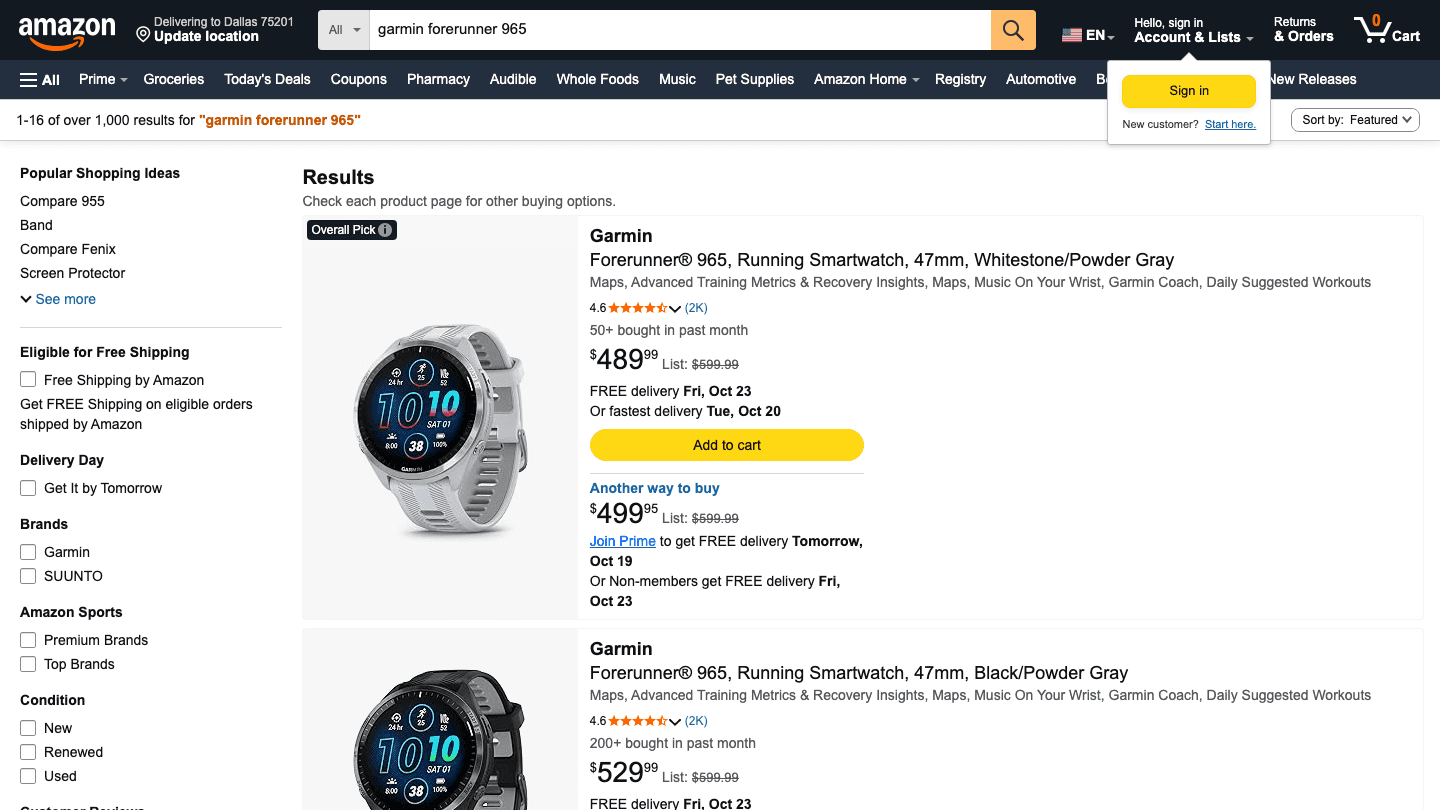
The Garmin Forerunner 965 launched in 2023 as Garmin's premium running watch -- the first Forerunner to pair an AMOLED display with the full training metrics suite that serious athletes expect. In 2026, with newer Forerunner models now on the market, the 965 has dropped to $489-$529 (from its original $599), making it arguably the best value in the premium running watch category right now.
This isn't a budget watch with premium features bolted on. The 965 was designed from the start for serious runners: wrist-based running dynamics, training load with chronic load tracking, real-time stamina, Hill Score, Endurance Score, onboard topo maps, and 32GB of music storage. The AMOLED display that separates it from the Forerunner 265 is genuinely excellent -- crisp at 454x454 resolution, bright enough for outdoor use, and touchscreen for navigation.
The battery life (23 days smartwatch mode, 22 hours full GPS) and the titanium bezel complete a package that holds up well in 2026.
Key Takeaways
The AMOLED display at 454x454 resolution is the headline upgrade over the Forerunner 265 -- crispier maps, better data visualization, and more readable in direct sunlight
Training metrics are the deepest available in a consumer running watch: Training Load Ratio, Chronic Load, Endurance Score, Real-time Stamina, Hill Score, and wrist-based Running Power -- all without any accessory
At $489-$529 in 2026 (down from $599), the Forerunner 965 offers better value than it did at launch
Display and Design
The 1.4-inch AMOLED display is the most tangible difference between the 965 and the rest of the Forerunner lineup. At 454x454 resolution on a 47mm case, it's sharp enough that text and map details are genuinely readable at a glance while running. The always-on mode works well in practice -- it dims to preserve battery but stays visible without needing a wrist raise.
The watch face is 47mm -- on the large end for a running watch, but not unusually so for serious athletes who prioritize visibility. Weight is 53 grams including the silicone band, which is competitive for the feature set. The titanium bezel gives it a quality feel without the weight penalty of full titanium construction. Water resistance is rated to 5ATM.
Color options include Whitestone/Powder Gray and Black/Powder Gray. The quick-release band system accepts standard 22mm bands, which is a practical decision -- you're not locked into Garmin's proprietary accessories.
GPS and Training Metrics
This is where the Forerunner 965 separates itself from mid-tier competitors. It uses multi-band GPS (GPS + GLONASS + Galileo) for more accurate tracking in environments where single-band GPS struggles: under tree canopy, in urban canyons, near tall buildings. In practice, track and route data is noticeably more consistent than Garmin's mid-tier Forerunners.
The training metrics suite is the deepest available in any consumer running watch:
Training Load Ratio: Compares your recent training load to your 4-week average. Tells you whether you're in the optimal range, undertraining, or overreaching before a breakdown happens.
Chronic Training Load: Tracks your fitness accumulation over weeks to show whether you're building or losing fitness.
Endurance Score: A single number (1-100) reflecting your aerobic fitness relative to your own history and peer benchmarks.
Real-time Stamina: During a run, shows your remaining stamina and estimated time before your pace degrades significantly.
Hill Score: Specifically evaluates your ability on hill repeats and climbing efforts over time.
Wrist-based Running Power: Estimates power output without a chest strap or footpod, using wrist accelerometer data and GPS.
Running Dynamics: Ground contact time, vertical oscillation, stride length, and vertical ratio -- all from the wrist, no accessory required.
These aren't features that casual runners use daily. But for athletes training for a half marathon, marathon, or ultramarathon, the load management tools are genuinely useful for avoiding overtraining injury.
Health Monitoring
The 965 tracks continuous heart rate, SpO2, Body Battery (Garmin's readiness score), sleep stages, and skin temperature. For a full explanation of how Body Battery works and what affects it, see our Garmin Body Battery guide.
One notable absence: no ECG. The Forerunner 965 does not have AFib detection via electrocardiogram. If that's a priority, you'll need the Apple Watch (Series 9+), Samsung Galaxy Watch 8, or Withings ScanWatch. The 965's optical heart rate monitoring is excellent for workout accuracy, but it doesn't produce a clinical-quality ECG trace.
Sleep tracking is solid but not the watch's primary value. Garmin's sleep scores are useful for trend analysis but less detailed than dedicated trackers like Oura Ring or Whoop. For serious runners, the Body Battery score (which incorporates sleep, HRV, and activity) is more actionable than the raw sleep stage breakdown. For a broader view of sleep tracking options, our best sleep trackers 2026 guide covers the full field.
Battery Life
23 days in smartwatch mode and 22 hours in GPS mode are the headline figures, and they hold up well in real-world use. Serious runners training 8-12 hours per week typically see 14-18 days between charges, depending on GPS use and display settings.
The AMOLED always-on display does consume more power than the MIP display on the Forerunner 265. If you're choosing between the 965 and 265 primarily on battery longevity, the 265 (26 days smartwatch mode) has the edge. In GPS mode the difference is small: 965 gets 22 hours, 265 gets 24 hours. Most runners won't notice the gap for training runs, though ultramarathon athletes running 100-mile races may find the 265 more practical.
Music and Smart Features
32GB of onboard storage holds roughly 2,000 songs. Wi-Fi lets you sync Spotify, Amazon Music, and Deezer playlists directly to the watch without needing your phone nearby. NFC enables Garmin Pay for contactless payments at NFC terminals. Incident detection and LiveTrack let emergency contacts follow your route in real time.
The onboard topo maps are a genuine differentiator versus non-mapping running watches. You can navigate by breadcrumb trail or turn-by-turn on pre-loaded routes, which matters for trail runners and anyone doing point-to-point routes in unfamiliar areas. For more on how to get the most from Garmin's ecosystem, see our apps to use with Garmin guide.
Who Should Buy the Forerunner 965
Buy it if:
You're a serious runner (half marathon, marathon, or ultramarathon training) who wants the deepest available training load management tools
You want onboard maps for trail running or international racing
The AMOLED display matters for daily wear and readability
You want music storage for run-only listening without your phone
Consider alternatives if:
You want ECG and AFib detection: look at Apple Watch or Samsung Galaxy Watch 8
Battery life for 100-mile ultras is the top priority: the Forerunner 265 (MIP display, 24 hours GPS) or Garmin Fenix series is more practical
You're a casual runner: the Forerunner 265 at a lower price covers everything most runners need
For a platform-level comparison, our Garmin vs Apple Watch guide and Garmin vs Fitbit breakdown cover the ecosystem tradeoffs in more detail.
Pair the Forerunner 965 with Lifestack

Garmin gives you detailed training load data, recovery scores, and Body Battery. The gap most athletes hit is structuring their non-training day around what the data says. A high training load day followed by a packed cognitive workload is a recovery problem your watch can't solve on its own.
Lifestack bridges this by scheduling your day around your energy patterns -- placing demanding work when your recovery and readiness are high, and lighter tasks when they aren't. For runners balancing training with professional work, energy-based scheduling is what prevents you from grinding through a mentally depleted day because your calendar didn't know you had a hard interval session that morning. Plans start at $10/month.
Frequently Asked Questions
Is the Garmin Forerunner 965 worth buying in 2026?
Yes, especially at its current price of $489-$529 (down from $599). The training metrics suite, AMOLED display, onboard maps, and 32GB music storage make it one of the best-equipped running watches available at its price point. If you're training seriously for distance running, it remains a top-tier choice.
What is the Garmin Forerunner 965 price in 2026?
$489-$529 depending on color, down from the original $599 launch price. The Whitestone/Powder Gray model is typically the lower price of the two.
What is the difference between Forerunner 965 and 265?
The main differences: the 965 has a larger 1.4" AMOLED display (vs 1.3" on 265), onboard topo maps, 32GB music storage (vs 8GB), Training Load Ratio and Chronic Load metrics, and a titanium bezel. The 265 has slightly better battery (24 vs 22 hrs GPS mode) and costs less. For most recreational runners, the 265 covers all the essentials; the 965 adds meaningful features for serious distance athletes. See our full Forerunner 265 review.
Does Garmin Forerunner 965 have ECG?
No. The Forerunner 965 does not include ECG or AFib detection. Its optical heart rate sensor is excellent for training accuracy but does not produce a clinical electrocardiogram trace. If ECG is a priority, Apple Watch or Samsung Galaxy Watch 8 are the primary alternatives.
How accurate is Garmin Forerunner 965 GPS?
Very accurate. Multi-band GPS (GPS + GLONASS + Galileo) produces notably more consistent track and route data than single-band GPS, especially in challenging environments like tree cover or urban canyons. In open terrain the difference from single-band is minimal; in dense environments it's meaningful.
Does Garmin Forerunner 965 have maps?
Yes. The 965 includes preloaded topo maps for your region and supports turn-by-turn navigation on saved routes. This differentiates it from mid-tier Forerunners (165, 265) which have breadcrumb trails but not full topo maps. The maps are useful for trail running, bikepacking, and navigation in unfamiliar areas.
Garmin Forerunner 965 at a Glance
The Garmin Forerunner 965 launched in 2023 as Garmin's premium running watch -- the first Forerunner to pair an AMOLED display with the full training metrics suite that serious athletes expect. In 2026, with newer Forerunner models now on the market, the 965 has dropped to $489-$529 (from its original $599), making it arguably the best value in the premium running watch category right now.
This isn't a budget watch with premium features bolted on. The 965 was designed from the start for serious runners: wrist-based running dynamics, training load with chronic load tracking, real-time stamina, Hill Score, Endurance Score, onboard topo maps, and 32GB of music storage. The AMOLED display that separates it from the Forerunner 265 is genuinely excellent -- crisp at 454x454 resolution, bright enough for outdoor use, and touchscreen for navigation.
The battery life (23 days smartwatch mode, 22 hours full GPS) and the titanium bezel complete a package that holds up well in 2026.
Key Takeaways
The AMOLED display at 454x454 resolution is the headline upgrade over the Forerunner 265 -- crispier maps, better data visualization, and more readable in direct sunlight
Training metrics are the deepest available in a consumer running watch: Training Load Ratio, Chronic Load, Endurance Score, Real-time Stamina, Hill Score, and wrist-based Running Power -- all without any accessory
At $489-$529 in 2026 (down from $599), the Forerunner 965 offers better value than it did at launch
Display and Design
The 1.4-inch AMOLED display is the most tangible difference between the 965 and the rest of the Forerunner lineup. At 454x454 resolution on a 47mm case, it's sharp enough that text and map details are genuinely readable at a glance while running. The always-on mode works well in practice -- it dims to preserve battery but stays visible without needing a wrist raise.
The watch face is 47mm -- on the large end for a running watch, but not unusually so for serious athletes who prioritize visibility. Weight is 53 grams including the silicone band, which is competitive for the feature set. The titanium bezel gives it a quality feel without the weight penalty of full titanium construction. Water resistance is rated to 5ATM.
Color options include Whitestone/Powder Gray and Black/Powder Gray. The quick-release band system accepts standard 22mm bands, which is a practical decision -- you're not locked into Garmin's proprietary accessories.
GPS and Training Metrics
This is where the Forerunner 965 separates itself from mid-tier competitors. It uses multi-band GPS (GPS + GLONASS + Galileo) for more accurate tracking in environments where single-band GPS struggles: under tree canopy, in urban canyons, near tall buildings. In practice, track and route data is noticeably more consistent than Garmin's mid-tier Forerunners.
The training metrics suite is the deepest available in any consumer running watch:
Training Load Ratio: Compares your recent training load to your 4-week average. Tells you whether you're in the optimal range, undertraining, or overreaching before a breakdown happens.
Chronic Training Load: Tracks your fitness accumulation over weeks to show whether you're building or losing fitness.
Endurance Score: A single number (1-100) reflecting your aerobic fitness relative to your own history and peer benchmarks.
Real-time Stamina: During a run, shows your remaining stamina and estimated time before your pace degrades significantly.
Hill Score: Specifically evaluates your ability on hill repeats and climbing efforts over time.
Wrist-based Running Power: Estimates power output without a chest strap or footpod, using wrist accelerometer data and GPS.
Running Dynamics: Ground contact time, vertical oscillation, stride length, and vertical ratio -- all from the wrist, no accessory required.
These aren't features that casual runners use daily. But for athletes training for a half marathon, marathon, or ultramarathon, the load management tools are genuinely useful for avoiding overtraining injury.
Health Monitoring
The 965 tracks continuous heart rate, SpO2, Body Battery (Garmin's readiness score), sleep stages, and skin temperature. For a full explanation of how Body Battery works and what affects it, see our Garmin Body Battery guide.
One notable absence: no ECG. The Forerunner 965 does not have AFib detection via electrocardiogram. If that's a priority, you'll need the Apple Watch (Series 9+), Samsung Galaxy Watch 8, or Withings ScanWatch. The 965's optical heart rate monitoring is excellent for workout accuracy, but it doesn't produce a clinical-quality ECG trace.
Sleep tracking is solid but not the watch's primary value. Garmin's sleep scores are useful for trend analysis but less detailed than dedicated trackers like Oura Ring or Whoop. For serious runners, the Body Battery score (which incorporates sleep, HRV, and activity) is more actionable than the raw sleep stage breakdown. For a broader view of sleep tracking options, our best sleep trackers 2026 guide covers the full field.
Battery Life
23 days in smartwatch mode and 22 hours in GPS mode are the headline figures, and they hold up well in real-world use. Serious runners training 8-12 hours per week typically see 14-18 days between charges, depending on GPS use and display settings.
The AMOLED always-on display does consume more power than the MIP display on the Forerunner 265. If you're choosing between the 965 and 265 primarily on battery longevity, the 265 (26 days smartwatch mode) has the edge. In GPS mode the difference is small: 965 gets 22 hours, 265 gets 24 hours. Most runners won't notice the gap for training runs, though ultramarathon athletes running 100-mile races may find the 265 more practical.
Music and Smart Features
32GB of onboard storage holds roughly 2,000 songs. Wi-Fi lets you sync Spotify, Amazon Music, and Deezer playlists directly to the watch without needing your phone nearby. NFC enables Garmin Pay for contactless payments at NFC terminals. Incident detection and LiveTrack let emergency contacts follow your route in real time.
The onboard topo maps are a genuine differentiator versus non-mapping running watches. You can navigate by breadcrumb trail or turn-by-turn on pre-loaded routes, which matters for trail runners and anyone doing point-to-point routes in unfamiliar areas. For more on how to get the most from Garmin's ecosystem, see our apps to use with Garmin guide.
Who Should Buy the Forerunner 965
Buy it if:
You're a serious runner (half marathon, marathon, or ultramarathon training) who wants the deepest available training load management tools
You want onboard maps for trail running or international racing
The AMOLED display matters for daily wear and readability
You want music storage for run-only listening without your phone
Consider alternatives if:
You want ECG and AFib detection: look at Apple Watch or Samsung Galaxy Watch 8
Battery life for 100-mile ultras is the top priority: the Forerunner 265 (MIP display, 24 hours GPS) or Garmin Fenix series is more practical
You're a casual runner: the Forerunner 265 at a lower price covers everything most runners need
For a platform-level comparison, our Garmin vs Apple Watch guide and Garmin vs Fitbit breakdown cover the ecosystem tradeoffs in more detail.
Pair the Forerunner 965 with Lifestack
Garmin gives you detailed training load data, recovery scores, and Body Battery. The gap most athletes hit is structuring their non-training day around what the data says. A high training load day followed by a packed cognitive workload is a recovery problem your watch can't solve on its own.
Lifestack bridges this by scheduling your day around your energy patterns -- placing demanding work when your recovery and readiness are high, and lighter tasks when they aren't. For runners balancing training with professional work, energy-based scheduling is what prevents you from grinding through a mentally depleted day because your calendar didn't know you had a hard interval session that morning. Plans start at $10/month.
Frequently Asked Questions
Is the Garmin Forerunner 965 worth buying in 2026?
Yes, especially at its current price of $489-$529 (down from $599). The training metrics suite, AMOLED display, onboard maps, and 32GB music storage make it one of the best-equipped running watches available at its price point. If you're training seriously for distance running, it remains a top-tier choice.
What is the Garmin Forerunner 965 price in 2026?
$489-$529 depending on color, down from the original $599 launch price. The Whitestone/Powder Gray model is typically the lower price of the two.
What is the difference between Forerunner 965 and 265?
The main differences: the 965 has a larger 1.4" AMOLED display (vs 1.3" on 265), onboard topo maps, 32GB music storage (vs 8GB), Training Load Ratio and Chronic Load metrics, and a titanium bezel. The 265 has slightly better battery (24 vs 22 hrs GPS mode) and costs less. For most recreational runners, the 265 covers all the essentials; the 965 adds meaningful features for serious distance athletes. See our full Forerunner 265 review.
Does Garmin Forerunner 965 have ECG?
No. The Forerunner 965 does not include ECG or AFib detection. Its optical heart rate sensor is excellent for training accuracy but does not produce a clinical electrocardiogram trace. If ECG is a priority, Apple Watch or Samsung Galaxy Watch 8 are the primary alternatives.
How accurate is Garmin Forerunner 965 GPS?
Very accurate. Multi-band GPS (GPS + GLONASS + Galileo) produces notably more consistent track and route data than single-band GPS, especially in challenging environments like tree cover or urban canyons. In open terrain the difference from single-band is minimal; in dense environments it's meaningful.
Does Garmin Forerunner 965 have maps?
Yes. The 965 includes preloaded topo maps for your region and supports turn-by-turn navigation on saved routes. This differentiates it from mid-tier Forerunners (165, 265) which have breadcrumb trails but not full topo maps. The maps are useful for trail running, bikepacking, and navigation in unfamiliar areas.



FOLLOW ON
FOLLOW ON
FOLLOW ON


Copyright 2026 © Lifestack. All rights reserved
Copyright 2026 © Lifestack. All rights reserved

