
Device
Garmin Venu vs Forerunner: Which Should You Buy?
Garmin Venu vs Forerunner: Which Should You Buy?

The Garmin Venu and Forerunner lines have been converging for years. As of 2026, the Venu 4 and Forerunner 570 are priced identically at $549.99, share the same sensor suite, and both run on multi-band GPS. So what exactly are you choosing between?
More than you might expect. The Venu 4 is built around a touch interface and a lifestyle-forward feature set. The Forerunner 570 is built around five physical buttons and a training platform designed for runners who want data that actually improves performance. Same price. Genuinely different watches.
This comparison focuses on the current flagships. If budget is a factor, both lines also have solid older options: the Venu 3 is available for $279 to $350 and the Forerunner 265 sits at $449. We'll note where those make sense at the end.
Key Takeaways
Both the Venu 4 and Forerunner 570 cost $549.99 and share the same health sensor hardware.
The Forerunner 570 wins for runners: better training analytics, button-first interface, and a race predictor that the Venu 4 doesn't have.
The Venu 4 wins for everyone else: ECG app, LED flashlight, touch screen, and a design that doesn't look like a sport watch at a dinner table.
Quick Verdict
Garmin Venu 4: The better everyday health watch. Buy it if you want polished health tracking, an ECG, and a watch that works in both gym and office.
Garmin Forerunner 570: The better training watch. Buy it if you run with structure, track load and recovery, or race.
Garmin Venu 4 Overview
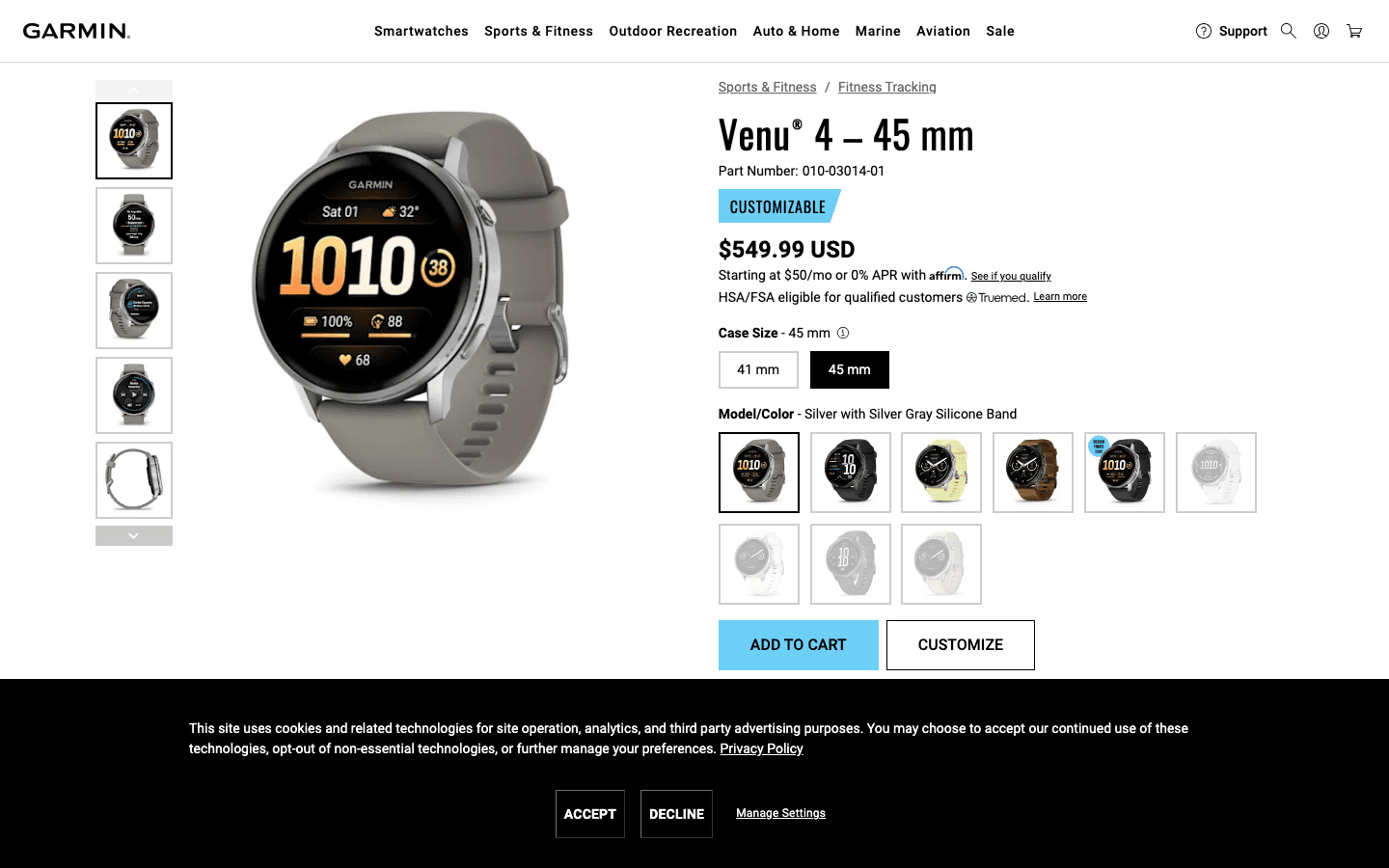
The Garmin Venu 4 is Garmin's clearest answer to the Apple Watch. It leads with a touch AMOLED display, comes in 41mm and 45mm sizes at the same price, and packs a feature list aimed at daily health monitoring rather than athletic performance.
The standout addition over the Venu 3 is the ECG app, which places the Venu 4 in a category that most Garmin watches don't reach. Pair that with nap detection, Body Battery energy tracking, menstrual cycle tracking, sleep coaching, and a built-in LED flashlight, and you have a watch designed for the version of health tracking that happens between workouts, not just during them.
The touch interface is genuinely good on the Venu 4. Two physical buttons handle back and action, and the rest is swipes and taps. For most daily use, this feels natural. For running in rain or with sweaty hands, it's less ideal, which is the one area where the Forerunner 570's button layout wins clearly.
What Works
ECG app for atrial fibrillation detection
Excellent sleep tracking with nap detection and coaching
Body Battery energy monitoring tied to sleep and HRV data
LED flashlight (not found on the Forerunner 570)
Touch interface with solid responsiveness
Phone calls, Garmin Pay, and 500+ songs onboard
Limitations
No Training Readiness score or acute/chronic load tracking
No race predictor
Touch screen becomes unreliable in rain or with gloves
No built-in maps (shared limitation with Forerunner 570)
Pricing: $549.99 for both 41mm and 45mm. The older Venu 3 is available for significantly less if you don't need the ECG or flashlight.
Garmin Forerunner 570 Overview
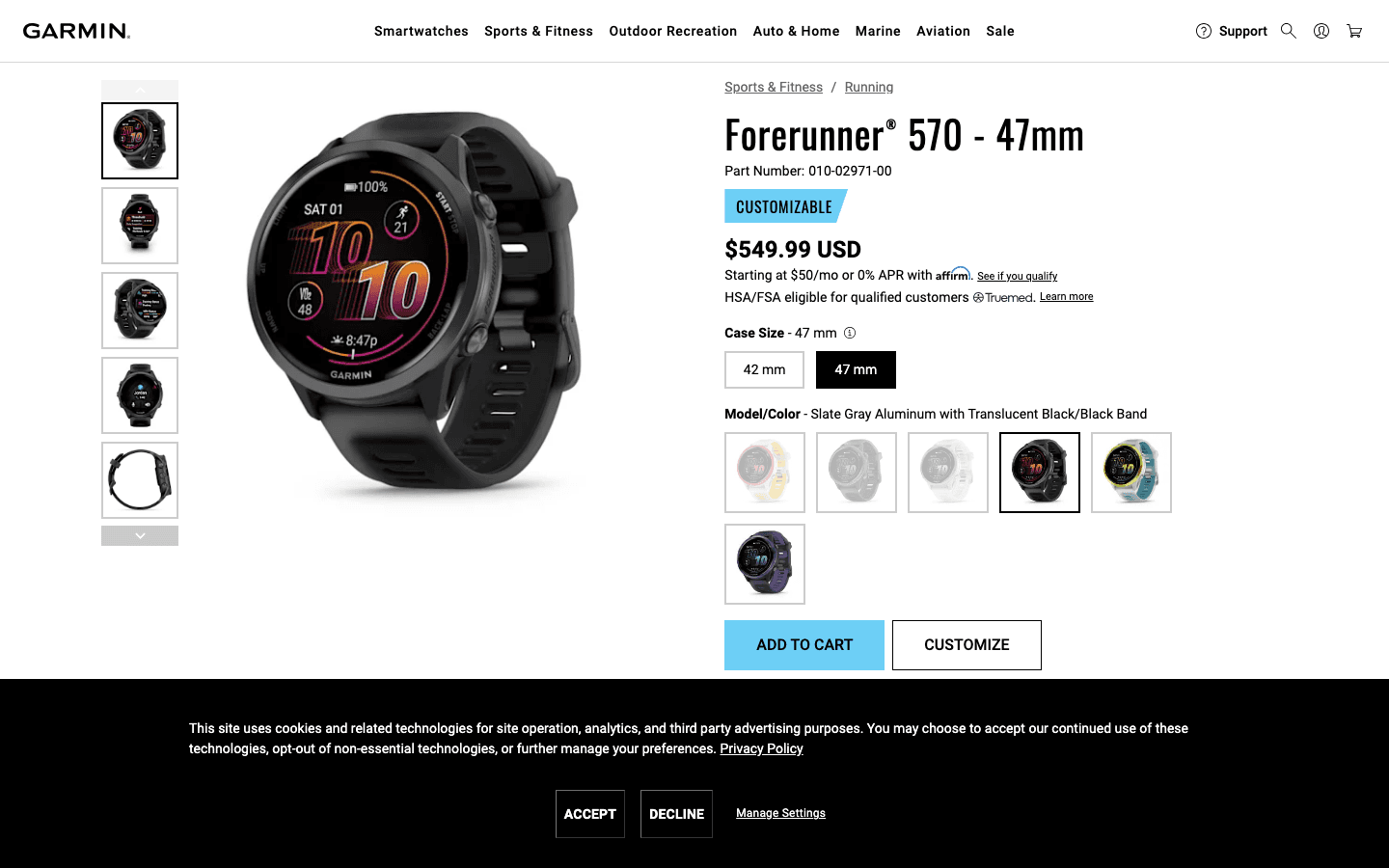
The Garmin Forerunner 570 is built for people who train with a plan. Five physical buttons (two on each side plus one at the bottom) make it possible to control the watch mid-run without breaking stride, even with gloves or wet hands. That detail tells you a lot about who this watch is for.
Where the Venu 4 adds an ECG and flashlight, the Forerunner 570 adds Training Readiness, acute and chronic load tracking, a race predictor for common distances, and advanced running dynamics. These aren't features that look impressive on a spec sheet. They're features that actually change how you train when you use them consistently. For a full breakdown, see our Forerunner 570 review.
The Forerunner 570 also has an AMOLED display, music storage, Garmin Pay, and the same Gen 5 sensor as the Venu 4. On health tracking fundamentals, the gap is smaller than the price tier used to imply.
What Works
Training Readiness score that tells you whether to push or recover
Acute/chronic training load tracking to prevent overtraining
Race predictor for 5K, 10K, half marathon, and marathon distances
Five physical buttons, reliable in any conditions
Multi-band GNSS for GPS accuracy during interval workouts in urban canyons
Strong recovery insights paired with sleep and HRV data
Limitations
No ECG app
No LED flashlight
More utilitarian design: reads clearly as a sport watch, not a lifestyle watch
No built-in maps (the Forerunner 970 adds those at a higher price)
Pricing: $549.99 for the 47mm. The older Forerunner 265 costs $449 and still offers most of the training features without the newer sensor suite.
Head-to-Head Comparison
Price: Both $549.99. No difference.
Display: Both AMOLED. Venu 4 comes in 41mm or 45mm; Forerunner 570 in 42mm or 47mm.
Battery: Venu 4 lasts 10-12 days; Forerunner 570 lasts 10-11 days. Negligible difference in practice.
Interface: Venu 4 uses touch + 2 buttons. Forerunner 570 uses 5 physical buttons. Forerunner wins for sport use; Venu wins for everyday navigation.
Training analytics: Forerunner 570 wins clearly. Training Readiness, load tracking, and race predictor are not in the Venu 4.
Health features: Venu 4 wins with ECG, nap detection, and menstrual cycle coaching. Both share Body Battery, HRV, SpO2, and sleep tracking.
GPS: Both use multi-band GNSS. No meaningful gap for most users.
Music and payments: Tied. Both carry 500+ songs and support Garmin Pay.
Flashlight: Venu 4 only.
Maps: Neither. The Forerunner 970 adds maps for $699.
Design: Venu 4 is more lifestyle-forward. Forerunner 570 is sport-first.
Which Should You Choose?
Buy the Forerunner 570 if you run more than three times a week, follow a structured training plan, care about your Training Readiness score, or race. The button interface is more reliable during workouts, and the training analytics are a real differentiator, not just a marketing bullet point. Pair it with Strava for post-run analysis and you have a genuinely powerful training setup.
Buy the Venu 4 if you work out regularly but running isn't your primary sport, you want health monitoring that covers cardiac health (ECG), or you want a watch that doesn't scream "athlete" at a work meeting. It also makes sense if you commute in the dark and actually want that flashlight. Check out our list of best apps to use with Garmin to extend either watch's capabilities.
Consider the older models if budget matters. The Forerunner 265 at $449 still offers Training Readiness and most of the training features that make the 570 compelling. The Venu 3 at around $300 is a strong everyday health watch if ECG isn't a requirement. These older models compare well against flagship options from other brands, including the Apple Watch ecosystem and fitness rings like Oura.
One More Option Worth Knowing
If you use either Garmin watch and find that your data doesn't actually change how you plan your day, Lifestack connects to Garmin and uses your Body Battery score, sleep quality, and HRV data to build a daily schedule that reflects your actual recovery state. It's a different layer from the watch itself. Instead of just showing you that your Body Battery is at 60, it adjusts your task plan to match. If you track your circadian energy patterns, check out the best circadian rhythm apps that pair well with wearable data.
Frequently Asked Questions
Is the Garmin Venu or Forerunner better for running?
The Forerunner 570 is better for running. It has Training Readiness, acute and chronic training load, a race predictor, and five physical buttons that work during a sweaty interval session or with winter gloves. The Venu 4 can track runs, but it's not built around the sport the way the Forerunner line is.
What is the main difference between Garmin Venu and Forerunner?
The Venu line prioritizes everyday health monitoring and lifestyle design. The Forerunner line prioritizes training performance and running-specific analytics. At the $549 price point (Venu 4 vs Forerunner 570), the hardware is nearly identical, but the software experience and interface design point in opposite directions.
Does the Garmin Venu have Training Readiness?
No. Training Readiness is a Forerunner and Fenix feature. The Venu 4 has Body Battery, which gives a sense of energy reserves, but it doesn't combine load, sleep, and recovery data into the structured training feedback that Training Readiness provides.
Which Garmin is better for everyday use and sleep tracking?
The Venu 4. It offers ECG, nap detection, sleep coaching, and a more lifestyle-oriented design. Both the Venu 4 and Forerunner 570 have strong sleep tracking through the Gen 5 sensor, but the Venu 4 adds more layers of health interpretation on top of the raw data.
Is the Garmin Forerunner 570 worth it over the 265?
Depends on how much the newer sensor suite matters to you. The Forerunner 265 at $449 still has Training Readiness, acute/chronic load, and a race predictor. The 570 adds the Gen 5 sensor, multi-band GNSS, a built-in speaker for calls, and a more modern design. If those additions are valuable to you, the $100 difference is justified.
Can the Garmin Venu 4 or Forerunner 570 show maps?
No, neither watch includes built-in maps. Both have GPS for breadcrumb navigation (following a saved route), but turn-by-turn mapping requires the Forerunner 970, which costs $699. If maps are essential, that's the one to look at in the Forerunner line.
The Garmin Venu and Forerunner lines have been converging for years. As of 2026, the Venu 4 and Forerunner 570 are priced identically at $549.99, share the same sensor suite, and both run on multi-band GPS. So what exactly are you choosing between?
More than you might expect. The Venu 4 is built around a touch interface and a lifestyle-forward feature set. The Forerunner 570 is built around five physical buttons and a training platform designed for runners who want data that actually improves performance. Same price. Genuinely different watches.
This comparison focuses on the current flagships. If budget is a factor, both lines also have solid older options: the Venu 3 is available for $279 to $350 and the Forerunner 265 sits at $449. We'll note where those make sense at the end.
Key Takeaways
Both the Venu 4 and Forerunner 570 cost $549.99 and share the same health sensor hardware.
The Forerunner 570 wins for runners: better training analytics, button-first interface, and a race predictor that the Venu 4 doesn't have.
The Venu 4 wins for everyone else: ECG app, LED flashlight, touch screen, and a design that doesn't look like a sport watch at a dinner table.
Quick Verdict
Garmin Venu 4: The better everyday health watch. Buy it if you want polished health tracking, an ECG, and a watch that works in both gym and office.
Garmin Forerunner 570: The better training watch. Buy it if you run with structure, track load and recovery, or race.
Garmin Venu 4 Overview
The Garmin Venu 4 is Garmin's clearest answer to the Apple Watch. It leads with a touch AMOLED display, comes in 41mm and 45mm sizes at the same price, and packs a feature list aimed at daily health monitoring rather than athletic performance.
The standout addition over the Venu 3 is the ECG app, which places the Venu 4 in a category that most Garmin watches don't reach. Pair that with nap detection, Body Battery energy tracking, menstrual cycle tracking, sleep coaching, and a built-in LED flashlight, and you have a watch designed for the version of health tracking that happens between workouts, not just during them.
The touch interface is genuinely good on the Venu 4. Two physical buttons handle back and action, and the rest is swipes and taps. For most daily use, this feels natural. For running in rain or with sweaty hands, it's less ideal, which is the one area where the Forerunner 570's button layout wins clearly.
What Works
ECG app for atrial fibrillation detection
Excellent sleep tracking with nap detection and coaching
Body Battery energy monitoring tied to sleep and HRV data
LED flashlight (not found on the Forerunner 570)
Touch interface with solid responsiveness
Phone calls, Garmin Pay, and 500+ songs onboard
Limitations
No Training Readiness score or acute/chronic load tracking
No race predictor
Touch screen becomes unreliable in rain or with gloves
No built-in maps (shared limitation with Forerunner 570)
Pricing: $549.99 for both 41mm and 45mm. The older Venu 3 is available for significantly less if you don't need the ECG or flashlight.
Garmin Forerunner 570 Overview
The Garmin Forerunner 570 is built for people who train with a plan. Five physical buttons (two on each side plus one at the bottom) make it possible to control the watch mid-run without breaking stride, even with gloves or wet hands. That detail tells you a lot about who this watch is for.
Where the Venu 4 adds an ECG and flashlight, the Forerunner 570 adds Training Readiness, acute and chronic load tracking, a race predictor for common distances, and advanced running dynamics. These aren't features that look impressive on a spec sheet. They're features that actually change how you train when you use them consistently. For a full breakdown, see our Forerunner 570 review.
The Forerunner 570 also has an AMOLED display, music storage, Garmin Pay, and the same Gen 5 sensor as the Venu 4. On health tracking fundamentals, the gap is smaller than the price tier used to imply.
What Works
Training Readiness score that tells you whether to push or recover
Acute/chronic training load tracking to prevent overtraining
Race predictor for 5K, 10K, half marathon, and marathon distances
Five physical buttons, reliable in any conditions
Multi-band GNSS for GPS accuracy during interval workouts in urban canyons
Strong recovery insights paired with sleep and HRV data
Limitations
No ECG app
No LED flashlight
More utilitarian design: reads clearly as a sport watch, not a lifestyle watch
No built-in maps (the Forerunner 970 adds those at a higher price)
Pricing: $549.99 for the 47mm. The older Forerunner 265 costs $449 and still offers most of the training features without the newer sensor suite.
Head-to-Head Comparison
Price: Both $549.99. No difference.
Display: Both AMOLED. Venu 4 comes in 41mm or 45mm; Forerunner 570 in 42mm or 47mm.
Battery: Venu 4 lasts 10-12 days; Forerunner 570 lasts 10-11 days. Negligible difference in practice.
Interface: Venu 4 uses touch + 2 buttons. Forerunner 570 uses 5 physical buttons. Forerunner wins for sport use; Venu wins for everyday navigation.
Training analytics: Forerunner 570 wins clearly. Training Readiness, load tracking, and race predictor are not in the Venu 4.
Health features: Venu 4 wins with ECG, nap detection, and menstrual cycle coaching. Both share Body Battery, HRV, SpO2, and sleep tracking.
GPS: Both use multi-band GNSS. No meaningful gap for most users.
Music and payments: Tied. Both carry 500+ songs and support Garmin Pay.
Flashlight: Venu 4 only.
Maps: Neither. The Forerunner 970 adds maps for $699.
Design: Venu 4 is more lifestyle-forward. Forerunner 570 is sport-first.
Which Should You Choose?
Buy the Forerunner 570 if you run more than three times a week, follow a structured training plan, care about your Training Readiness score, or race. The button interface is more reliable during workouts, and the training analytics are a real differentiator, not just a marketing bullet point. Pair it with Strava for post-run analysis and you have a genuinely powerful training setup.
Buy the Venu 4 if you work out regularly but running isn't your primary sport, you want health monitoring that covers cardiac health (ECG), or you want a watch that doesn't scream "athlete" at a work meeting. It also makes sense if you commute in the dark and actually want that flashlight. Check out our list of best apps to use with Garmin to extend either watch's capabilities.
Consider the older models if budget matters. The Forerunner 265 at $449 still offers Training Readiness and most of the training features that make the 570 compelling. The Venu 3 at around $300 is a strong everyday health watch if ECG isn't a requirement. These older models compare well against flagship options from other brands, including the Apple Watch ecosystem and fitness rings like Oura.
One More Option Worth Knowing
If you use either Garmin watch and find that your data doesn't actually change how you plan your day, Lifestack connects to Garmin and uses your Body Battery score, sleep quality, and HRV data to build a daily schedule that reflects your actual recovery state. It's a different layer from the watch itself. Instead of just showing you that your Body Battery is at 60, it adjusts your task plan to match. If you track your circadian energy patterns, check out the best circadian rhythm apps that pair well with wearable data.
Frequently Asked Questions
Is the Garmin Venu or Forerunner better for running?
The Forerunner 570 is better for running. It has Training Readiness, acute and chronic training load, a race predictor, and five physical buttons that work during a sweaty interval session or with winter gloves. The Venu 4 can track runs, but it's not built around the sport the way the Forerunner line is.
What is the main difference between Garmin Venu and Forerunner?
The Venu line prioritizes everyday health monitoring and lifestyle design. The Forerunner line prioritizes training performance and running-specific analytics. At the $549 price point (Venu 4 vs Forerunner 570), the hardware is nearly identical, but the software experience and interface design point in opposite directions.
Does the Garmin Venu have Training Readiness?
No. Training Readiness is a Forerunner and Fenix feature. The Venu 4 has Body Battery, which gives a sense of energy reserves, but it doesn't combine load, sleep, and recovery data into the structured training feedback that Training Readiness provides.
Which Garmin is better for everyday use and sleep tracking?
The Venu 4. It offers ECG, nap detection, sleep coaching, and a more lifestyle-oriented design. Both the Venu 4 and Forerunner 570 have strong sleep tracking through the Gen 5 sensor, but the Venu 4 adds more layers of health interpretation on top of the raw data.
Is the Garmin Forerunner 570 worth it over the 265?
Depends on how much the newer sensor suite matters to you. The Forerunner 265 at $449 still has Training Readiness, acute/chronic load, and a race predictor. The 570 adds the Gen 5 sensor, multi-band GNSS, a built-in speaker for calls, and a more modern design. If those additions are valuable to you, the $100 difference is justified.
Can the Garmin Venu 4 or Forerunner 570 show maps?
No, neither watch includes built-in maps. Both have GPS for breadcrumb navigation (following a saved route), but turn-by-turn mapping requires the Forerunner 970, which costs $699. If maps are essential, that's the one to look at in the Forerunner line.



FOLLOW ON
FOLLOW ON
FOLLOW ON


Copyright 2026 © Lifestack. All rights reserved
Copyright 2026 © Lifestack. All rights reserved

