
Tips
How to Be a Team Player: 8 Qualities That Matter
How to Be a Team Player: 8 Qualities That Matter

Being a team player is one of those phrases that shows up in every job description and performance review, yet rarely gets defined with any precision. It tends to mean "easy to work with" or "does not make things difficult," which is not especially useful if you are trying to actually become one.
The qualities that genuinely make someone a great collaborator go deeper than attitude. They are behaviors: specific, learnable patterns of communication, reliability, and judgment that teams depend on to function at a high level. Some people develop these naturally. Most have to work at them deliberately.
This guide covers 8 qualities that separate good team players from average ones, with practical strategies for building each. Whether you are onboarding at a new company, trying to improve how you work with a particular team, or building your organizational skills more broadly, these are the areas that pay off most.
Key Takeaways
Being a team player is about consistent, observable behaviors rather than general attitude or willingness
Proactive communication prevents more problems than reactive problem-solving
Aligning your personal work to shared team goals is what separates collaborative contributors from independent operators
Quality 1: Listen More Than You Talk
Active listening is the foundation of most other collaboration skills. You cannot give useful feedback without understanding what someone actually said. You cannot resolve disagreements without hearing the other person's position clearly. You cannot coordinate work without absorbing the full context of a request.
Active listening is not passive silence while waiting to speak. It involves asking clarifying questions, reflecting back what you heard, and resisting the urge to formulate your response while the other person is still talking. Most people are significantly worse at this than they think.
A simple practice: before responding to any substantive message or in a meeting, spend one sentence summarizing what you just heard before adding your own perspective. This catches misunderstandings early and signals to your colleagues that you are genuinely engaged with what they said.
Quality 2: Own Your Commitments Completely
The single biggest trust signal in a team context is whether people can rely on you to do what you said you would do, by when you said you would do it. Not some of the time. Consistently.
This is harder than it sounds because most workplaces generate more commitments than any individual can realistically fulfill. The mistake is saying yes to everything and then delivering inconsistently. The better approach is being selective about commitments and then treating each one as non-negotiable once made.
When you cannot deliver on time, the team player move is to communicate early, not at deadline. "I'm not going to make Thursday, I can have this to you by Monday" is far more useful to a teammate than a Thursday email saying it will be late. Early warning lets people plan around the gap. Late warning creates emergencies.
Quality 3: Communicate Proactively, Not Reactively
Reactive communication is answering questions when asked. Proactive communication is sharing information before someone has to ask for it. The gap between the two is one of the clearest markers of collaborative maturity.
If you hit a blocker on a project, proactive communication means flagging it to the relevant person as soon as you know, not after it has delayed the timeline. If your estimate turns out to be wrong, proactive communication means updating stakeholders before they notice the discrepancy. If context changes that affects someone else's work, proactive communication means telling them immediately.
Teams that operate reactively spend a lot of time on coordination overhead, discovery, and catching up. Teams that operate proactively spend that same time on actual work. The individual habit that shifts the entire team culture is each person choosing to over-communicate on what matters, rather than waiting to be asked.
Quality 4: Align Your Work to Shared Goals
Individual contributors who are technically excellent but operate in isolation are often frustrating to work with. They deliver great work on their own terms, but it does not always connect to what the team actually needs. Being a team player means regularly checking that your effort is pointed in the same direction as everyone else's.
This requires knowing what the shared goals actually are, which is not always obvious. Make it a habit to ask at the start of projects: what are we trying to achieve, and how does my piece connect to that? At the start of each week, check whether your planned tasks feed the team's current priorities or whether you are working on something that was more important last month.
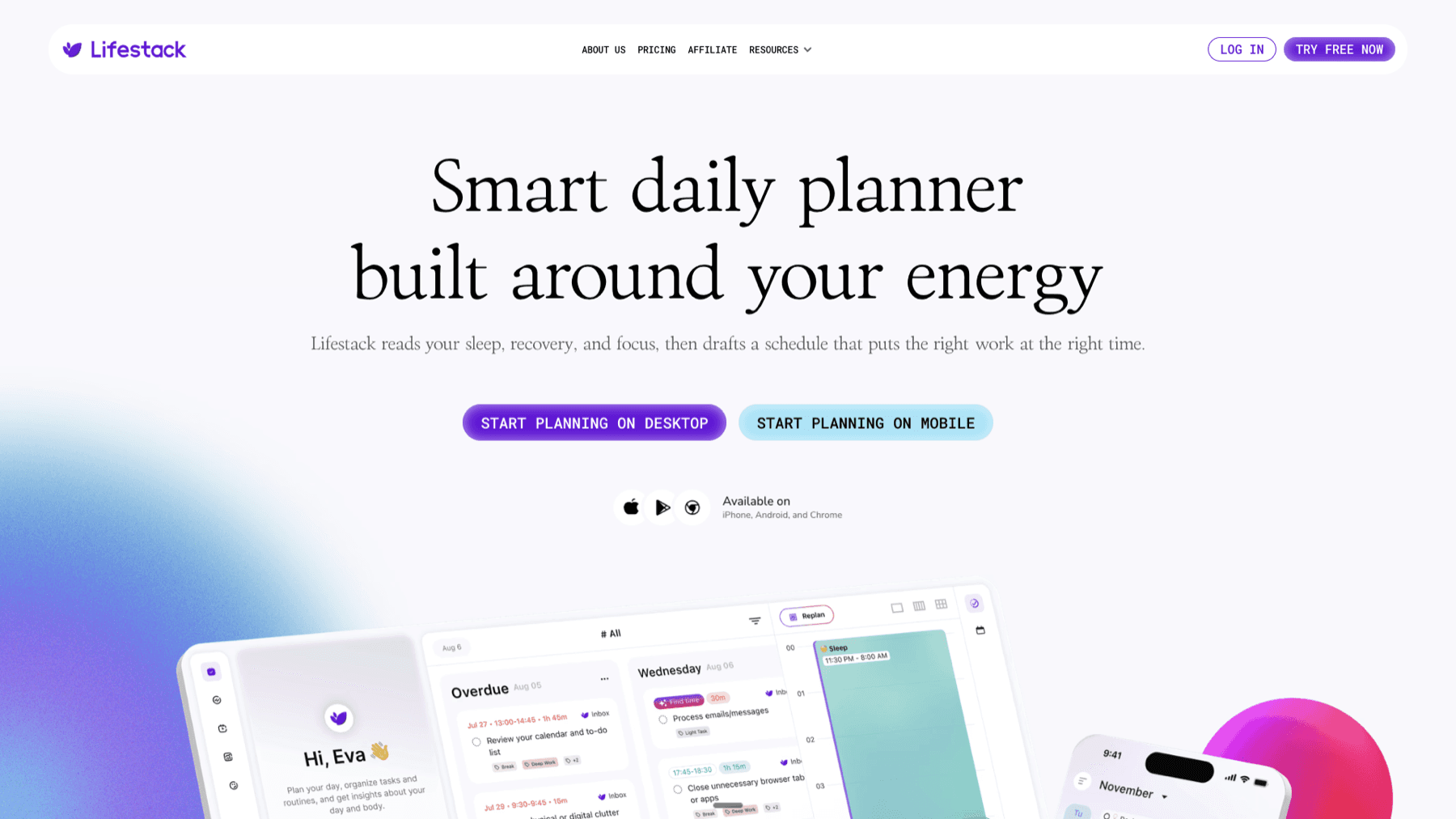
Tools that help here include daily planner apps that let you see your week's commitments at a glance alongside team deliverables. Lifestack takes this further by intelligently scheduling your individual tasks based on your energy levels, helping you ensure that your contribution to shared goals happens during your best cognitive hours rather than being squeezed into low-energy windows.
Quality 5: Adapt When Plans Change
Plans change in every team, all the time. Projects get reprioritized. Scope shifts. People move between roles. The team players who add the most value are those who adapt without becoming a source of additional friction in the process.
Adaptation does not mean accepting every change silently. It means processing changes constructively: asking questions about the new direction, flagging dependencies that the change affects, and adjusting your own work plan without requiring the team to manage your emotional response to the shift.
A visual calendar planner makes adaptation faster because you can see immediately which commitments the change affects and reschedule accordingly. The time between "plan changes" and "new plan is running" should be as short as possible. Slow adaptation is its own form of friction.
Quality 6: Give and Receive Feedback Well
Teams that cannot give each other honest feedback operate in a fog. Problems persist because nobody names them. Work quality stays flat because people never learn where their blind spots are. The team players who accelerate team performance are those who create conditions where feedback flows freely in both directions.
Giving feedback well means being specific, timely, and focused on behavior rather than character. "This section of the report is hard to follow, can we talk about restructuring it?" is useful. "This is unclear" is not. "You always do this" is counterproductive.
Receiving feedback well is the harder skill. It means not immediately defending yourself, asking clarifying questions to understand the concern fully, and genuinely considering whether the feedback is valid before deciding how to respond. People who receive feedback gracefully tend to get more of it, which makes them faster learners than those who make giving feedback feel costly.
Quality 7: Build Trust Through Consistency
Trust on teams is built through repetition, not grand gestures. Each small kept commitment, each time you communicate proactively, each time you follow through on what you said, deposits into the trust account. Each missed deadline, each dropped ball, each surprise at deadline day makes a withdrawal.
The compounding effect works in both directions. Highly trusted team members get more autonomy, more responsibility, and more interesting work. Unreliable team members get managed more closely, which limits their growth and makes their work less satisfying.
Consistency is also where good task management habits pay off indirectly. When you have a reliable system for tracking your commitments and your deadlines, you miss fewer of them. The consistency that others experience as trustworthy is often just well-managed internal organization that nobody else sees.
Quality 8: Support Others' Success, Not Just Your Own
The last quality that separates good team players from great ones is generosity with credit, attention, and help. People who are visibly focused only on their own performance metrics, who claim credit for collaborative work, or who are unwilling to help unless it directly benefits them, are noticed. So are the people who do the opposite.
Practically, this looks like: giving credit to collaborators in public forums, volunteering to help a teammate who is blocked even when it is not your job, surfacing others' good work to leadership, and asking "what do you need?" before diving into your own priorities during team crunches.
None of this requires sacrificing your own output. It requires being aware that team success and individual success are more connected than they appear, and acting accordingly.
Best Tool for Being a More Effective Team Player
A lot of what makes someone a reliable team player comes down to personal organization: knowing what you have committed to, when things are due, and whether your current energy matches what the work requires. Lifestack addresses all three.
It reads your sleep and recovery data from wearables, scores your daily energy, and schedules tasks accordingly. When you have a high-stakes deliverable for a teammate, it will make sure that work lands in your best cognitive window, not in the mid-afternoon trough when you are running on fumes. That kind of energy-aware planning translates directly into more consistent output quality, which is what makes you reliably useful to the people you work with.
Pricing starts at $7/month or $50/year, with a free trial on the annual plan. If you use an AI planner to manage your commitments already, Lifestack layers in the energy dimension that most planning tools miss.
FAQ
What does it mean to be a team player at work?
Being a team player means consistently behaving in ways that make the team more effective: communicating proactively, keeping your commitments, aligning your work to shared goals, giving honest feedback, and supporting your colleagues' success alongside your own. It is a pattern of behavior, not a personality type.
Can you be a team player and still be assertive?
Yes. Being a team player does not mean being agreeable or deferential. The best collaborators are often the ones who push back on bad ideas, flag risks early, and say no when they are at capacity. Assertiveness in service of team outcomes is one of the more valuable qualities a team player can have.
How do you become a better team player if you naturally prefer working alone?
Start with the behaviors that do not require changing your preference for solo work: over-communicate on your status, keep your commitments, and surface blockers early. These are coordination behaviors that happen around your solo work, not instead of it. Over time, the trust you build through reliability creates more room for the kind of independent contribution that suits your working style.
What is the difference between a team player and someone who just agrees with everything?
A team player is invested in the team's outcomes and will disagree, push back, or raise concerns when they see something that could hurt those outcomes. Someone who just agrees with everything is optimizing for social comfort, not team success. These look different in practice: the team player who voices concerns is contributing. The conflict-avoider who stays silent is not.
How does task management help you be a better team player?
When your commitments are tracked and visible to you, you are less likely to over-commit, miss deadlines, or drop things that matter to teammates. Good task management creates the reliability that team trust is built on. It also makes it easier to communicate proactively, because you can see in advance when something is at risk rather than discovering it at deadline.
Being a team player is one of those phrases that shows up in every job description and performance review, yet rarely gets defined with any precision. It tends to mean "easy to work with" or "does not make things difficult," which is not especially useful if you are trying to actually become one.
The qualities that genuinely make someone a great collaborator go deeper than attitude. They are behaviors: specific, learnable patterns of communication, reliability, and judgment that teams depend on to function at a high level. Some people develop these naturally. Most have to work at them deliberately.
This guide covers 8 qualities that separate good team players from average ones, with practical strategies for building each. Whether you are onboarding at a new company, trying to improve how you work with a particular team, or building your organizational skills more broadly, these are the areas that pay off most.
Key Takeaways
Being a team player is about consistent, observable behaviors rather than general attitude or willingness
Proactive communication prevents more problems than reactive problem-solving
Aligning your personal work to shared team goals is what separates collaborative contributors from independent operators
Quality 1: Listen More Than You Talk
Active listening is the foundation of most other collaboration skills. You cannot give useful feedback without understanding what someone actually said. You cannot resolve disagreements without hearing the other person's position clearly. You cannot coordinate work without absorbing the full context of a request.
Active listening is not passive silence while waiting to speak. It involves asking clarifying questions, reflecting back what you heard, and resisting the urge to formulate your response while the other person is still talking. Most people are significantly worse at this than they think.
A simple practice: before responding to any substantive message or in a meeting, spend one sentence summarizing what you just heard before adding your own perspective. This catches misunderstandings early and signals to your colleagues that you are genuinely engaged with what they said.
Quality 2: Own Your Commitments Completely
The single biggest trust signal in a team context is whether people can rely on you to do what you said you would do, by when you said you would do it. Not some of the time. Consistently.
This is harder than it sounds because most workplaces generate more commitments than any individual can realistically fulfill. The mistake is saying yes to everything and then delivering inconsistently. The better approach is being selective about commitments and then treating each one as non-negotiable once made.
When you cannot deliver on time, the team player move is to communicate early, not at deadline. "I'm not going to make Thursday, I can have this to you by Monday" is far more useful to a teammate than a Thursday email saying it will be late. Early warning lets people plan around the gap. Late warning creates emergencies.
Quality 3: Communicate Proactively, Not Reactively
Reactive communication is answering questions when asked. Proactive communication is sharing information before someone has to ask for it. The gap between the two is one of the clearest markers of collaborative maturity.
If you hit a blocker on a project, proactive communication means flagging it to the relevant person as soon as you know, not after it has delayed the timeline. If your estimate turns out to be wrong, proactive communication means updating stakeholders before they notice the discrepancy. If context changes that affects someone else's work, proactive communication means telling them immediately.
Teams that operate reactively spend a lot of time on coordination overhead, discovery, and catching up. Teams that operate proactively spend that same time on actual work. The individual habit that shifts the entire team culture is each person choosing to over-communicate on what matters, rather than waiting to be asked.
Quality 4: Align Your Work to Shared Goals
Individual contributors who are technically excellent but operate in isolation are often frustrating to work with. They deliver great work on their own terms, but it does not always connect to what the team actually needs. Being a team player means regularly checking that your effort is pointed in the same direction as everyone else's.
This requires knowing what the shared goals actually are, which is not always obvious. Make it a habit to ask at the start of projects: what are we trying to achieve, and how does my piece connect to that? At the start of each week, check whether your planned tasks feed the team's current priorities or whether you are working on something that was more important last month.
Tools that help here include daily planner apps that let you see your week's commitments at a glance alongside team deliverables. Lifestack takes this further by intelligently scheduling your individual tasks based on your energy levels, helping you ensure that your contribution to shared goals happens during your best cognitive hours rather than being squeezed into low-energy windows.
Quality 5: Adapt When Plans Change
Plans change in every team, all the time. Projects get reprioritized. Scope shifts. People move between roles. The team players who add the most value are those who adapt without becoming a source of additional friction in the process.
Adaptation does not mean accepting every change silently. It means processing changes constructively: asking questions about the new direction, flagging dependencies that the change affects, and adjusting your own work plan without requiring the team to manage your emotional response to the shift.
A visual calendar planner makes adaptation faster because you can see immediately which commitments the change affects and reschedule accordingly. The time between "plan changes" and "new plan is running" should be as short as possible. Slow adaptation is its own form of friction.
Quality 6: Give and Receive Feedback Well
Teams that cannot give each other honest feedback operate in a fog. Problems persist because nobody names them. Work quality stays flat because people never learn where their blind spots are. The team players who accelerate team performance are those who create conditions where feedback flows freely in both directions.
Giving feedback well means being specific, timely, and focused on behavior rather than character. "This section of the report is hard to follow, can we talk about restructuring it?" is useful. "This is unclear" is not. "You always do this" is counterproductive.
Receiving feedback well is the harder skill. It means not immediately defending yourself, asking clarifying questions to understand the concern fully, and genuinely considering whether the feedback is valid before deciding how to respond. People who receive feedback gracefully tend to get more of it, which makes them faster learners than those who make giving feedback feel costly.
Quality 7: Build Trust Through Consistency
Trust on teams is built through repetition, not grand gestures. Each small kept commitment, each time you communicate proactively, each time you follow through on what you said, deposits into the trust account. Each missed deadline, each dropped ball, each surprise at deadline day makes a withdrawal.
The compounding effect works in both directions. Highly trusted team members get more autonomy, more responsibility, and more interesting work. Unreliable team members get managed more closely, which limits their growth and makes their work less satisfying.
Consistency is also where good task management habits pay off indirectly. When you have a reliable system for tracking your commitments and your deadlines, you miss fewer of them. The consistency that others experience as trustworthy is often just well-managed internal organization that nobody else sees.
Quality 8: Support Others' Success, Not Just Your Own
The last quality that separates good team players from great ones is generosity with credit, attention, and help. People who are visibly focused only on their own performance metrics, who claim credit for collaborative work, or who are unwilling to help unless it directly benefits them, are noticed. So are the people who do the opposite.
Practically, this looks like: giving credit to collaborators in public forums, volunteering to help a teammate who is blocked even when it is not your job, surfacing others' good work to leadership, and asking "what do you need?" before diving into your own priorities during team crunches.
None of this requires sacrificing your own output. It requires being aware that team success and individual success are more connected than they appear, and acting accordingly.
Best Tool for Being a More Effective Team Player
A lot of what makes someone a reliable team player comes down to personal organization: knowing what you have committed to, when things are due, and whether your current energy matches what the work requires. Lifestack addresses all three.
It reads your sleep and recovery data from wearables, scores your daily energy, and schedules tasks accordingly. When you have a high-stakes deliverable for a teammate, it will make sure that work lands in your best cognitive window, not in the mid-afternoon trough when you are running on fumes. That kind of energy-aware planning translates directly into more consistent output quality, which is what makes you reliably useful to the people you work with.
Pricing starts at $7/month or $50/year, with a free trial on the annual plan. If you use an AI planner to manage your commitments already, Lifestack layers in the energy dimension that most planning tools miss.
FAQ
What does it mean to be a team player at work?
Being a team player means consistently behaving in ways that make the team more effective: communicating proactively, keeping your commitments, aligning your work to shared goals, giving honest feedback, and supporting your colleagues' success alongside your own. It is a pattern of behavior, not a personality type.
Can you be a team player and still be assertive?
Yes. Being a team player does not mean being agreeable or deferential. The best collaborators are often the ones who push back on bad ideas, flag risks early, and say no when they are at capacity. Assertiveness in service of team outcomes is one of the more valuable qualities a team player can have.
How do you become a better team player if you naturally prefer working alone?
Start with the behaviors that do not require changing your preference for solo work: over-communicate on your status, keep your commitments, and surface blockers early. These are coordination behaviors that happen around your solo work, not instead of it. Over time, the trust you build through reliability creates more room for the kind of independent contribution that suits your working style.
What is the difference between a team player and someone who just agrees with everything?
A team player is invested in the team's outcomes and will disagree, push back, or raise concerns when they see something that could hurt those outcomes. Someone who just agrees with everything is optimizing for social comfort, not team success. These look different in practice: the team player who voices concerns is contributing. The conflict-avoider who stays silent is not.
How does task management help you be a better team player?
When your commitments are tracked and visible to you, you are less likely to over-commit, miss deadlines, or drop things that matter to teammates. Good task management creates the reliability that team trust is built on. It also makes it easier to communicate proactively, because you can see in advance when something is at risk rather than discovering it at deadline.



FOLLOW ON
FOLLOW ON
FOLLOW ON


Copyright 2026 © Lifestack. All rights reserved
Copyright 2026 © Lifestack. All rights reserved

