
App
SleepScore App Review: Is It Worth $60/Year?
SleepScore App Review: Is It Worth $60/Year?

Almost every sleep tracker requires you to wear something. A ring, a wrist band, a chest strap. SleepScore takes a different approach: place your phone on the nightstand, and the app uses your speaker and microphone to track sleep stages with sonar. No contact required. The sound waves are inaudible, typically between 18 and 20 kHz, above the range of human hearing, and the reflections coming back from your body as you breathe and move are what the app analyzes.
The tech was developed by ResMed, the healthcare company behind many clinical sleep monitoring products, and SleepScore Labs has published 14 peer-reviewed papers validating accuracy against polysomnography, the gold standard clinical sleep study. For people who dislike wearing devices to bed, or who have found wrist-worn trackers uncomfortable or inaccurate for them specifically, that's a meaningful alternative.
The app is free to download with basic features. The premium subscription unlocks historical data, doctor-printable reports, and in-depth coaching at $9.99 per month or $59.99 per year. Here's what the SleepScore app actually delivers at each tier and who it's best suited for.
Key Takeaways
The contactless sonar approach is genuinely unique: no wearable, no contact, validated by clinical research against polysomnography in published studies
The free version provides functional sleep stage tracking, smart alarm, and basic coaching, covering most needs for casual sleep monitoring
Premium at $59.99 per year adds historical analysis and doctor reports, worth it mainly for people tracking a specific sleep concern over weeks or months
How SleepScore Works

SleepScore's sonar technology works by emitting a continuous, inaudible sound signal from your phone's speaker. As you breathe, move, and shift sleep stages throughout the night, your body reflects the sound waves differently. The microphone captures these reflections and the algorithm analyzes the patterns to estimate breathing rate, body movement, and sleep stage transitions.
The phone should sit on your nightstand at roughly chest height, 1.5 to 3 feet from where you sleep. The app works for one person at a time: if you share a bed with a partner, their movements can introduce noise into the signal and reduce accuracy. Environmental noise from fans, air conditioning, pets, or traffic can also affect readings, though the algorithm has been trained to filter out common background sounds.
Compared to a wrist-worn tracker, SleepScore captures a different type of signal. Wrist devices measure heart rate and motion directly from your body. SleepScore measures movement and respiration from across the room, which has different accuracy characteristics for different metrics. HRV, skin temperature, and heart rate are not available in SleepScore because the sonar can't measure them at a distance. What it does measure, sleep stages based on breathing and movement patterns, it does with clinical validation behind it.
Sleep Tracking Features
SleepScore's core output is a SleepScore number (0-100) that reflects your night's quality based on multiple factors: time in each sleep stage, total sleep time, sleep efficiency, and how closely the night matched your targets. You also get a breakdown of how much time you spent in light, deep, and REM sleep, along with the number of times you woke up during the night.
The sleep stage detection distinguishes between four stages: light, deep (slow-wave), REM, and awake. For anyone working to improve their restorative sleep quality specifically, tracking how much time you spend in deep sleep versus light sleep provides more actionable information than total sleep time alone. Deep sleep is where physical recovery and memory consolidation happen. Most people don't get as much as they need, and trending this metric over weeks reveals whether behavioral changes are actually moving the needle.
Smart Alarm
SleepScore's smart alarm attempts to wake you during a lighter sleep stage within a window you define. Set a 6:00 AM alarm with a 20-minute window, and the app will trigger the alarm anywhere between 5:40 and 6:00 AM when you're in a lighter sleep phase, reducing the grogginess of being woken from deep sleep.
The smart alarm concept is well-established in sleep science: waking from light sleep feels dramatically different than waking from deep sleep. Whether this application is worth $60 per year on its own is debatable, but as part of a broader sleep improvement toolkit, it's a practical addition. For people who consistently wake feeling groggy regardless of how many hours they slept, the question of whether sleep duration is the real variable often gets answered once they start tracking which stage they're waking from.
Sleep Improvement Tools
Beyond tracking, SleepScore includes a library of sleep sounds, guided relaxation content, and personalized coaching recommendations. The coaching is data-driven: based on your tracked sleep patterns, the app identifies specific habits or behaviors likely contributing to poor sleep quality and suggests targeted changes.
For people investigating possible sleep disorder indicators, SleepScore includes validated screening tools that can flag patterns associated with insomnia, sleep apnea, or other conditions. These aren't diagnostic, and the app explicitly recommends consulting a healthcare provider for anything concerning. But having a screening tool that uses your actual sleep data, rather than just a questionnaire, provides more context when you do seek medical advice. The doctor-printable reports (premium feature) are specifically designed to bring tracked data into a clinical conversation.
What Works Well
Zero friction to start. Download the app, place your phone on the nightstand, set your bedtime and wake target, and the tracking begins. There's no device to charge, no ring to size, no band to adjust. For people who've tried smart rings or wrist trackers and found them physically distracting or uncomfortable at night, this is the practical alternative.
The free tier is genuinely functional. You get nightly sleep stage tracking, a SleepScore number, smart alarm access, and basic sleep recommendations without paying anything. The free tier of SleepScore is more complete than many apps' paid tiers, and it covers the needs of casual sleep trackers who just want to understand their patterns. If you're looking for free sleep apps without a subscription, SleepScore's free version is one of the more capable options available.
The clinical validation is real. Published peer-reviewed research comparing SleepScore to polysomnography exists and is accessible. For health-conscious buyers who scrutinize accuracy claims, this is a meaningful differentiator over apps that market "advanced sleep tracking" without scientific backing.
Where It Falls Short
No HRV, no heart rate, no skin temperature. If you want the biometric data that wearables provide, SleepScore simply can't deliver it. For recovery tracking, stress monitoring, or circadian rhythm analysis tied to heart rate variability, you need a device on your body. Circadian rhythm apps that integrate HRV data tell a different and often more complete story than sonar-based tracking alone can.
Multi-sleeper accuracy is limited. Partners, pets, and even loud environmental noise can introduce enough signal interference to reduce reading quality. Some users who share a bed with a restless sleeper or a dog report erratic nightly scores that don't match how they actually slept.
The app has received some recent user complaints about reliability: crashes, alarm issues, and occasional data loss on certain Android devices. The iOS experience is generally more stable, but it's worth noting before switching from a reliable existing tracker.
SleepScore Pricing
Free: Sleep stage tracking, SleepScore number, smart alarm, basic recommendations, 7-day history
Premium Monthly: $9.99 per month
Premium Annual: $59.99 per year (best value, roughly $5 per month)
Trial: 7-day free trial for both premium plans
Premium adds full historical data access, doctor-printable sleep reports, detailed weekly analytics, and in-depth sleep improvement guidance. For casual users, the free tier is sufficient. Premium is worth it if you're tracking a specific sleep issue over weeks or months and want the historical trends and doctor-ready documentation that support a clinical conversation about sleep restriction therapy or a sleep concern.
Turning Sleep Data into Better Days
SleepScore gives you morning data on how you slept. The next question is whether that information actually changes how you spend your day. A 74 SleepScore on a Monday morning tells you something about your recovery, but only if your schedule can flex around it.
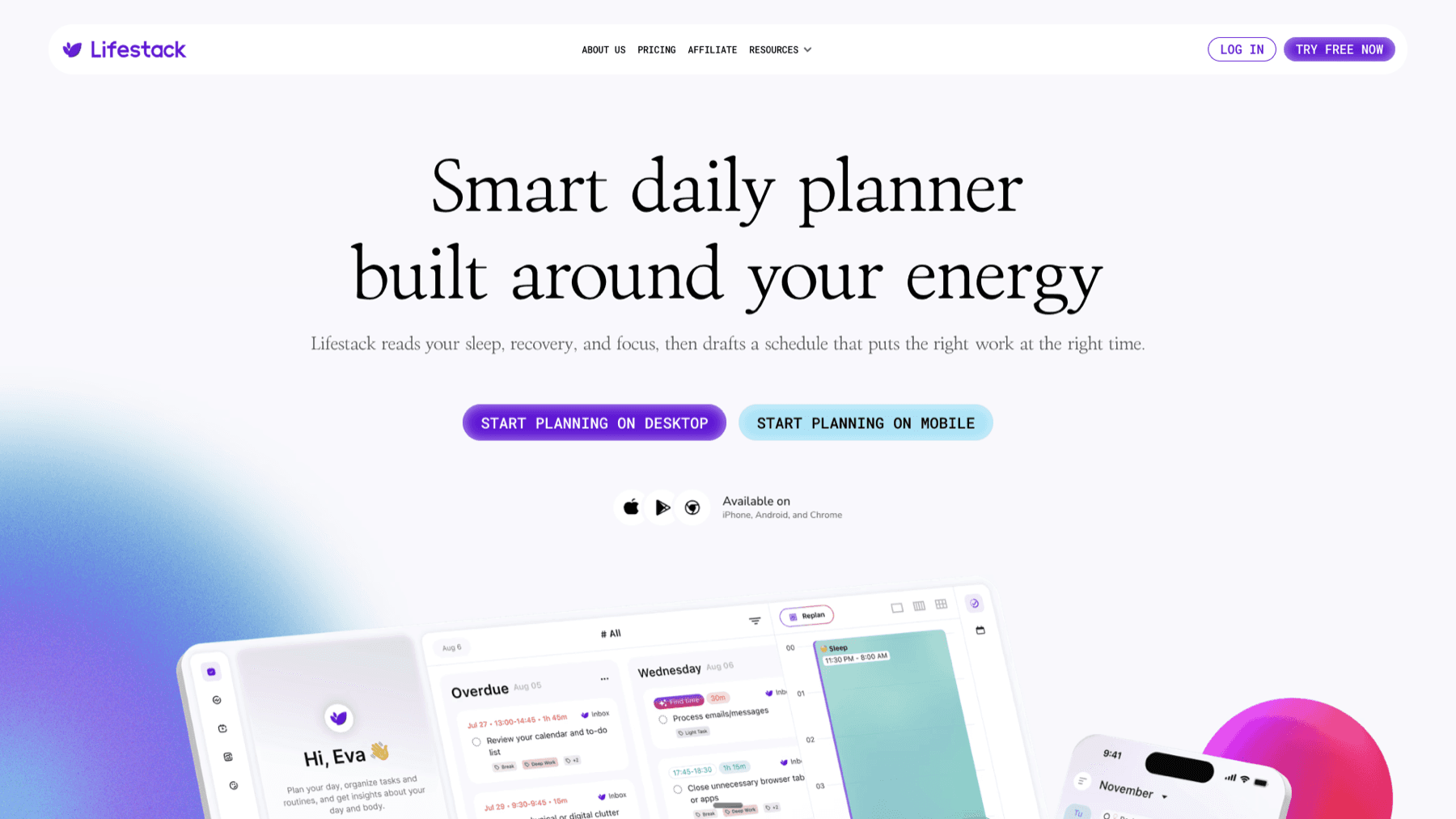
Lifestack is an AI scheduler designed around exactly this problem. Rather than treating all hours as equal, Lifestack maps cognitively demanding work to your high-energy windows and routes lighter tasks to your natural dip periods. Sleep data from apps like SleepScore informs your energy patterns over time: nights with low deep sleep ratios tend to produce lower-energy mornings, and Lifestack's scheduling adapts to those patterns rather than ignoring them. The combination of tracking what your sleep actually produces and scheduling your day around the resulting energy is closer to how high-performing individuals approach their time than a standard calendar allows.
Who Should Use SleepScore
Wearable-averse sleepers: If rings, bands, or any on-body device disrupts your sleep, SleepScore's contactless approach removes the hardware burden entirely
Science-motivated users: The clinical validation behind SleepScore's technology matters if you're skeptical of consumer sleep tracking claims. The published research is real and accessible
People investigating sleep disorders: The validated screening tools and doctor-printable reports (premium) are more useful for clinical conversations than most consumer sleep apps provide
Free-tier-first evaluators: The free version is genuinely capable. Try it for 30 days before deciding whether premium adds enough value for your specific use case
SleepScore is a harder fit if you share a bed with a restless partner, if HRV and heart rate data are important to your health tracking, or if you want continuous daytime monitoring. For those needs, a wearable ring or wrist band delivers data that sonar-based tracking cannot.
Frequently Asked Questions
Is SleepScore accurate?
SleepScore's sonar technology has been validated in 14 published peer-reviewed studies comparing it to polysomnography, the clinical gold standard for sleep analysis. Consumer accuracy for sleep staging is solid for single-person use in a relatively quiet environment. Accuracy decreases with a bed partner or significant environmental noise. It is not medical-grade diagnostic equipment, but its clinical validation is stronger than most consumer sleep apps.
Is the SleepScore free version good enough?
For most casual users, yes. The free version provides nightly sleep stage tracking, a SleepScore number, smart alarm access, and 7 days of history. Upgrade to premium if you want complete historical trends, doctor-printable reports, or deeper analytics for tracking a specific sleep concern over months. The 7-day premium trial lets you experience the difference before committing.
Does SleepScore work with two people in a bed?
Not reliably. The sonar tracks one person at a time, and a restless bed partner's movement can interfere with the signal path and reduce accuracy. Some couples solve this by placing the phone closer to one side of the bed, but the signal quality depends on having a relatively clear path between the phone and the person being tracked.
Does SleepScore track HRV?
No. Sonar-based tracking captures breathing rate and body movement but cannot measure heart rate variability, resting heart rate, or SpO2 at a distance. If HRV tracking is important for your recovery monitoring, a wearable ring or wrist device is required.
How is SleepScore different from other sleep apps?
The sonar technology is the primary differentiator. Most sleep apps either require a connected wearable or use phone accelerometer data (motion detection) to estimate sleep. SleepScore's sonar measures breathing patterns at a distance, which provides a different and in many cases more accurate sleep stage signal than accelerometer-only approaches. The clinical validation behind this method is also more extensive than most competitors.
Is SleepScore still being developed?
SleepScore Labs, now operating under the Sleep.ai brand, continues to develop the app and publish research. ResMed, the healthcare technology company backing SleepScore, remains actively involved. The app receives regular updates. Some recent user reviews on Google Play have flagged bugs on certain Android configurations, so check current reviews for your specific device before making a premium purchase.
Almost every sleep tracker requires you to wear something. A ring, a wrist band, a chest strap. SleepScore takes a different approach: place your phone on the nightstand, and the app uses your speaker and microphone to track sleep stages with sonar. No contact required. The sound waves are inaudible, typically between 18 and 20 kHz, above the range of human hearing, and the reflections coming back from your body as you breathe and move are what the app analyzes.
The tech was developed by ResMed, the healthcare company behind many clinical sleep monitoring products, and SleepScore Labs has published 14 peer-reviewed papers validating accuracy against polysomnography, the gold standard clinical sleep study. For people who dislike wearing devices to bed, or who have found wrist-worn trackers uncomfortable or inaccurate for them specifically, that's a meaningful alternative.
The app is free to download with basic features. The premium subscription unlocks historical data, doctor-printable reports, and in-depth coaching at $9.99 per month or $59.99 per year. Here's what the SleepScore app actually delivers at each tier and who it's best suited for.
Key Takeaways
The contactless sonar approach is genuinely unique: no wearable, no contact, validated by clinical research against polysomnography in published studies
The free version provides functional sleep stage tracking, smart alarm, and basic coaching, covering most needs for casual sleep monitoring
Premium at $59.99 per year adds historical analysis and doctor reports, worth it mainly for people tracking a specific sleep concern over weeks or months
How SleepScore Works
SleepScore's sonar technology works by emitting a continuous, inaudible sound signal from your phone's speaker. As you breathe, move, and shift sleep stages throughout the night, your body reflects the sound waves differently. The microphone captures these reflections and the algorithm analyzes the patterns to estimate breathing rate, body movement, and sleep stage transitions.
The phone should sit on your nightstand at roughly chest height, 1.5 to 3 feet from where you sleep. The app works for one person at a time: if you share a bed with a partner, their movements can introduce noise into the signal and reduce accuracy. Environmental noise from fans, air conditioning, pets, or traffic can also affect readings, though the algorithm has been trained to filter out common background sounds.
Compared to a wrist-worn tracker, SleepScore captures a different type of signal. Wrist devices measure heart rate and motion directly from your body. SleepScore measures movement and respiration from across the room, which has different accuracy characteristics for different metrics. HRV, skin temperature, and heart rate are not available in SleepScore because the sonar can't measure them at a distance. What it does measure, sleep stages based on breathing and movement patterns, it does with clinical validation behind it.
Sleep Tracking Features
SleepScore's core output is a SleepScore number (0-100) that reflects your night's quality based on multiple factors: time in each sleep stage, total sleep time, sleep efficiency, and how closely the night matched your targets. You also get a breakdown of how much time you spent in light, deep, and REM sleep, along with the number of times you woke up during the night.
The sleep stage detection distinguishes between four stages: light, deep (slow-wave), REM, and awake. For anyone working to improve their restorative sleep quality specifically, tracking how much time you spend in deep sleep versus light sleep provides more actionable information than total sleep time alone. Deep sleep is where physical recovery and memory consolidation happen. Most people don't get as much as they need, and trending this metric over weeks reveals whether behavioral changes are actually moving the needle.
Smart Alarm
SleepScore's smart alarm attempts to wake you during a lighter sleep stage within a window you define. Set a 6:00 AM alarm with a 20-minute window, and the app will trigger the alarm anywhere between 5:40 and 6:00 AM when you're in a lighter sleep phase, reducing the grogginess of being woken from deep sleep.
The smart alarm concept is well-established in sleep science: waking from light sleep feels dramatically different than waking from deep sleep. Whether this application is worth $60 per year on its own is debatable, but as part of a broader sleep improvement toolkit, it's a practical addition. For people who consistently wake feeling groggy regardless of how many hours they slept, the question of whether sleep duration is the real variable often gets answered once they start tracking which stage they're waking from.
Sleep Improvement Tools
Beyond tracking, SleepScore includes a library of sleep sounds, guided relaxation content, and personalized coaching recommendations. The coaching is data-driven: based on your tracked sleep patterns, the app identifies specific habits or behaviors likely contributing to poor sleep quality and suggests targeted changes.
For people investigating possible sleep disorder indicators, SleepScore includes validated screening tools that can flag patterns associated with insomnia, sleep apnea, or other conditions. These aren't diagnostic, and the app explicitly recommends consulting a healthcare provider for anything concerning. But having a screening tool that uses your actual sleep data, rather than just a questionnaire, provides more context when you do seek medical advice. The doctor-printable reports (premium feature) are specifically designed to bring tracked data into a clinical conversation.
What Works Well
Zero friction to start. Download the app, place your phone on the nightstand, set your bedtime and wake target, and the tracking begins. There's no device to charge, no ring to size, no band to adjust. For people who've tried smart rings or wrist trackers and found them physically distracting or uncomfortable at night, this is the practical alternative.
The free tier is genuinely functional. You get nightly sleep stage tracking, a SleepScore number, smart alarm access, and basic sleep recommendations without paying anything. The free tier of SleepScore is more complete than many apps' paid tiers, and it covers the needs of casual sleep trackers who just want to understand their patterns. If you're looking for free sleep apps without a subscription, SleepScore's free version is one of the more capable options available.
The clinical validation is real. Published peer-reviewed research comparing SleepScore to polysomnography exists and is accessible. For health-conscious buyers who scrutinize accuracy claims, this is a meaningful differentiator over apps that market "advanced sleep tracking" without scientific backing.
Where It Falls Short
No HRV, no heart rate, no skin temperature. If you want the biometric data that wearables provide, SleepScore simply can't deliver it. For recovery tracking, stress monitoring, or circadian rhythm analysis tied to heart rate variability, you need a device on your body. Circadian rhythm apps that integrate HRV data tell a different and often more complete story than sonar-based tracking alone can.
Multi-sleeper accuracy is limited. Partners, pets, and even loud environmental noise can introduce enough signal interference to reduce reading quality. Some users who share a bed with a restless sleeper or a dog report erratic nightly scores that don't match how they actually slept.
The app has received some recent user complaints about reliability: crashes, alarm issues, and occasional data loss on certain Android devices. The iOS experience is generally more stable, but it's worth noting before switching from a reliable existing tracker.
SleepScore Pricing
Free: Sleep stage tracking, SleepScore number, smart alarm, basic recommendations, 7-day history
Premium Monthly: $9.99 per month
Premium Annual: $59.99 per year (best value, roughly $5 per month)
Trial: 7-day free trial for both premium plans
Premium adds full historical data access, doctor-printable sleep reports, detailed weekly analytics, and in-depth sleep improvement guidance. For casual users, the free tier is sufficient. Premium is worth it if you're tracking a specific sleep issue over weeks or months and want the historical trends and doctor-ready documentation that support a clinical conversation about sleep restriction therapy or a sleep concern.
Turning Sleep Data into Better Days
SleepScore gives you morning data on how you slept. The next question is whether that information actually changes how you spend your day. A 74 SleepScore on a Monday morning tells you something about your recovery, but only if your schedule can flex around it.
Lifestack is an AI scheduler designed around exactly this problem. Rather than treating all hours as equal, Lifestack maps cognitively demanding work to your high-energy windows and routes lighter tasks to your natural dip periods. Sleep data from apps like SleepScore informs your energy patterns over time: nights with low deep sleep ratios tend to produce lower-energy mornings, and Lifestack's scheduling adapts to those patterns rather than ignoring them. The combination of tracking what your sleep actually produces and scheduling your day around the resulting energy is closer to how high-performing individuals approach their time than a standard calendar allows.
Who Should Use SleepScore
Wearable-averse sleepers: If rings, bands, or any on-body device disrupts your sleep, SleepScore's contactless approach removes the hardware burden entirely
Science-motivated users: The clinical validation behind SleepScore's technology matters if you're skeptical of consumer sleep tracking claims. The published research is real and accessible
People investigating sleep disorders: The validated screening tools and doctor-printable reports (premium) are more useful for clinical conversations than most consumer sleep apps provide
Free-tier-first evaluators: The free version is genuinely capable. Try it for 30 days before deciding whether premium adds enough value for your specific use case
SleepScore is a harder fit if you share a bed with a restless partner, if HRV and heart rate data are important to your health tracking, or if you want continuous daytime monitoring. For those needs, a wearable ring or wrist band delivers data that sonar-based tracking cannot.
Frequently Asked Questions
Is SleepScore accurate?
SleepScore's sonar technology has been validated in 14 published peer-reviewed studies comparing it to polysomnography, the clinical gold standard for sleep analysis. Consumer accuracy for sleep staging is solid for single-person use in a relatively quiet environment. Accuracy decreases with a bed partner or significant environmental noise. It is not medical-grade diagnostic equipment, but its clinical validation is stronger than most consumer sleep apps.
Is the SleepScore free version good enough?
For most casual users, yes. The free version provides nightly sleep stage tracking, a SleepScore number, smart alarm access, and 7 days of history. Upgrade to premium if you want complete historical trends, doctor-printable reports, or deeper analytics for tracking a specific sleep concern over months. The 7-day premium trial lets you experience the difference before committing.
Does SleepScore work with two people in a bed?
Not reliably. The sonar tracks one person at a time, and a restless bed partner's movement can interfere with the signal path and reduce accuracy. Some couples solve this by placing the phone closer to one side of the bed, but the signal quality depends on having a relatively clear path between the phone and the person being tracked.
Does SleepScore track HRV?
No. Sonar-based tracking captures breathing rate and body movement but cannot measure heart rate variability, resting heart rate, or SpO2 at a distance. If HRV tracking is important for your recovery monitoring, a wearable ring or wrist device is required.
How is SleepScore different from other sleep apps?
The sonar technology is the primary differentiator. Most sleep apps either require a connected wearable or use phone accelerometer data (motion detection) to estimate sleep. SleepScore's sonar measures breathing patterns at a distance, which provides a different and in many cases more accurate sleep stage signal than accelerometer-only approaches. The clinical validation behind this method is also more extensive than most competitors.
Is SleepScore still being developed?
SleepScore Labs, now operating under the Sleep.ai brand, continues to develop the app and publish research. ResMed, the healthcare technology company backing SleepScore, remains actively involved. The app receives regular updates. Some recent user reviews on Google Play have flagged bugs on certain Android configurations, so check current reviews for your specific device before making a premium purchase.



FOLLOW ON
FOLLOW ON
FOLLOW ON


Copyright 2026 © Lifestack. All rights reserved
Copyright 2026 © Lifestack. All rights reserved

