
Strava vs Garmin Connect
Strava vs Garmin Connect

Strava and Garmin Connect are both fitness tracking platforms, but they were built with different users in mind. Strava started as a social platform for cyclists and runners. Garmin Connect started as the data hub for Garmin's device ecosystem. Both have expanded significantly, and today millions of people use them side by side. But if you are deciding which one deserves your attention and potentially your money, understanding the difference matters.
This comparison breaks down both platforms on the dimensions that actually affect your training and daily use: social features, analytics depth, device compatibility, pricing, and the overall experience.
Key Takeaways
Strava is the stronger platform for community, social motivation, and segment racing. It costs $79.99/year for full features with a 30-day free trial.
Garmin Connect is free, deeply analytical, and tightly integrated with Garmin watches. It is the better tool if you want training load, body battery, and long-term performance trends.
Most serious Garmin users run both. They use Garmin Connect for data and Strava for community. The platforms are designed to sync, not compete.
Quick Verdict
Strava: Best for runners and cyclists who want competitive motivation, social connection, and route discovery.
Garmin Connect: Best for Garmin device owners who want deep training analytics, body battery tracking, and health monitoring without an extra subscription.
Strava Overview
Strava is built around activity logging and social competition. At its core, every run, ride, swim, or workout you record gets shared to your feed, where your connections can give kudos and comment. The defining feature is segments: GPS-defined sections of road or trail where Strava tracks everyone's time and maintains live leaderboards. Competing for a segment CR (course record) has motivated more training miles than most coaching programs.
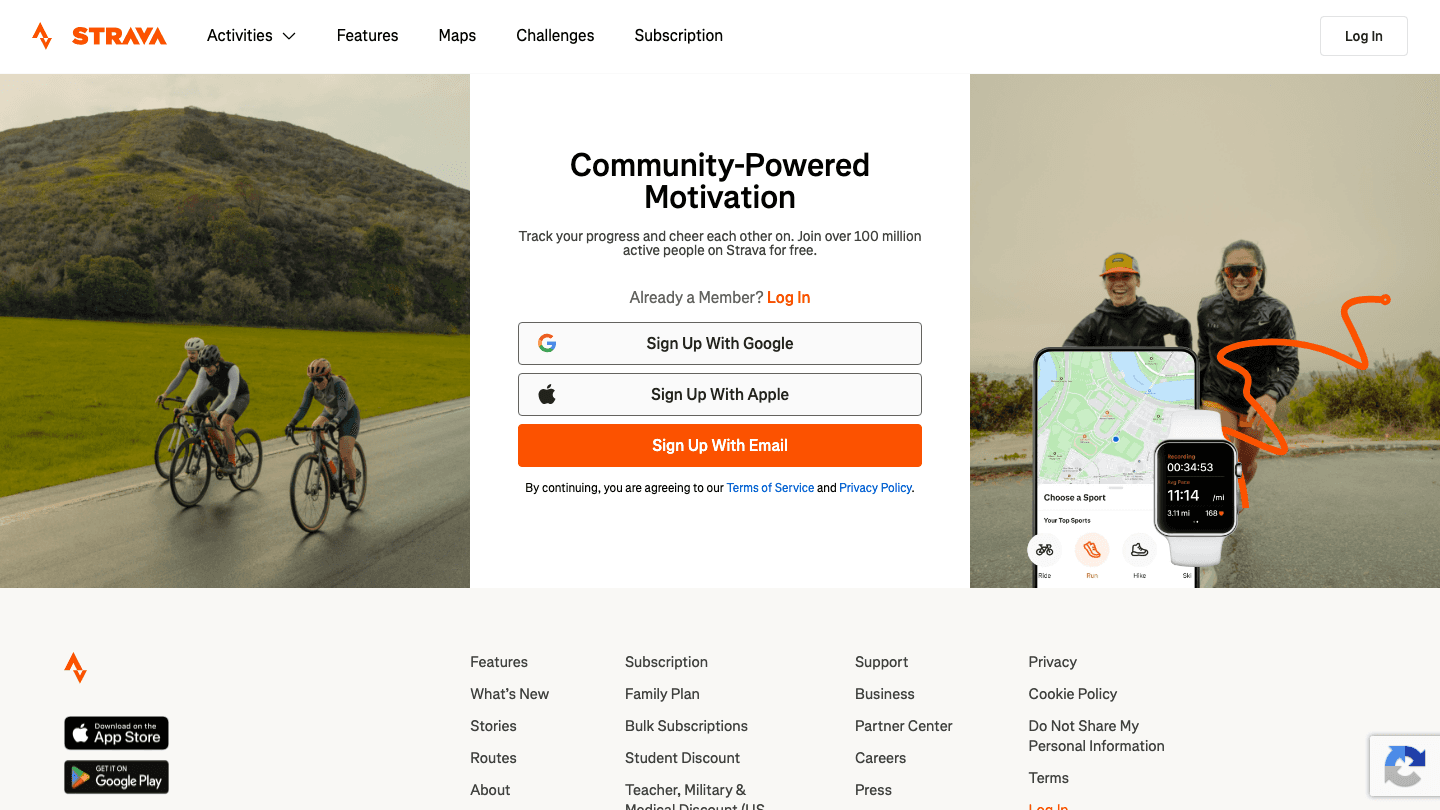
Free features: Activity recording, feed and social features, safety beacon, basic segment data
Paid subscription (Summit): $79.99/year ($6.67/month), 30-day free trial. Includes full segment leaderboards, advanced route recommendations, fitness score tracking, offline maps, custom goals
What works: The social layer is unmatched; segment competition is genuinely motivating; route discovery and navigation tools are excellent; huge community for virtually every sport
Limitations: Training analytics are basic compared to Garmin Connect; free tier is significantly limited; the social feed gets noisy; no hardware device of its own
Garmin Connect Overview
Garmin Connect is the companion app for Garmin's watch and device ecosystem. It is completely free, with all features available from the moment you pair a Garmin device. The platform is built around data depth: training load, training status (productive, unproductive, maintaining), body battery levels across the day, stress tracking, sleep data, and long-term performance trends going back years.

Price: Free for all features
What works: Deepest training analytics of any fitness app; body battery and stress tracking are genuinely useful; training load and recovery advisor help prevent overtraining; excellent for multi-sport athletes; no paywall anywhere
Limitations: Social features are minimal compared to Strava; interface can be dense; best features require a Garmin device; not useful without Garmin hardware
The guide on what Garmin's Body Battery actually measures is worth reading if you want to understand how Garmin translates your training and recovery data into an actionable daily energy score.
Head-to-Head Comparison
Social features: Strava is dominant. Feed, kudos, clubs, segment leaderboards, group challenges. Garmin Connect has basic follower features most users ignore.
Training analytics: Garmin Connect is deeper. Training load, training status, VO2 max trends, lactate threshold estimates, training effect. Strava's analytics are focused on segments and fitness score.
Body battery / recovery: Garmin Connect only. This is a Garmin-exclusive feature that scores your readiness to train based on sleep, HRV, and stress throughout the day.
Price: Garmin Connect is free. Strava is free with limited features, $79.99/year for full access.
Device compatibility: Strava works with virtually any GPS device or phone. Garmin Connect is designed around Garmin hardware.
Route planning: Strava has better route recommendations and navigation with its heat map data from millions of users. Garmin Connect has solid route creation tools but less community data.
Syncing between platforms: Strava and Garmin Connect sync automatically when connected. Activities recorded on a Garmin watch appear on both platforms without manual uploads.
The Subscription Question
Strava's free tier is frustratingly limited. Segment leaderboards, the flagship competitive feature, are behind the paywall. If you are using Strava without paying, you are missing the core reason most athletes use it. The $79.99/year price is fair given what full access unlocks, but it is worth knowing that "free Strava" is a meaningfully worse experience than the paid version.
Garmin Connect has no paywall. Everything works from day one. The only requirement is a Garmin device. If you already have a Garmin watch, you are getting elite-level analytics at no extra cost. The guide on best apps to use with Garmin covers how to get more out of your existing Garmin ecosystem beyond just Garmin Connect.
Who Should Use Which
Use Strava if:
Community and social motivation drive your training
You want to compete on segments or in group challenges
You use a non-Garmin device (Apple Watch, Polar, Suunto, phone GPS)
Route discovery and heat-map-based navigation matter to you
Use Garmin Connect if:
You own a Garmin watch and want maximum analytics from it
Training load, recovery, and body battery matter more than social features
You want a free solution with no paywall anywhere
You care about how your training is affecting your overall health, not just your times
The honest answer for most serious Garmin users is both. Set up Strava and Garmin Connect to sync, use Garmin Connect as your data dashboard, and use Strava for community and segment competition. The platforms complement each other. See the full guide on best apps to use alongside Strava for other tools that fit into this stack.
Using Fitness Data in Your Daily Schedule
Both platforms tell you how fit you are and how hard you trained. What neither does is connect that data to how you should structure the rest of your day. If your body battery is 25% after a hard training block, that is not just a fitness signal. It is a signal to shift demanding cognitive work to a later window. Lifestack makes this connection, scheduling your tasks into calendar blocks based on your energy and recovery state so your hardest work happens when you are genuinely ready for it. For more on how fitness and recovery data can shape a productive schedule, the guide on using biometric data to plan your day is a good starting point.
Frequently Asked Questions
Is Strava better than Garmin Connect?
They are better at different things. Strava is better for social features, community, and segment competition. Garmin Connect is better for training analytics, body battery, and recovery monitoring. Most Garmin users run both and sync them together.
Does Garmin Connect sync with Strava?
Yes. You can connect your Garmin account to Strava so that every activity recorded on your Garmin watch automatically appears on Strava. The guide on how to connect Strava and Garmin walks through the setup. It takes about 5 minutes.
Is Garmin Connect free?
Yes. Garmin Connect is completely free with no paid tiers or feature paywalls. The only requirement is a Garmin device to sync data from.
What does Strava premium (Summit) cost?
Strava's paid subscription costs $79.99/year ($6.67/month). It includes a 30-day free trial. Student pricing is available at $39.99/year. The subscription unlocks full segment leaderboards, advanced route planning, fitness score tracking, and offline maps.
Can I use Strava without a Garmin watch?
Yes. Strava works with any GPS device, Apple Watch, Polar, Suunto, Wahoo, or just your phone's GPS. It is device-agnostic. Garmin Connect, by contrast, is designed around Garmin hardware and is not useful without a Garmin device.
Which app has better running analytics?
Garmin Connect provides deeper running analytics, including training load, running dynamics (cadence, ground contact time, vertical oscillation on compatible watches), VO2 max trends, and lactate threshold estimates. Strava's analytics focus on pace, elevation, and segment comparison. The best fitness apps guide covers both alongside other options for different training goals.
Strava and Garmin Connect are both fitness tracking platforms, but they were built with different users in mind. Strava started as a social platform for cyclists and runners. Garmin Connect started as the data hub for Garmin's device ecosystem. Both have expanded significantly, and today millions of people use them side by side. But if you are deciding which one deserves your attention and potentially your money, understanding the difference matters.
This comparison breaks down both platforms on the dimensions that actually affect your training and daily use: social features, analytics depth, device compatibility, pricing, and the overall experience.
Key Takeaways
Strava is the stronger platform for community, social motivation, and segment racing. It costs $79.99/year for full features with a 30-day free trial.
Garmin Connect is free, deeply analytical, and tightly integrated with Garmin watches. It is the better tool if you want training load, body battery, and long-term performance trends.
Most serious Garmin users run both. They use Garmin Connect for data and Strava for community. The platforms are designed to sync, not compete.
Quick Verdict
Strava: Best for runners and cyclists who want competitive motivation, social connection, and route discovery.
Garmin Connect: Best for Garmin device owners who want deep training analytics, body battery tracking, and health monitoring without an extra subscription.
Strava Overview
Strava is built around activity logging and social competition. At its core, every run, ride, swim, or workout you record gets shared to your feed, where your connections can give kudos and comment. The defining feature is segments: GPS-defined sections of road or trail where Strava tracks everyone's time and maintains live leaderboards. Competing for a segment CR (course record) has motivated more training miles than most coaching programs.
Free features: Activity recording, feed and social features, safety beacon, basic segment data
Paid subscription (Summit): $79.99/year ($6.67/month), 30-day free trial. Includes full segment leaderboards, advanced route recommendations, fitness score tracking, offline maps, custom goals
What works: The social layer is unmatched; segment competition is genuinely motivating; route discovery and navigation tools are excellent; huge community for virtually every sport
Limitations: Training analytics are basic compared to Garmin Connect; free tier is significantly limited; the social feed gets noisy; no hardware device of its own
Garmin Connect Overview
Garmin Connect is the companion app for Garmin's watch and device ecosystem. It is completely free, with all features available from the moment you pair a Garmin device. The platform is built around data depth: training load, training status (productive, unproductive, maintaining), body battery levels across the day, stress tracking, sleep data, and long-term performance trends going back years.
Price: Free for all features
What works: Deepest training analytics of any fitness app; body battery and stress tracking are genuinely useful; training load and recovery advisor help prevent overtraining; excellent for multi-sport athletes; no paywall anywhere
Limitations: Social features are minimal compared to Strava; interface can be dense; best features require a Garmin device; not useful without Garmin hardware
The guide on what Garmin's Body Battery actually measures is worth reading if you want to understand how Garmin translates your training and recovery data into an actionable daily energy score.
Head-to-Head Comparison
Social features: Strava is dominant. Feed, kudos, clubs, segment leaderboards, group challenges. Garmin Connect has basic follower features most users ignore.
Training analytics: Garmin Connect is deeper. Training load, training status, VO2 max trends, lactate threshold estimates, training effect. Strava's analytics are focused on segments and fitness score.
Body battery / recovery: Garmin Connect only. This is a Garmin-exclusive feature that scores your readiness to train based on sleep, HRV, and stress throughout the day.
Price: Garmin Connect is free. Strava is free with limited features, $79.99/year for full access.
Device compatibility: Strava works with virtually any GPS device or phone. Garmin Connect is designed around Garmin hardware.
Route planning: Strava has better route recommendations and navigation with its heat map data from millions of users. Garmin Connect has solid route creation tools but less community data.
Syncing between platforms: Strava and Garmin Connect sync automatically when connected. Activities recorded on a Garmin watch appear on both platforms without manual uploads.
The Subscription Question
Strava's free tier is frustratingly limited. Segment leaderboards, the flagship competitive feature, are behind the paywall. If you are using Strava without paying, you are missing the core reason most athletes use it. The $79.99/year price is fair given what full access unlocks, but it is worth knowing that "free Strava" is a meaningfully worse experience than the paid version.
Garmin Connect has no paywall. Everything works from day one. The only requirement is a Garmin device. If you already have a Garmin watch, you are getting elite-level analytics at no extra cost. The guide on best apps to use with Garmin covers how to get more out of your existing Garmin ecosystem beyond just Garmin Connect.
Who Should Use Which
Use Strava if:
Community and social motivation drive your training
You want to compete on segments or in group challenges
You use a non-Garmin device (Apple Watch, Polar, Suunto, phone GPS)
Route discovery and heat-map-based navigation matter to you
Use Garmin Connect if:
You own a Garmin watch and want maximum analytics from it
Training load, recovery, and body battery matter more than social features
You want a free solution with no paywall anywhere
You care about how your training is affecting your overall health, not just your times
The honest answer for most serious Garmin users is both. Set up Strava and Garmin Connect to sync, use Garmin Connect as your data dashboard, and use Strava for community and segment competition. The platforms complement each other. See the full guide on best apps to use alongside Strava for other tools that fit into this stack.
Using Fitness Data in Your Daily Schedule
Both platforms tell you how fit you are and how hard you trained. What neither does is connect that data to how you should structure the rest of your day. If your body battery is 25% after a hard training block, that is not just a fitness signal. It is a signal to shift demanding cognitive work to a later window. Lifestack makes this connection, scheduling your tasks into calendar blocks based on your energy and recovery state so your hardest work happens when you are genuinely ready for it. For more on how fitness and recovery data can shape a productive schedule, the guide on using biometric data to plan your day is a good starting point.
Frequently Asked Questions
Is Strava better than Garmin Connect?
They are better at different things. Strava is better for social features, community, and segment competition. Garmin Connect is better for training analytics, body battery, and recovery monitoring. Most Garmin users run both and sync them together.
Does Garmin Connect sync with Strava?
Yes. You can connect your Garmin account to Strava so that every activity recorded on your Garmin watch automatically appears on Strava. The guide on how to connect Strava and Garmin walks through the setup. It takes about 5 minutes.
Is Garmin Connect free?
Yes. Garmin Connect is completely free with no paid tiers or feature paywalls. The only requirement is a Garmin device to sync data from.
What does Strava premium (Summit) cost?
Strava's paid subscription costs $79.99/year ($6.67/month). It includes a 30-day free trial. Student pricing is available at $39.99/year. The subscription unlocks full segment leaderboards, advanced route planning, fitness score tracking, and offline maps.
Can I use Strava without a Garmin watch?
Yes. Strava works with any GPS device, Apple Watch, Polar, Suunto, Wahoo, or just your phone's GPS. It is device-agnostic. Garmin Connect, by contrast, is designed around Garmin hardware and is not useful without a Garmin device.
Which app has better running analytics?
Garmin Connect provides deeper running analytics, including training load, running dynamics (cadence, ground contact time, vertical oscillation on compatible watches), VO2 max trends, and lactate threshold estimates. Strava's analytics focus on pace, elevation, and segment comparison. The best fitness apps guide covers both alongside other options for different training goals.



FOLLOW ON
FOLLOW ON
FOLLOW ON



Copyright 2026 © Lifestack. All rights reserved
Copyright 2026 © Lifestack. All rights reserved

