
Device
WHOOP Bands Review: 5.0 vs MG in 2026
WHOOP Bands Review: 5.0 vs MG in 2026

WHOOP doesn't look like a fitness tracker. There's no display, no step counter, no notification badge. It's a fabric band with sensors inside, designed to do one thing: measure your body's readiness and recovery 24 hours a day without interrupting your life. That philosophy, controversial when WHOOP launched, has built one of the most devoted user bases in the wearable space.
The lineup now includes two devices. The WHOOP 5.0 is their core offering, starting at $199 per year through a membership model. The WHOOP MG (Medical Grade) steps up to clinical-precision sensors with ECG, blood pressure insights, and irregular heart rhythm detection, included in the $359/year WHOOP Life tier. Both devices are screenless. Both ship free with your membership.
Here's what WHOOP does well, where the membership model creates friction, and which tier makes sense for which type of person.
Key Takeaways
Recovery Score is WHOOP's strongest feature: a daily percentage built from HRV, resting heart rate, respiratory rate, and sleep quality that genuinely reflects how ready your body is to perform
The membership model means no upfront hardware cost, but $199 to $359 per year ongoing; you're renting access as much as owning a device
WHOOP MG adds clinical-grade blood pressure, ECG, and irregular heart rhythm detection, making it the first consumer wearable to cross into medical-monitoring territory at this price
WHOOP 5.0 vs WHOOP MG: What's Different
The two devices share the same screenless form factor and 14-plus day battery life. What separates them is the sensor array and the software features those sensors unlock:
WHOOP 5.0: HRV, resting heart rate, respiratory rate, SpO2, skin temperature, sleep staging, strain scoring, and recovery percentages. This covers everything most athletes and health-focused users want
WHOOP MG: All of the above, plus daily blood pressure insights, an ECG with irregular heart rhythm notifications, and clinical-precision skin temperature tracking. The MG is designed for people who want the monitoring depth of a medical device in a fitness wearable
The MG doesn't replace a cardiologist visit or clinical-grade equipment. What it does is give people with cardiovascular risk factors or those recovering from illness a daily data layer that previously required a hospital visit to obtain. For a wellness wearable, that's a meaningful step forward.
Recovery Score: What It Measures and Why It Matters
WHOOP's Recovery Score is the product's central output. Every morning, you get a percentage (0-100%) that reflects your physiological readiness for the day. The calculation pulls from four main inputs: overnight HRV, resting heart rate, respiratory rate during sleep, and your sleep performance score. A green recovery (67-100%) signals your body is primed for hard effort. Yellow (34-66%) means moderate activity is appropriate. Red (0-33%) says your recovery is incomplete and hard training will likely hurt more than it helps.
HRV is the heaviest-weighted variable. Heart rate variability measures the variation in time between heartbeats: higher variation indicates a well-recovered nervous system; lower variation signals stress, fatigue, or illness. WHOOP measures HRV continuously throughout the night and averages across sleep cycles rather than capturing a single morning reading, which smooths out outlier measurements and gives a more reliable baseline.
Users who stick with WHOOP for 30-plus days typically report that Recovery Score starts predicting how they'll feel before they consciously register it. A 25% recovery before a Monday morning meeting often correlates with difficulty focusing. A 90% recovery on a rest day is a signal that adding a training session would be well-tolerated. Understanding your chronotype and energy patterns at this resolution is something most consumers have never had access to before.
Sleep Tracking
WHOOP tracks sleep stages (light, deep/slow-wave, REM), total time in each stage, sleep efficiency, and latency. Sleep performance is scored as a percentage of your self-reported or auto-detected sleep need. If WHOOP calculates you need 8.2 hours based on your strain and baseline, and you slept 7.4, your sleep performance score reflects that gap.
The Sleep Coach feature recommends when to go to bed based on your planned wake time, recent strain, and desired recovery level. If you want to hit a green recovery for an important workout or race, WHOOP calculates the bedtime needed to achieve it. For anyone trying to understand how much 6 hours of sleep actually costs them in recovery, the data is sobering and motivating.
Sleep tracking accuracy is solid for a wrist-worn device, though not equivalent to a sleep study. Where WHOOP shines is trending over time: understanding whether restorative sleep is improving or declining over weeks, and what behavioral patterns (alcohol, late training, screen time) correlate with worse sleep scores.
Strain Score
Strain is WHOOP's measure of cardiovascular load throughout the day. It uses a 0-21 scale. A rest day might score a 5-8. A hard run might push 14-16. A race day or intense competition can approach 20-21. The Strain Coach recommends a daily target based on your recovery score and recent training load, helping you avoid stacking high-strain days on low-recovery days.
The Strain system captures all activity, not just intentional workouts. A stressful workday with a high heart rate and minimal movement can register more strain than a moderate gym session. This is one of WHOOP's most frequently cited insights: people often discover that work stress, travel, and emotional load put a measurable load on their recovery that they weren't accounting for.
WHOOP Bands: Form Factor and Comfort
The screenless design is the feature that most divides potential WHOOP buyers. There's nothing to check, tap, or swipe. Notifications don't appear. You're wearing a sensor array that communicates through the app, not the device. For people who want to reduce screen time and notification-checking habits, this is a genuine benefit. For people who want a smartwatch that happens to track health, WHOOP is the wrong tool.
The band itself is a fabric strap that sits against the skin. It's comfortable for continuous wear, including sleeping, showering, and swimming (water-resistant to 10 meters). The sensor pod snaps off the band, allowing you to swap bands without removing the sensors, and the battery charges via a slide-on PowerPack while you're still wearing it, so you never need to take it off to charge.
Band options include standard CoreKnit, SuperKnit, and specialty materials in various colors. Additional bands are sold separately and typically cost $20-60 depending on material. The MG tier ships with a SuperKnit Luxe band; the base tier ships with CoreKnit.
WHOOP Pricing: Membership Tiers
WHOOP One ($199/year, $25/month): Includes WHOOP 5.0 device, standard charger, CoreKnit band; all core tracking features
WHOOP Peak ($239/year, $30/month): Includes WHOOP 5.0 with additional accessories and features
WHOOP Life ($359/year, $40/month): Includes WHOOP MG device, wireless PowerPack charger, SuperKnit Luxe band; adds daily blood pressure insights, ECG, irregular heart rhythm notifications, and clinical-precision skin temperature
There is no one-time purchase option. When you stop paying, your WHOOP data remains accessible but the device no longer syncs new data. This is the core criticism: you're committing to ongoing costs rather than owning hardware outright. At $199/year, WHOOP is comparable in annual cost to many other premium services. At $359/year, the MG tier needs to deliver meaningful clinical insight to justify itself beyond novelty.
Using WHOOP Data to Plan Your Day
WHOOP's daily output is a set of signals that most people don't know what to do with beyond noting "green = good day." The data is actionable, but only if your schedule actually responds to it. A 28% recovery day shouldn't look the same as an 88% recovery day in your calendar, but for most people it does, because their schedule was built in advance without accounting for physiological state.
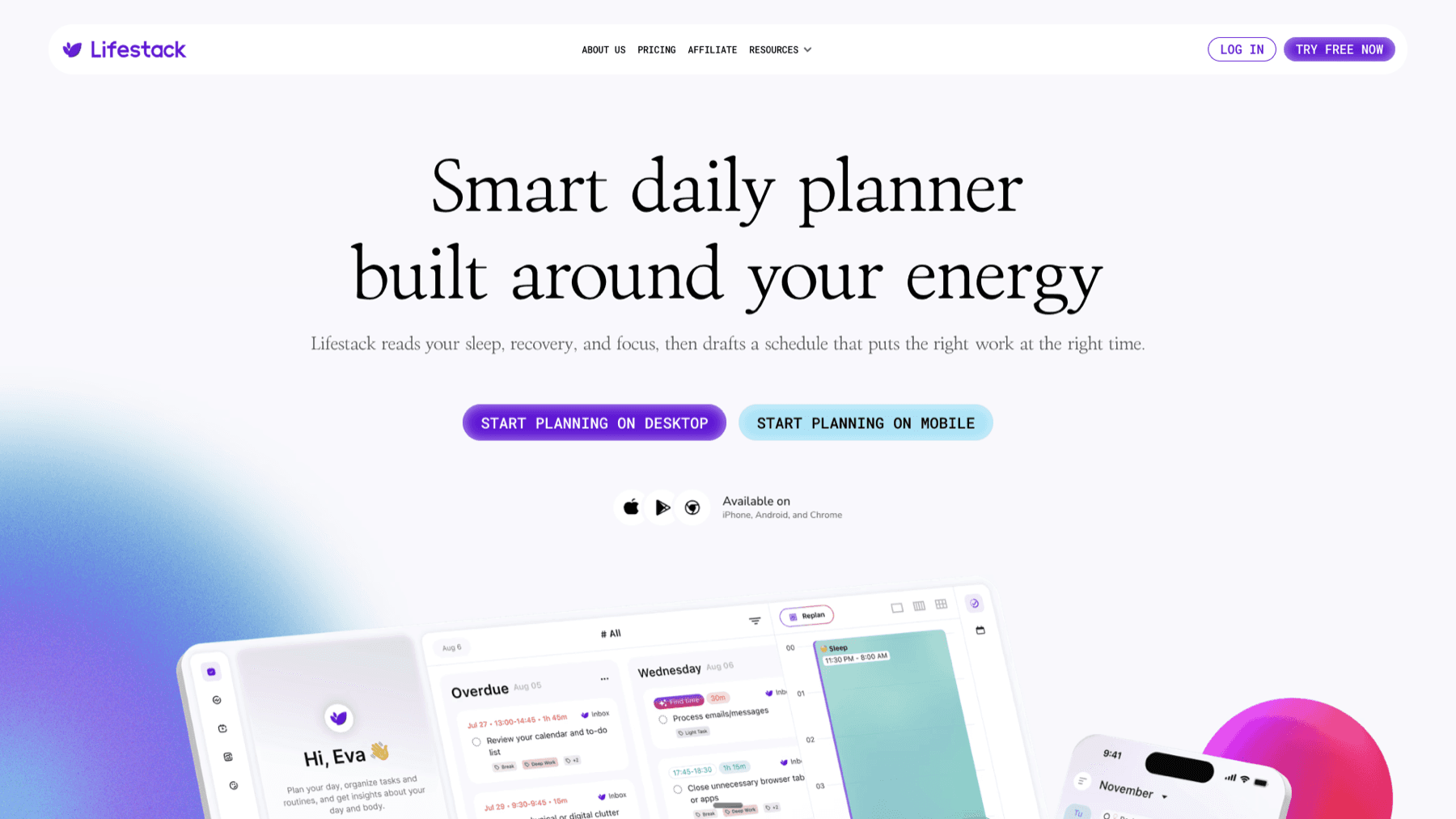
Lifestack is an AI scheduler that maps your energy state to your task list. Rather than filling every available slot equally, Lifestack assigns cognitively demanding work to your peak-energy windows and routes administrative or low-stakes tasks to your natural dip periods. Pairing WHOOP's recovery data with Lifestack's energy-aware scheduling closes the loop: you're not just knowing your recovery level, you're letting it shape how your day is actually arranged.
For users who track their circadian rhythm patterns and HRV trends over time, the combination reveals which days are best for deep work, which are better for meetings and communication, and when physical training can be pushed hard versus held back. That's a level of self-knowledge that generic time-blocking approaches can't replicate.
Who Should Subscribe to WHOOP
Serious athletes: WHOOP's strain-to-recovery ratio is specifically designed for athletic training periodization. If you're training for a marathon, cycling race, or competition season, the daily recovery data is directly applicable to training load decisions
Recovery-focused individuals: People who've been overtraining, underrecovering, or experiencing fatigue without understanding why often find WHOOP's data illuminating
Those with cardiovascular concerns: The WHOOP Life tier's blood pressure insights and ECG features give people with cardiac risk factors a passive daily monitoring layer that previously wasn't available outside clinical settings
People who don't want a screen: If wrist device notifications are a productivity problem or you just want health data without a second screen on your body, WHOOP's screenless design solves that specifically
WHOOP isn't the right fit if you primarily want GPS activity tracking, smartphone notifications, or contactless payments on your wrist. For those needs, the Garmin Venu X1 or Apple Watch serves better. WHOOP is a biometric monitoring device first, and almost nothing else. The people who get the most out of it treat that as a feature, not a limitation.
Frequently Asked Questions
What are WHOOP bands?
WHOOP bands are screenless fitness wearables that track biometric data 24/7 including HRV, sleep stages, strain, and recovery. They come with a required membership subscription starting at $199/year, which includes the hardware. The two current models are WHOOP 5.0 (standard) and WHOOP MG (medical grade with ECG and blood pressure).
Is WHOOP worth the money?
For serious athletes and people focused on recovery optimization, yes. The Recovery Score and Strain system provide actionable data that's difficult to replicate with other consumer wearables. For casual exercisers who mainly want step counting or notifications, the $199+ annual cost is hard to justify versus lower-cost alternatives or free sleep tracking apps.
Can you buy WHOOP without a subscription?
No. WHOOP operates entirely on a membership model. The device ships free with your membership, but there is no option to purchase the hardware outright without an active subscription. When you cancel, the device no longer syncs new data, though historical data remains accessible.
How long does WHOOP battery last?
The WHOOP 5.0 and WHOOP MG both offer 14-plus days of battery life. Because the battery charges via a slide-on PowerPack while you continue wearing the device, you never need to remove it. This makes WHOOP's continuous-wear capability genuinely better than smartwatches that require several hours of off-wrist charging time.
How accurate is WHOOP sleep tracking?
WHOOP's sleep staging is reliable for tracking personal trends, though like all wrist-worn devices it's less precise than a clinical polysomnography study. Its strength is consistency: over weeks and months, the data accurately reflects what behaviors improve or harm sleep quality. Single-night readings should be treated as directional, not definitive.
Does WHOOP track GPS?
No. WHOOP has no GPS chip. It tracks cardiovascular strain from heart rate data but doesn't record route, pace, or distance independently. For GPS-tracked workouts, you'd need a separate device or to carry your phone. This is a meaningful limitation for outdoor runners and cyclists who want route data as part of their workout analysis.
WHOOP doesn't look like a fitness tracker. There's no display, no step counter, no notification badge. It's a fabric band with sensors inside, designed to do one thing: measure your body's readiness and recovery 24 hours a day without interrupting your life. That philosophy, controversial when WHOOP launched, has built one of the most devoted user bases in the wearable space.
The lineup now includes two devices. The WHOOP 5.0 is their core offering, starting at $199 per year through a membership model. The WHOOP MG (Medical Grade) steps up to clinical-precision sensors with ECG, blood pressure insights, and irregular heart rhythm detection, included in the $359/year WHOOP Life tier. Both devices are screenless. Both ship free with your membership.
Here's what WHOOP does well, where the membership model creates friction, and which tier makes sense for which type of person.
Key Takeaways
Recovery Score is WHOOP's strongest feature: a daily percentage built from HRV, resting heart rate, respiratory rate, and sleep quality that genuinely reflects how ready your body is to perform
The membership model means no upfront hardware cost, but $199 to $359 per year ongoing; you're renting access as much as owning a device
WHOOP MG adds clinical-grade blood pressure, ECG, and irregular heart rhythm detection, making it the first consumer wearable to cross into medical-monitoring territory at this price
WHOOP 5.0 vs WHOOP MG: What's Different
The two devices share the same screenless form factor and 14-plus day battery life. What separates them is the sensor array and the software features those sensors unlock:
WHOOP 5.0: HRV, resting heart rate, respiratory rate, SpO2, skin temperature, sleep staging, strain scoring, and recovery percentages. This covers everything most athletes and health-focused users want
WHOOP MG: All of the above, plus daily blood pressure insights, an ECG with irregular heart rhythm notifications, and clinical-precision skin temperature tracking. The MG is designed for people who want the monitoring depth of a medical device in a fitness wearable
The MG doesn't replace a cardiologist visit or clinical-grade equipment. What it does is give people with cardiovascular risk factors or those recovering from illness a daily data layer that previously required a hospital visit to obtain. For a wellness wearable, that's a meaningful step forward.
Recovery Score: What It Measures and Why It Matters
WHOOP's Recovery Score is the product's central output. Every morning, you get a percentage (0-100%) that reflects your physiological readiness for the day. The calculation pulls from four main inputs: overnight HRV, resting heart rate, respiratory rate during sleep, and your sleep performance score. A green recovery (67-100%) signals your body is primed for hard effort. Yellow (34-66%) means moderate activity is appropriate. Red (0-33%) says your recovery is incomplete and hard training will likely hurt more than it helps.
HRV is the heaviest-weighted variable. Heart rate variability measures the variation in time between heartbeats: higher variation indicates a well-recovered nervous system; lower variation signals stress, fatigue, or illness. WHOOP measures HRV continuously throughout the night and averages across sleep cycles rather than capturing a single morning reading, which smooths out outlier measurements and gives a more reliable baseline.
Users who stick with WHOOP for 30-plus days typically report that Recovery Score starts predicting how they'll feel before they consciously register it. A 25% recovery before a Monday morning meeting often correlates with difficulty focusing. A 90% recovery on a rest day is a signal that adding a training session would be well-tolerated. Understanding your chronotype and energy patterns at this resolution is something most consumers have never had access to before.
Sleep Tracking
WHOOP tracks sleep stages (light, deep/slow-wave, REM), total time in each stage, sleep efficiency, and latency. Sleep performance is scored as a percentage of your self-reported or auto-detected sleep need. If WHOOP calculates you need 8.2 hours based on your strain and baseline, and you slept 7.4, your sleep performance score reflects that gap.
The Sleep Coach feature recommends when to go to bed based on your planned wake time, recent strain, and desired recovery level. If you want to hit a green recovery for an important workout or race, WHOOP calculates the bedtime needed to achieve it. For anyone trying to understand how much 6 hours of sleep actually costs them in recovery, the data is sobering and motivating.
Sleep tracking accuracy is solid for a wrist-worn device, though not equivalent to a sleep study. Where WHOOP shines is trending over time: understanding whether restorative sleep is improving or declining over weeks, and what behavioral patterns (alcohol, late training, screen time) correlate with worse sleep scores.
Strain Score
Strain is WHOOP's measure of cardiovascular load throughout the day. It uses a 0-21 scale. A rest day might score a 5-8. A hard run might push 14-16. A race day or intense competition can approach 20-21. The Strain Coach recommends a daily target based on your recovery score and recent training load, helping you avoid stacking high-strain days on low-recovery days.
The Strain system captures all activity, not just intentional workouts. A stressful workday with a high heart rate and minimal movement can register more strain than a moderate gym session. This is one of WHOOP's most frequently cited insights: people often discover that work stress, travel, and emotional load put a measurable load on their recovery that they weren't accounting for.
WHOOP Bands: Form Factor and Comfort
The screenless design is the feature that most divides potential WHOOP buyers. There's nothing to check, tap, or swipe. Notifications don't appear. You're wearing a sensor array that communicates through the app, not the device. For people who want to reduce screen time and notification-checking habits, this is a genuine benefit. For people who want a smartwatch that happens to track health, WHOOP is the wrong tool.
The band itself is a fabric strap that sits against the skin. It's comfortable for continuous wear, including sleeping, showering, and swimming (water-resistant to 10 meters). The sensor pod snaps off the band, allowing you to swap bands without removing the sensors, and the battery charges via a slide-on PowerPack while you're still wearing it, so you never need to take it off to charge.
Band options include standard CoreKnit, SuperKnit, and specialty materials in various colors. Additional bands are sold separately and typically cost $20-60 depending on material. The MG tier ships with a SuperKnit Luxe band; the base tier ships with CoreKnit.
WHOOP Pricing: Membership Tiers
WHOOP One ($199/year, $25/month): Includes WHOOP 5.0 device, standard charger, CoreKnit band; all core tracking features
WHOOP Peak ($239/year, $30/month): Includes WHOOP 5.0 with additional accessories and features
WHOOP Life ($359/year, $40/month): Includes WHOOP MG device, wireless PowerPack charger, SuperKnit Luxe band; adds daily blood pressure insights, ECG, irregular heart rhythm notifications, and clinical-precision skin temperature
There is no one-time purchase option. When you stop paying, your WHOOP data remains accessible but the device no longer syncs new data. This is the core criticism: you're committing to ongoing costs rather than owning hardware outright. At $199/year, WHOOP is comparable in annual cost to many other premium services. At $359/year, the MG tier needs to deliver meaningful clinical insight to justify itself beyond novelty.
Using WHOOP Data to Plan Your Day
WHOOP's daily output is a set of signals that most people don't know what to do with beyond noting "green = good day." The data is actionable, but only if your schedule actually responds to it. A 28% recovery day shouldn't look the same as an 88% recovery day in your calendar, but for most people it does, because their schedule was built in advance without accounting for physiological state.
Lifestack is an AI scheduler that maps your energy state to your task list. Rather than filling every available slot equally, Lifestack assigns cognitively demanding work to your peak-energy windows and routes administrative or low-stakes tasks to your natural dip periods. Pairing WHOOP's recovery data with Lifestack's energy-aware scheduling closes the loop: you're not just knowing your recovery level, you're letting it shape how your day is actually arranged.
For users who track their circadian rhythm patterns and HRV trends over time, the combination reveals which days are best for deep work, which are better for meetings and communication, and when physical training can be pushed hard versus held back. That's a level of self-knowledge that generic time-blocking approaches can't replicate.
Who Should Subscribe to WHOOP
Serious athletes: WHOOP's strain-to-recovery ratio is specifically designed for athletic training periodization. If you're training for a marathon, cycling race, or competition season, the daily recovery data is directly applicable to training load decisions
Recovery-focused individuals: People who've been overtraining, underrecovering, or experiencing fatigue without understanding why often find WHOOP's data illuminating
Those with cardiovascular concerns: The WHOOP Life tier's blood pressure insights and ECG features give people with cardiac risk factors a passive daily monitoring layer that previously wasn't available outside clinical settings
People who don't want a screen: If wrist device notifications are a productivity problem or you just want health data without a second screen on your body, WHOOP's screenless design solves that specifically
WHOOP isn't the right fit if you primarily want GPS activity tracking, smartphone notifications, or contactless payments on your wrist. For those needs, the Garmin Venu X1 or Apple Watch serves better. WHOOP is a biometric monitoring device first, and almost nothing else. The people who get the most out of it treat that as a feature, not a limitation.
Frequently Asked Questions
What are WHOOP bands?
WHOOP bands are screenless fitness wearables that track biometric data 24/7 including HRV, sleep stages, strain, and recovery. They come with a required membership subscription starting at $199/year, which includes the hardware. The two current models are WHOOP 5.0 (standard) and WHOOP MG (medical grade with ECG and blood pressure).
Is WHOOP worth the money?
For serious athletes and people focused on recovery optimization, yes. The Recovery Score and Strain system provide actionable data that's difficult to replicate with other consumer wearables. For casual exercisers who mainly want step counting or notifications, the $199+ annual cost is hard to justify versus lower-cost alternatives or free sleep tracking apps.
Can you buy WHOOP without a subscription?
No. WHOOP operates entirely on a membership model. The device ships free with your membership, but there is no option to purchase the hardware outright without an active subscription. When you cancel, the device no longer syncs new data, though historical data remains accessible.
How long does WHOOP battery last?
The WHOOP 5.0 and WHOOP MG both offer 14-plus days of battery life. Because the battery charges via a slide-on PowerPack while you continue wearing the device, you never need to remove it. This makes WHOOP's continuous-wear capability genuinely better than smartwatches that require several hours of off-wrist charging time.
How accurate is WHOOP sleep tracking?
WHOOP's sleep staging is reliable for tracking personal trends, though like all wrist-worn devices it's less precise than a clinical polysomnography study. Its strength is consistency: over weeks and months, the data accurately reflects what behaviors improve or harm sleep quality. Single-night readings should be treated as directional, not definitive.
Does WHOOP track GPS?
No. WHOOP has no GPS chip. It tracks cardiovascular strain from heart rate data but doesn't record route, pace, or distance independently. For GPS-tracked workouts, you'd need a separate device or to carry your phone. This is a meaningful limitation for outdoor runners and cyclists who want route data as part of their workout analysis.



FOLLOW ON
FOLLOW ON
FOLLOW ON


Copyright 2026 © Lifestack. All rights reserved
Copyright 2026 © Lifestack. All rights reserved

