
App
Best AI Tools for HR Teams in 2026
Best AI Tools for HR Teams in 2026

HR managers spend more of their day on administrative tasks than on anything that actually moves the organization forward. Interview scheduling, performance reviews, onboarding paperwork, policy drafts. The list is endless. AI tools have gotten good enough that the administrative parts of HR can largely be delegated to software, freeing up your time for the work that actually needs a human.
But "AI tools for HR" is a broad category. Some are built for recruiting. Some for performance. Some for payroll. A few are built for the HR manager themselves, helping them plan their own day around all these demands. This list covers six tools that stand out in 2026, ranked by how much they actually change an HR manager's day-to-day experience.
We looked at ease of setup, the quality of the AI output, integrations with existing HR systems, mobile access, and real user feedback. Here's what we found.
Key Takeaways
The best AI tools for HR reduce admin burden without requiring a lengthy implementation or IT involvement to get started.
Lifestack stands out as the only tool on this list built around the HR manager's own schedule and energy, not just their organization's data.
For recruiting and performance management, purpose-built platforms like Paradox and Lattice outperform general AI tools in depth and accuracy.
Quick Guide: Best AI Tools for HR
Lifestack: Best for HR managers' personal scheduling and time management
ChatGPT: Best for drafting job descriptions, policies, and HR communications
Rippling: Best all-in-one HR, IT, and payroll platform
Lattice: Best for AI-powered performance management
Paradox (Olivia): Best for automated interview scheduling and candidate screening
BambooHR: Best for small-to-mid-size HR teams wanting a clean, simple HRIS
How We Evaluated These Tools
Time savings: Does it materially reduce hours spent on admin tasks?
AI quality: Is the AI output usable, or does it require heavy editing?
Setup friction: Can an HR manager get value within a day, or does it need an IT project?
Integrations: Does it connect with the tools HR teams already use?
Mobile access: HR managers are rarely desk-bound. Does the tool work on mobile?
1. Lifestack: Best for HR Manager Scheduling
The only tool built around when you're actually capable of doing your best work.

Lifestack takes a different approach from every other tool on this list. It's not built for your organization. It's built for you. It reads your sleep, recovery, and focus data, then builds a daily schedule that places your most important work during your peak cognitive hours. For an HR manager juggling recruiting, performance cycles, benefits administration, and one-on-ones, that matters.
Most HR managers describe their days as reactive. Lifestack makes them proactive. When you have a deadline-heavy week or a big performance review cycle, it rearranges your tasks automatically and makes sure the high-stakes work lands when your brain is actually ready for it. It also integrates with your calendar so meetings don't blindside the plan.
Key Features: Energy-aware daily scheduling, AI task prioritization, calendar sync, sleep and recovery tracking, mobile app
What Works: Automatically blocks your peak hours for focused work; updates the plan as your day changes; no manual rescheduling needed
Limitations: Personal productivity tool only. Does not manage org-level HR data, payroll, or recruiting workflows
Pricing: $7/month or $50/year. 7-day free trial on the annual plan.
Best for: HR managers who feel like their time disappears into reactive tasks and want a smarter way to protect focused work. Pairs well with a time-blocking practice for high-output weeks.
2. ChatGPT: Best for HR Content and Drafting
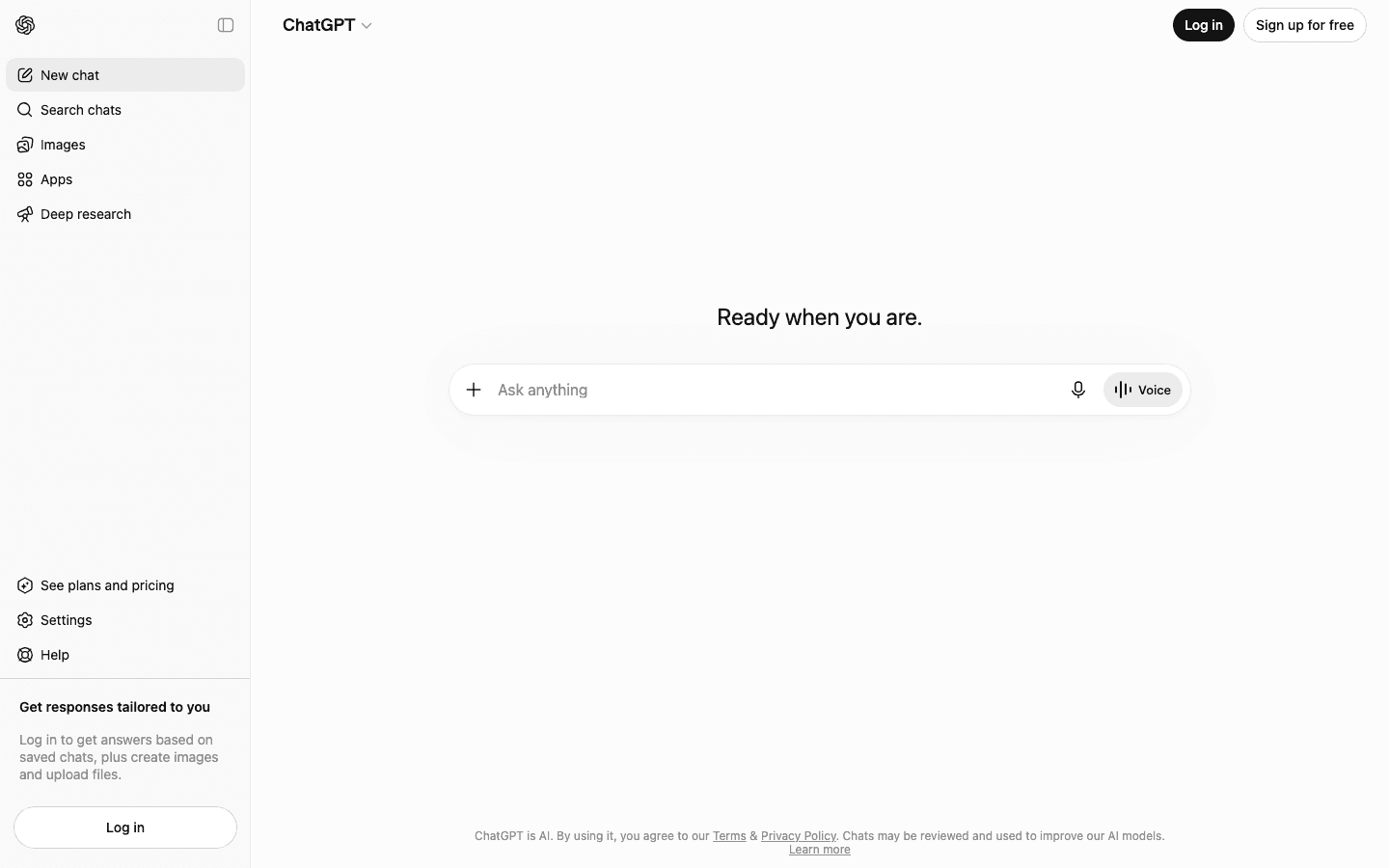
ChatGPT is already in many HR managers' daily rotation. The use cases are wide: drafting job descriptions, writing performance review templates, creating onboarding guides, generating first drafts of HR policies, summarizing long documents. With a good system prompt and specific instructions, it produces output that's 80% of the way there.
The free tier is genuinely useful. The Plus plan unlocks GPT-4o, which is noticeably better at tone-matching and following structured formats, and it's worth it for HR teams that generate a lot of written content.
What Works: Fast drafting of repetitive documents; strong at tone adjustment; available on every device
Limitations: No HR-specific integrations; outputs require review; not suitable for sensitive employee data
Pricing: Free tier available. Plus plan: $20/month.
Best for: HR managers who write a lot and want to cut drafting time in half. Also useful for building templates and SOPs.
3. Rippling: Best All-in-One HR Platform
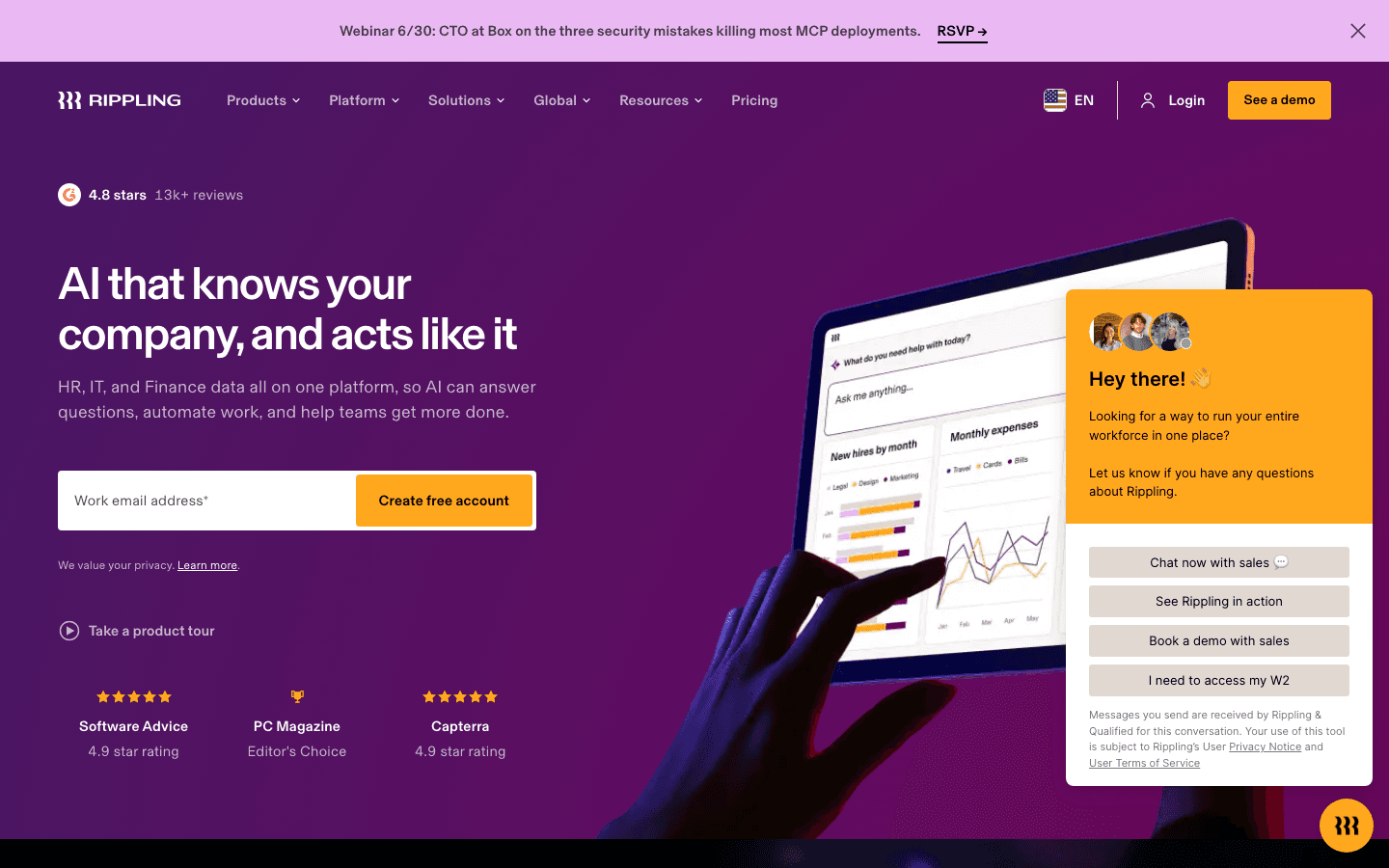
Rippling combines HR, IT, and finance into one platform, which sounds like it's trying to do too much until you realize how much time HR teams waste on cross-system data entry. New hire? Rippling can provision their laptop, set up their email, enroll them in benefits, and run their first payroll, all from one workflow.
The AI layer in Rippling is embedded throughout: answering employee questions, flagging compliance issues, generating reports. It's not a standalone AI tool you interact with directly. It's AI woven into an operational system.
What Works: Eliminates cross-system manual work; strong automation for onboarding and offboarding; solid compliance tools
Limitations: Complex to set up; pricing is modular and can add up quickly; better suited for growing companies than very small teams
Pricing: Custom quote required. Per-employee, per-month model. Contact sales for pricing.
Best for: HR teams at companies with 50+ employees who want a unified system across HR, IT, and finance.
4. Lattice: Best for Performance Management
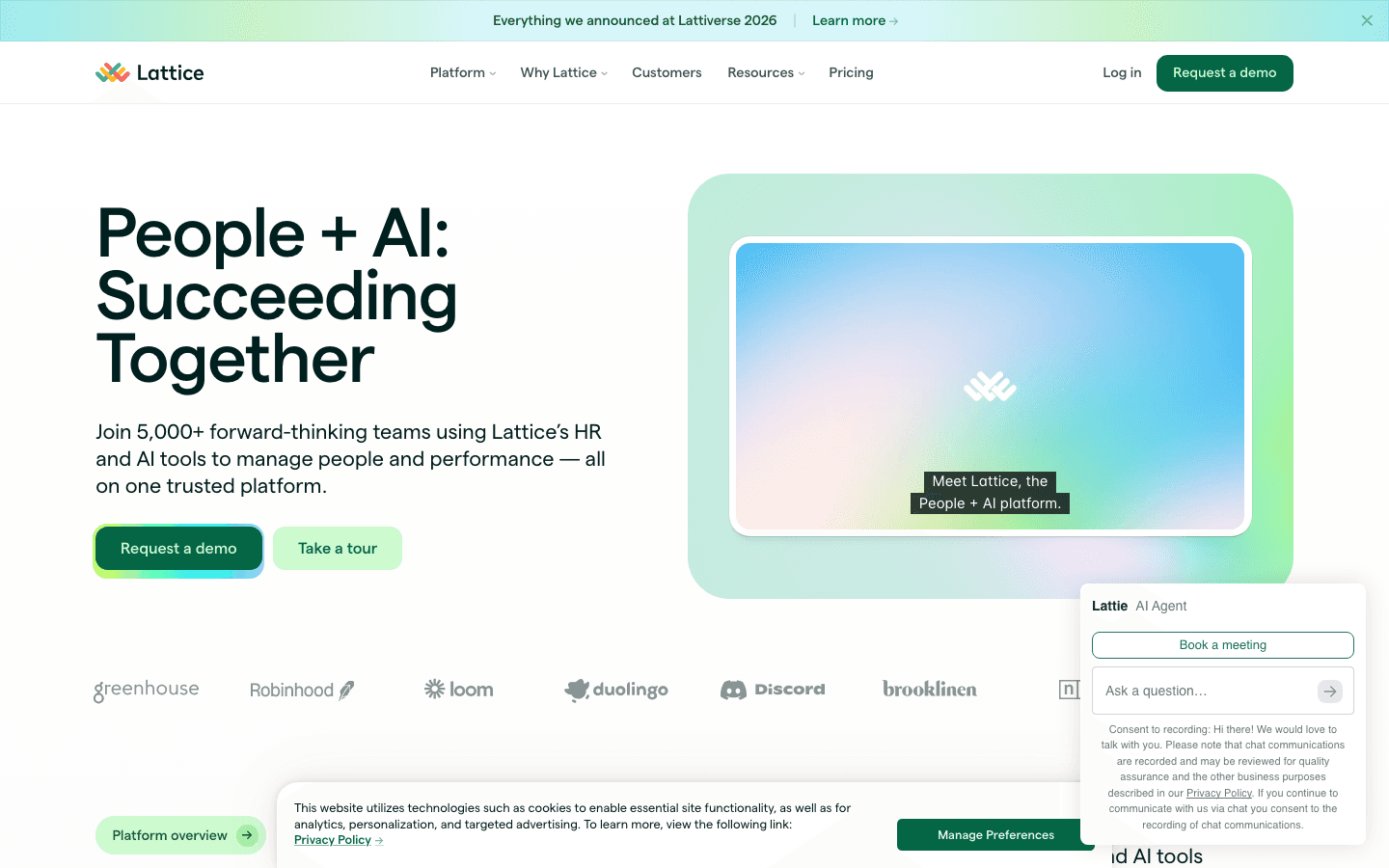
Lattice is the most mature AI-powered performance management platform available. It handles performance reviews, OKR tracking, engagement surveys, and compensation management. The AI features focus on surfacing patterns: which teams are disengaged, which employees are flight risks, where review scores may be biased.
For HR managers who run quarterly or annual review cycles, Lattice significantly reduces the coordination overhead. Review templates, automated reminders, calibration tools, and built-in analytics replace the spreadsheet-and-email workflow most teams still use.
What Works: Deep performance analytics; strong review cycle tooling; AI flags anomalies in review data
Limitations: Annual contracts with a $4,000 minimum spend; designed for organizations with established HR processes, not early-stage teams
Pricing: From $8/seat/month for performance (annual contract). $4,000 annual minimum.
Best for: Mid-size to large companies running structured performance cycles who want data-driven insights. Also works well with AI project management tools when HR and ops teams overlap.
5. Paradox (Olivia): Best for Interview Scheduling
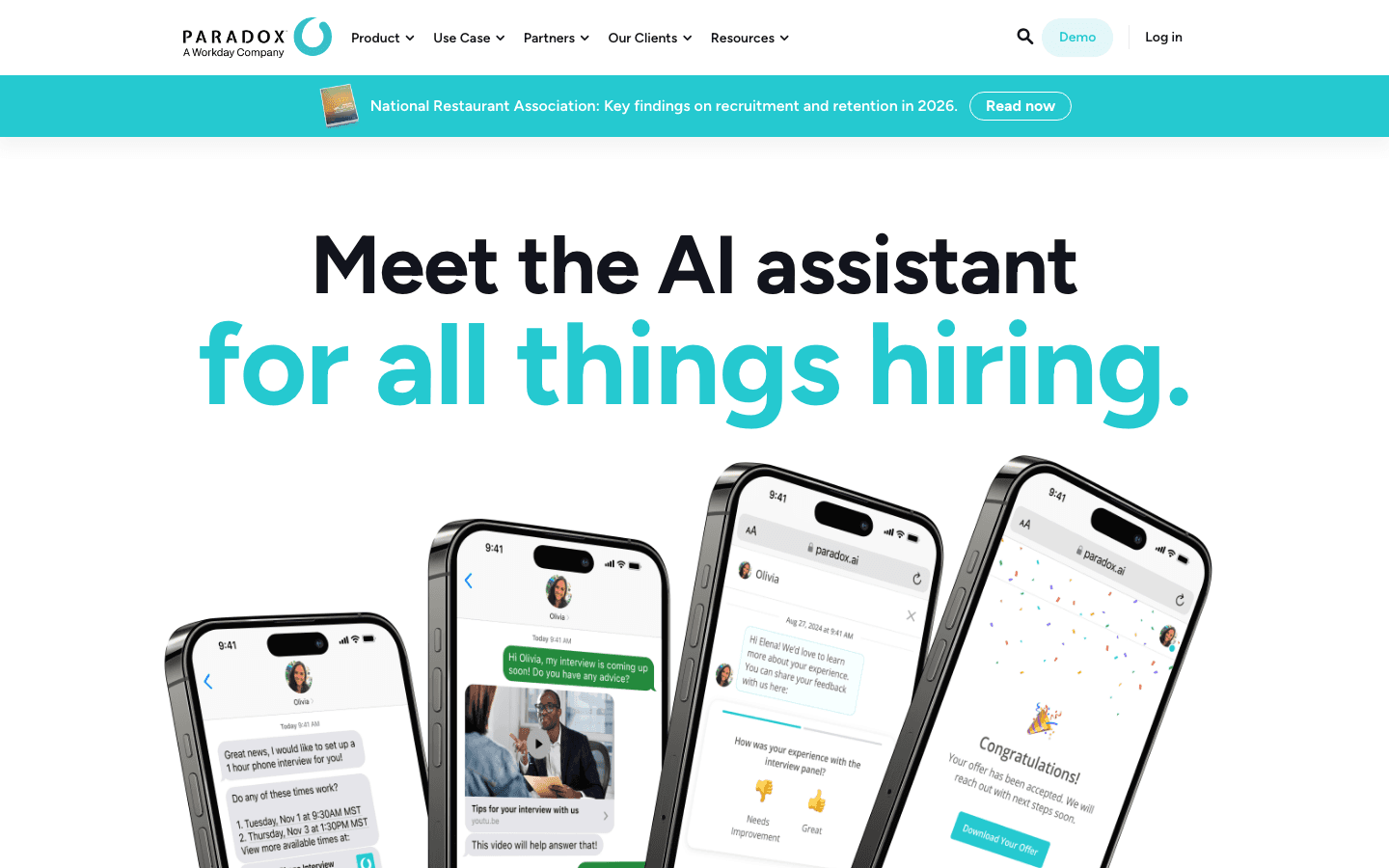
Paradox runs on a conversational AI called Olivia that handles candidate screening, interview scheduling, and hiring logistics over chat, often without the candidate realizing they're talking to AI. For high-volume recruiting (retail, healthcare, logistics), it's transformative. Scheduling 50 interviews a week becomes an automated background task instead of a full-time job.
The candidate experience is better too. Instead of email tag, candidates get real-time responses on their own timeline. Paradox claims significant reductions in time-to-fill for teams using it, and the reviews from high-volume HR teams back that up.
What Works: Eliminates interview scheduling work almost entirely; solid candidate experience; multilingual support
Limitations: Enterprise-focused pricing; requires integration setup with your ATS; not suitable for low-volume recruiting
Pricing: Custom pricing. Request a demo to get a quote.
Best for: HR teams doing high-volume hiring who want to automate the scheduling and screening workflow. Goes well alongside an AI executive assistant if you're also managing a packed calendar.
6. BambooHR: Best for Small HR Teams
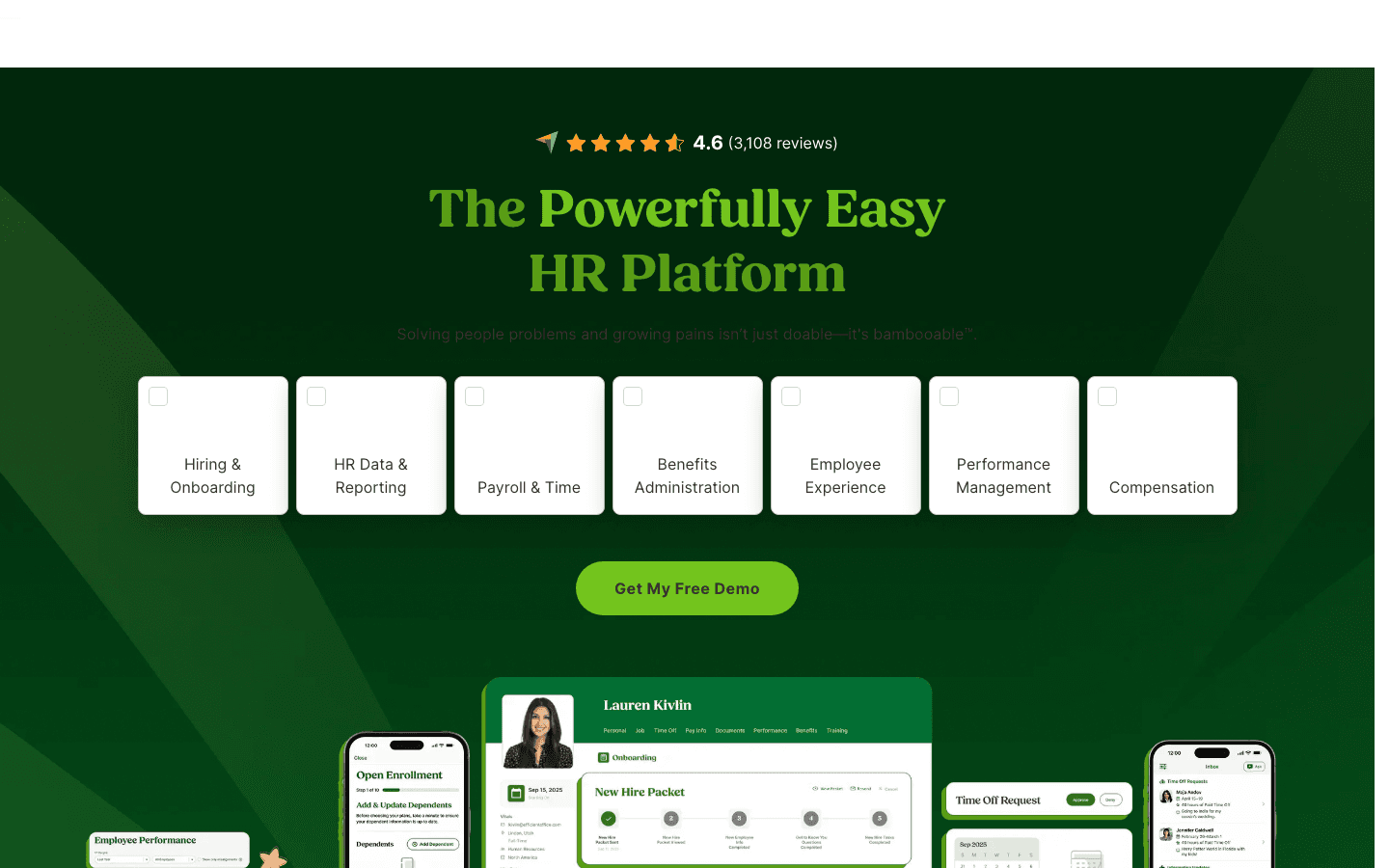
BambooHR is the most accessible HRIS on this list. It handles the essentials: employee records, time off, onboarding, e-signatures, and basic reporting. It has a clean interface that doesn't require training to figure out. The AI features are lighter than the other platforms: smarter search, auto-populated fields, suggested actions. But for a 50-person company that doesn't need a full enterprise suite, that's enough.
Where BambooHR shines is in getting a team off spreadsheets and into a real system quickly. The setup is fast, the UX is friendly, and the mobile app works well for HR managers who need to approve requests on the go.
What Works: Fast to set up; clean interface; strong mobile app; good for companies moving off spreadsheets
Limitations: AI features are less advanced than Lattice or Rippling; limited customization for complex HR workflows
Pricing: Custom pricing. Contact sales for a quote.
Best for: Small-to-mid HR teams (20-200 employees) wanting their first real HRIS. Pairs well with AI productivity tools for managing the rest of your work outside the platform.
Which AI Tool for HR Is Right for You?
You're drowning in your own schedule: Start with Lifestack. It won't fix your org's HR system, but it will fix your day.
You write a lot of HR content: ChatGPT Plus pays for itself in the first week.
You're scaling fast and need systems: Rippling handles the operational complexity.
You run formal performance cycles: Lattice is the category leader.
You're doing high-volume hiring: Paradox removes the scheduling bottleneck entirely.
You're under 200 employees and want simplicity: BambooHR gets you to a real system fast.
For most individual HR managers, combining two or three of these tools makes more sense than picking one. Lifestack handles your personal schedule, ChatGPT handles your writing, and a purpose-built platform handles the org data. That combination covers the majority of what makes the role hard. If you want to go deeper on personal productivity as an HR pro, the apps for executive functioning guide covers tools that work well alongside these.
FAQ
What is the best AI tool for HR managers?
It depends on what you're trying to solve. For personal scheduling and time management, Lifestack is the top pick. For drafting HR content, ChatGPT is the fastest. For recruiting automation, Paradox leads. For performance management at scale, Lattice is the most mature option.
Can AI replace HR managers?
No. AI tools handle the administrative layer well: scheduling, drafting, data entry, routing. The judgment-heavy parts of HR (navigating conflict, reading culture, making compensation decisions, supporting employees through difficult situations) require human experience and context. AI reduces admin so HR managers can spend more time on those things.
Is ChatGPT good for HR use cases?
Yes, with caveats. It's excellent for drafting job descriptions, writing policies, creating training materials, and generating interview questions. It should not be used with confidential employee data, and its output always needs human review before it goes to candidates or employees. The Plus plan ($20/month) produces better output than the free tier for professional use.
What AI tools do HR teams use for scheduling?
For candidate interview scheduling, Paradox (Olivia) is the specialist. For the HR manager's own schedule and time management, Lifestack is the best fit: it builds your day around your energy levels and deadlines automatically. Both work well alongside a digital planning app for managing everything else.
Are AI tools for HR secure?
Enterprise platforms like Rippling, Lattice, and BambooHR are built for HR compliance and typically SOC 2 certified. General AI tools like ChatGPT should not be used with personally identifiable employee data. Use anonymized examples or synthetic scenarios for drafting work instead. Always check your company's data handling policy before using any AI tool with HR data.
HR managers spend more of their day on administrative tasks than on anything that actually moves the organization forward. Interview scheduling, performance reviews, onboarding paperwork, policy drafts. The list is endless. AI tools have gotten good enough that the administrative parts of HR can largely be delegated to software, freeing up your time for the work that actually needs a human.
But "AI tools for HR" is a broad category. Some are built for recruiting. Some for performance. Some for payroll. A few are built for the HR manager themselves, helping them plan their own day around all these demands. This list covers six tools that stand out in 2026, ranked by how much they actually change an HR manager's day-to-day experience.
We looked at ease of setup, the quality of the AI output, integrations with existing HR systems, mobile access, and real user feedback. Here's what we found.
Key Takeaways
The best AI tools for HR reduce admin burden without requiring a lengthy implementation or IT involvement to get started.
Lifestack stands out as the only tool on this list built around the HR manager's own schedule and energy, not just their organization's data.
For recruiting and performance management, purpose-built platforms like Paradox and Lattice outperform general AI tools in depth and accuracy.
Quick Guide: Best AI Tools for HR
Lifestack: Best for HR managers' personal scheduling and time management
ChatGPT: Best for drafting job descriptions, policies, and HR communications
Rippling: Best all-in-one HR, IT, and payroll platform
Lattice: Best for AI-powered performance management
Paradox (Olivia): Best for automated interview scheduling and candidate screening
BambooHR: Best for small-to-mid-size HR teams wanting a clean, simple HRIS
How We Evaluated These Tools
Time savings: Does it materially reduce hours spent on admin tasks?
AI quality: Is the AI output usable, or does it require heavy editing?
Setup friction: Can an HR manager get value within a day, or does it need an IT project?
Integrations: Does it connect with the tools HR teams already use?
Mobile access: HR managers are rarely desk-bound. Does the tool work on mobile?
1. Lifestack: Best for HR Manager Scheduling
The only tool built around when you're actually capable of doing your best work.
Lifestack takes a different approach from every other tool on this list. It's not built for your organization. It's built for you. It reads your sleep, recovery, and focus data, then builds a daily schedule that places your most important work during your peak cognitive hours. For an HR manager juggling recruiting, performance cycles, benefits administration, and one-on-ones, that matters.
Most HR managers describe their days as reactive. Lifestack makes them proactive. When you have a deadline-heavy week or a big performance review cycle, it rearranges your tasks automatically and makes sure the high-stakes work lands when your brain is actually ready for it. It also integrates with your calendar so meetings don't blindside the plan.
Key Features: Energy-aware daily scheduling, AI task prioritization, calendar sync, sleep and recovery tracking, mobile app
What Works: Automatically blocks your peak hours for focused work; updates the plan as your day changes; no manual rescheduling needed
Limitations: Personal productivity tool only. Does not manage org-level HR data, payroll, or recruiting workflows
Pricing: $7/month or $50/year. 7-day free trial on the annual plan.
Best for: HR managers who feel like their time disappears into reactive tasks and want a smarter way to protect focused work. Pairs well with a time-blocking practice for high-output weeks.
2. ChatGPT: Best for HR Content and Drafting
ChatGPT is already in many HR managers' daily rotation. The use cases are wide: drafting job descriptions, writing performance review templates, creating onboarding guides, generating first drafts of HR policies, summarizing long documents. With a good system prompt and specific instructions, it produces output that's 80% of the way there.
The free tier is genuinely useful. The Plus plan unlocks GPT-4o, which is noticeably better at tone-matching and following structured formats, and it's worth it for HR teams that generate a lot of written content.
What Works: Fast drafting of repetitive documents; strong at tone adjustment; available on every device
Limitations: No HR-specific integrations; outputs require review; not suitable for sensitive employee data
Pricing: Free tier available. Plus plan: $20/month.
Best for: HR managers who write a lot and want to cut drafting time in half. Also useful for building templates and SOPs.
3. Rippling: Best All-in-One HR Platform
Rippling combines HR, IT, and finance into one platform, which sounds like it's trying to do too much until you realize how much time HR teams waste on cross-system data entry. New hire? Rippling can provision their laptop, set up their email, enroll them in benefits, and run their first payroll, all from one workflow.
The AI layer in Rippling is embedded throughout: answering employee questions, flagging compliance issues, generating reports. It's not a standalone AI tool you interact with directly. It's AI woven into an operational system.
What Works: Eliminates cross-system manual work; strong automation for onboarding and offboarding; solid compliance tools
Limitations: Complex to set up; pricing is modular and can add up quickly; better suited for growing companies than very small teams
Pricing: Custom quote required. Per-employee, per-month model. Contact sales for pricing.
Best for: HR teams at companies with 50+ employees who want a unified system across HR, IT, and finance.
4. Lattice: Best for Performance Management
Lattice is the most mature AI-powered performance management platform available. It handles performance reviews, OKR tracking, engagement surveys, and compensation management. The AI features focus on surfacing patterns: which teams are disengaged, which employees are flight risks, where review scores may be biased.
For HR managers who run quarterly or annual review cycles, Lattice significantly reduces the coordination overhead. Review templates, automated reminders, calibration tools, and built-in analytics replace the spreadsheet-and-email workflow most teams still use.
What Works: Deep performance analytics; strong review cycle tooling; AI flags anomalies in review data
Limitations: Annual contracts with a $4,000 minimum spend; designed for organizations with established HR processes, not early-stage teams
Pricing: From $8/seat/month for performance (annual contract). $4,000 annual minimum.
Best for: Mid-size to large companies running structured performance cycles who want data-driven insights. Also works well with AI project management tools when HR and ops teams overlap.
5. Paradox (Olivia): Best for Interview Scheduling
Paradox runs on a conversational AI called Olivia that handles candidate screening, interview scheduling, and hiring logistics over chat, often without the candidate realizing they're talking to AI. For high-volume recruiting (retail, healthcare, logistics), it's transformative. Scheduling 50 interviews a week becomes an automated background task instead of a full-time job.
The candidate experience is better too. Instead of email tag, candidates get real-time responses on their own timeline. Paradox claims significant reductions in time-to-fill for teams using it, and the reviews from high-volume HR teams back that up.
What Works: Eliminates interview scheduling work almost entirely; solid candidate experience; multilingual support
Limitations: Enterprise-focused pricing; requires integration setup with your ATS; not suitable for low-volume recruiting
Pricing: Custom pricing. Request a demo to get a quote.
Best for: HR teams doing high-volume hiring who want to automate the scheduling and screening workflow. Goes well alongside an AI executive assistant if you're also managing a packed calendar.
6. BambooHR: Best for Small HR Teams
BambooHR is the most accessible HRIS on this list. It handles the essentials: employee records, time off, onboarding, e-signatures, and basic reporting. It has a clean interface that doesn't require training to figure out. The AI features are lighter than the other platforms: smarter search, auto-populated fields, suggested actions. But for a 50-person company that doesn't need a full enterprise suite, that's enough.
Where BambooHR shines is in getting a team off spreadsheets and into a real system quickly. The setup is fast, the UX is friendly, and the mobile app works well for HR managers who need to approve requests on the go.
What Works: Fast to set up; clean interface; strong mobile app; good for companies moving off spreadsheets
Limitations: AI features are less advanced than Lattice or Rippling; limited customization for complex HR workflows
Pricing: Custom pricing. Contact sales for a quote.
Best for: Small-to-mid HR teams (20-200 employees) wanting their first real HRIS. Pairs well with AI productivity tools for managing the rest of your work outside the platform.
Which AI Tool for HR Is Right for You?
You're drowning in your own schedule: Start with Lifestack. It won't fix your org's HR system, but it will fix your day.
You write a lot of HR content: ChatGPT Plus pays for itself in the first week.
You're scaling fast and need systems: Rippling handles the operational complexity.
You run formal performance cycles: Lattice is the category leader.
You're doing high-volume hiring: Paradox removes the scheduling bottleneck entirely.
You're under 200 employees and want simplicity: BambooHR gets you to a real system fast.
For most individual HR managers, combining two or three of these tools makes more sense than picking one. Lifestack handles your personal schedule, ChatGPT handles your writing, and a purpose-built platform handles the org data. That combination covers the majority of what makes the role hard. If you want to go deeper on personal productivity as an HR pro, the apps for executive functioning guide covers tools that work well alongside these.
FAQ
What is the best AI tool for HR managers?
It depends on what you're trying to solve. For personal scheduling and time management, Lifestack is the top pick. For drafting HR content, ChatGPT is the fastest. For recruiting automation, Paradox leads. For performance management at scale, Lattice is the most mature option.
Can AI replace HR managers?
No. AI tools handle the administrative layer well: scheduling, drafting, data entry, routing. The judgment-heavy parts of HR (navigating conflict, reading culture, making compensation decisions, supporting employees through difficult situations) require human experience and context. AI reduces admin so HR managers can spend more time on those things.
Is ChatGPT good for HR use cases?
Yes, with caveats. It's excellent for drafting job descriptions, writing policies, creating training materials, and generating interview questions. It should not be used with confidential employee data, and its output always needs human review before it goes to candidates or employees. The Plus plan ($20/month) produces better output than the free tier for professional use.
What AI tools do HR teams use for scheduling?
For candidate interview scheduling, Paradox (Olivia) is the specialist. For the HR manager's own schedule and time management, Lifestack is the best fit: it builds your day around your energy levels and deadlines automatically. Both work well alongside a digital planning app for managing everything else.
Are AI tools for HR secure?
Enterprise platforms like Rippling, Lattice, and BambooHR are built for HR compliance and typically SOC 2 certified. General AI tools like ChatGPT should not be used with personally identifiable employee data. Use anonymized examples or synthetic scenarios for drafting work instead. Always check your company's data handling policy before using any AI tool with HR data.



FOLLOW ON
FOLLOW ON
FOLLOW ON


Copyright 2026 © Lifestack. All rights reserved
Copyright 2026 © Lifestack. All rights reserved

