
Device
Eight Sleep Pod Reviews: Worth It in 2026?
Eight Sleep Pod Reviews: Worth It in 2026?

Most sleep advice comes down to tips you already know. Go to bed earlier. Limit caffeine. Keep your room dark. Eight Sleep takes a different approach: instead of telling you what to do, the Pod 6 does it for you, adjusting your mattress temperature in real time based on your sleep stage, body temperature, and recovery data.
The Pod 6 is their sixth-generation intelligent sleep system. It wraps around your mattress like a fitted sheet, circulates water through internal tubes to heat or cool the surface, and tracks dozens of biometric signals while you sleep. No chest strap, no wrist device, just a smart cover doing its job quietly beneath you.
We dug into what the Pod 6 actually delivers, where it earns its price, and where it falls short. If you're researching whether Eight Sleep belongs in your bedroom, here's what the data and real-world testing tell us.
Key Takeaways
The Pod 6's temperature control genuinely works, hitting the target range across a wide swing from 55°F to 110°F with dual-zone precision for couples
Biometric tracking captures HRV, sleep stages, snoring, and respiratory rate with 9x more sensors than the previous generation, without requiring you to wear anything
At $1,999 and up, it's a significant investment best suited to people who've already optimized the basics and want hardware-level control over sleep quality
What Is Eight Sleep?
Eight Sleep launched in 2014 with a simple premise: temperature is one of the most powerful levers for sleep quality, and most people have no control over it beyond a thermostat that affects the whole room. Their Pod cover solves that by heating or cooling the sleeping surface itself, independent of ambient room temperature.
The Pod 6 is not a mattress. It sits on top of your existing mattress and works with virtually any bed. A small hub unit (about the size of a bedside speaker) circulates water through micro-tubes woven into the cover. That hub is where the pump, heating, and cooling systems live. The cover itself is thin enough that most users don't notice the added height.
The companion app links the hardware to your data. When you set a sleep schedule, the Pod begins cooling or warming the surface before you even get in bed, reaching your target temperature by the time you lie down. Throughout the night, it adjusts automatically as your sleep stage changes, since deep sleep often calls for cooler temperatures while REM may benefit from slight warming.
Eight Sleep Pod 6: Key Features

The Pod 6 represents a meaningful jump from earlier versions. The biometric sensor array is 9x denser than the Pod 4, which means more data points for sleep stage detection, HRV tracking, and snoring analysis. Here's what the system actually monitors and controls:
Dual-zone temperature control: Each side of the bed operates independently, from 55°F to 110°F. One partner can sleep at 68°F while the other sleeps at 74°F, with no interference between zones
Autopilot temperature adjustments: The system detects your sleep stage in real time and fine-tunes surface temperature automatically. You set a general preference; the Pod handles the micro-adjustments
Biometric tracking: Heart rate, HRV, respiratory rate, sleep stages (light, deep, REM), and snoring events are captured passively throughout the night
Thermal alarm: Instead of a jarring sound, the Pod warms or cools the bed gradually during your lightest sleep phase to ease you awake. Most users report waking up before the backup alarm goes off
App integrations: Connects to Apple Health, Strava, and other fitness platforms so your sleep data can inform your workout recovery and activity planning
The snoring detection is worth calling out separately. When the Pod detects snoring patterns, it can subtly raise the head of the bed (if you're using a compatible base) or adjust temperature to shift your sleep position. It's a passive intervention, not a disruptive one.
Sleep Tracking Performance
Eight Sleep's tracking accuracy is the area where it separates itself most clearly from cheaper alternatives. Consumer wrist devices estimate sleep stages from motion and heart rate. The Pod 6 captures respiratory rate, body temperature shifts, micro-movements, and cardiac signals simultaneously, giving it far more signal to work with.
For those concerned about restorative sleep, the daily readiness scores are genuinely useful. You'll see breakdowns of how much time you spent in deep sleep versus light sleep, where your HRV landed relative to your baseline, and what your overnight heart rate curve looked like. Over time, the app learns your patterns and flags anomalies like a high resting heart rate after alcohol or compressed deep sleep following late exercise.
One limitation: like all consumer sleep trackers, the Pod's stage detection is less precise than a clinical polysomnography test. If you're tracking a genuine sleep disorder, a medical evaluation remains the standard. But for everyday optimization, especially understanding how habits affect your circadian rhythm, the data quality is well above what most wearables deliver.
Eight Sleep claims users see up to 34% more deep sleep and 44% less time to fall asleep after adopting the Pod. Individual results vary widely, and the company hasn't published independent peer-reviewed studies behind these numbers. That said, the temperature control mechanism is scientifically grounded: your body naturally drops core temperature to initiate sleep, and sleeping on a cool surface accelerates that process.
What Works Well
The temperature control is legitimately impressive. Unlike a cooling mattress topper that holds a fixed temperature, the Pod adjusts dynamically. Hot sleepers who've tried everything from cooling pillows to cranking the AC will notice a real difference within the first week. Couples with different thermal preferences tend to report the highest satisfaction, since dual-zone removes one of the most common bedroom negotiation points.
Passive tracking is genuinely convenient. If you've bounced between sleep apps and wearables, having a system that requires zero daily setup or on-body hardware is a meaningful quality-of-life improvement. You wear nothing. You do nothing. In the morning, your sleep data is waiting in the app.
The thermal alarm works better than expected. Many users find themselves waking naturally during the gradual temperature shift, which means waking during a lighter sleep stage rather than being yanked out of deep sleep by a loud alarm. For anyone who wakes up groggy regardless of how many hours they slept, this alone can meaningfully affect morning alertness.
Where Eight Sleep Falls Short
The price is the obvious friction point. At $1,999 for a solo Twin configuration, and more for larger sizes, the Pod 6 costs more than many people's mattresses. Eight Sleep offers Affirm financing and accepts HSA/FSA payments, which helps, but this remains a premium product for a specific buyer.
The hub unit produces some pump noise. Most users describe it as similar to a white noise machine, which many actually find helpful for sleep. But if you're sensitive to any mechanical sound in the bedroom, it's worth being aware of before buying. Eight Sleep does offer a 30-night trial, which gives you enough time to assess whether the noise is a dealbreaker.
Setup takes about 20 minutes and requires filling the hub with water. The system periodically needs water top-offs, typically every few months. It's not burdensome, but it's more maintenance than a standard mattress topper requires.
Finally, if you're already sleeping well and just want better data, the Pod is overkill. There are capable free sleep tracking apps and lower-cost wearables that deliver solid insights without the hardware investment. The Pod earns its price when temperature is genuinely interfering with your sleep quality.
Eight Sleep Pricing
Eight Sleep pricing starts at $1,999 for the Pod 6 in Solo Twin or Twin XL configurations. Queen, King, and California King sizes are priced higher. Solo sizes cover one side of a larger bed with independent temperature control; dual configurations cover both sides.
Financing: Available through Affirm with 36-month payment options
HSA/FSA: Eight Sleep is HSA/FSA eligible, which can meaningfully reduce after-tax cost for buyers who have these accounts
Trial period: 30 nights with a full refund option if you're not satisfied
The Pod 6 does not require a monthly subscription for core features. The companion app includes temperature scheduling, sleep tracking, and the Autopilot function. Some premium integrations and historical data analysis may require their membership tier; check their current pricing page for details before purchasing.
How Better Sleep Powers Your Day
Eight Sleep's tracking gives you something most people underestimate: reliable data on when your energy is highest and lowest throughout the day. Your chronotype and nightly sleep quality directly shape your cognitive performance windows. After a few weeks with the Pod, patterns become visible: deep sleep percentage on Sunday night correlates with Monday afternoon focus, and nights above a certain HRV threshold show up as high-energy mornings.
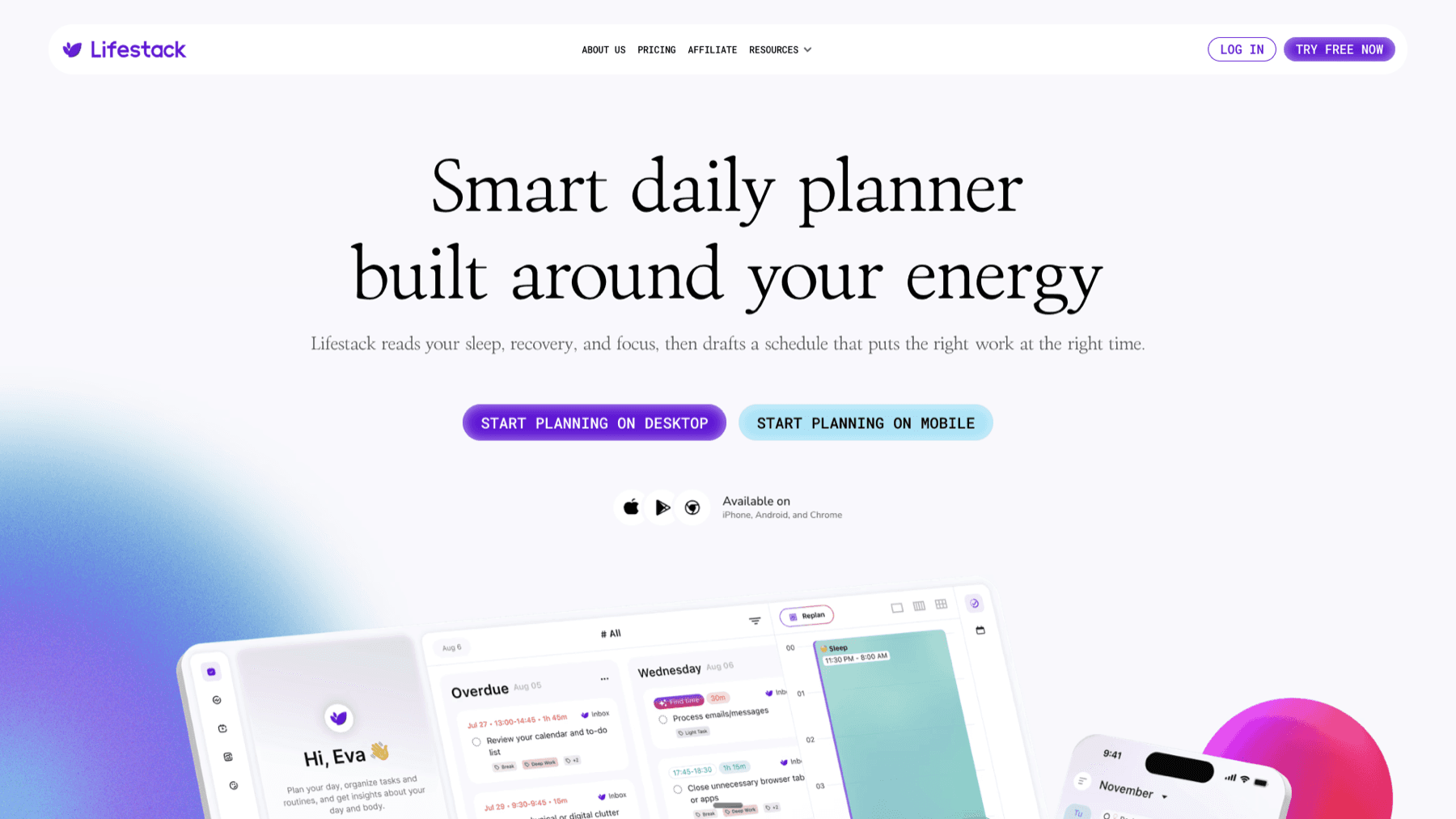
That data is only as useful as what you do with it. Lifestack is an AI calendar that uses energy awareness as a scheduling input. Rather than treating all hours equally, Lifestack maps your high-focus windows to deep work and meetings while moving lower-stakes tasks to your natural dip periods. If you're using Eight Sleep to improve your sleep quality and the Pod's app to understand your energy patterns, Lifestack closes the loop by optimizing how you spend the hours those patterns predict.
Understanding that feeling more energized isn't always about sleeping longer is one of the key lessons good sleep data teaches. Quality matters more than quantity in ways that are hard to see without tracking. Eight Sleep and Lifestack together give you both sides of that equation: the hardware to improve sleep quality, and the scheduling intelligence to deploy the resulting energy where it matters most.
Who Should Buy Eight Sleep
Eight Sleep makes the most sense for a specific set of buyers. If any of these describe you, it's worth serious consideration:
Hot sleepers: If you routinely kick off covers, wake up sweating, or sleep with a fan pointed directly at you, temperature-controlled bedding addresses the root cause rather than the symptom
Couples with different preferences: Dual-zone removes the nightly negotiation over thermostat settings and is one of the most frequently cited reasons for purchase satisfaction
Data-driven optimizers: If you already track HRV with a wearable and want passive, higher-resolution data without wearing anything to bed, the Pod 6's sensor array is meaningfully better than consumer wristbands
People who've plateaued on basics: If you've already addressed sleep hygiene, screen time, caffeine timing, and room darkness and still wake up feeling unrefreshed, temperature control is one of the remaining high-impact interventions
If you're still working through fundamentals like sleep schedule consistency or addressing a potential sleep disorder, start there. Resources like sleep restriction therapy and addressing whether 5 hours of sleep is actually enough are worth reading before spending $2,000 on hardware.
Frequently Asked Questions
Is Eight Sleep worth the money?
For people whose sleep quality is primarily affected by temperature, yes. The Pod's active heating and cooling system is the most effective consumer-grade solution available. For buyers without a temperature problem, the price is hard to justify when lower-cost sleep apps and wearables deliver comparable tracking data.
Does Eight Sleep require a monthly subscription?
Core features including temperature scheduling and sleep tracking are included with the hardware purchase. Some advanced analytics or membership features may carry additional costs. Always check the current Eight Sleep pricing page before buying, as subscription tiers have changed with product generations.
How long does the Eight Sleep Pod last?
Eight Sleep targets a 5-plus year lifespan for the Pod hardware. The mattress cover itself is machine-washable. The hub unit contains the heating, cooling, and pump systems, so its longevity depends on maintenance and water quality. Using distilled water, as recommended, extends component life.
Can I use Eight Sleep with an adjustable base?
Yes. The Pod cover is designed to flex with adjustable bases. The snoring intervention feature that subtly raises the head requires a compatible adjustable base. Eight Sleep sells their own base, but many third-party adjustable bases are compatible with the cover itself.
How does Eight Sleep compare to Chili Sleep?
Both use water-circulation technology for temperature control. Eight Sleep's advantage is its integrated biometric tracking, Autopilot sleep stage adjustments, and more refined app experience. Chili Sleep (OOLER and ChiliPad) tends to be less expensive and focuses primarily on temperature control without the sleep analytics layer. The right choice depends on whether tracking matters to you as much as the temperature control itself.
Does Eight Sleep accurately track sleep stages?
Better than most consumer wearables, but not at clinical-grade polysomnography accuracy. The Pod 6's expanded sensor array captures more biometric signals than a wrist device, which improves stage estimation. For understanding your personal trends and optimizing your sleep program over time, the accuracy is more than sufficient. For diagnosing a sleep disorder, consult a sleep specialist.
Most sleep advice comes down to tips you already know. Go to bed earlier. Limit caffeine. Keep your room dark. Eight Sleep takes a different approach: instead of telling you what to do, the Pod 6 does it for you, adjusting your mattress temperature in real time based on your sleep stage, body temperature, and recovery data.
The Pod 6 is their sixth-generation intelligent sleep system. It wraps around your mattress like a fitted sheet, circulates water through internal tubes to heat or cool the surface, and tracks dozens of biometric signals while you sleep. No chest strap, no wrist device, just a smart cover doing its job quietly beneath you.
We dug into what the Pod 6 actually delivers, where it earns its price, and where it falls short. If you're researching whether Eight Sleep belongs in your bedroom, here's what the data and real-world testing tell us.
Key Takeaways
The Pod 6's temperature control genuinely works, hitting the target range across a wide swing from 55°F to 110°F with dual-zone precision for couples
Biometric tracking captures HRV, sleep stages, snoring, and respiratory rate with 9x more sensors than the previous generation, without requiring you to wear anything
At $1,999 and up, it's a significant investment best suited to people who've already optimized the basics and want hardware-level control over sleep quality
What Is Eight Sleep?
Eight Sleep launched in 2014 with a simple premise: temperature is one of the most powerful levers for sleep quality, and most people have no control over it beyond a thermostat that affects the whole room. Their Pod cover solves that by heating or cooling the sleeping surface itself, independent of ambient room temperature.
The Pod 6 is not a mattress. It sits on top of your existing mattress and works with virtually any bed. A small hub unit (about the size of a bedside speaker) circulates water through micro-tubes woven into the cover. That hub is where the pump, heating, and cooling systems live. The cover itself is thin enough that most users don't notice the added height.
The companion app links the hardware to your data. When you set a sleep schedule, the Pod begins cooling or warming the surface before you even get in bed, reaching your target temperature by the time you lie down. Throughout the night, it adjusts automatically as your sleep stage changes, since deep sleep often calls for cooler temperatures while REM may benefit from slight warming.
Eight Sleep Pod 6: Key Features
The Pod 6 represents a meaningful jump from earlier versions. The biometric sensor array is 9x denser than the Pod 4, which means more data points for sleep stage detection, HRV tracking, and snoring analysis. Here's what the system actually monitors and controls:
Dual-zone temperature control: Each side of the bed operates independently, from 55°F to 110°F. One partner can sleep at 68°F while the other sleeps at 74°F, with no interference between zones
Autopilot temperature adjustments: The system detects your sleep stage in real time and fine-tunes surface temperature automatically. You set a general preference; the Pod handles the micro-adjustments
Biometric tracking: Heart rate, HRV, respiratory rate, sleep stages (light, deep, REM), and snoring events are captured passively throughout the night
Thermal alarm: Instead of a jarring sound, the Pod warms or cools the bed gradually during your lightest sleep phase to ease you awake. Most users report waking up before the backup alarm goes off
App integrations: Connects to Apple Health, Strava, and other fitness platforms so your sleep data can inform your workout recovery and activity planning
The snoring detection is worth calling out separately. When the Pod detects snoring patterns, it can subtly raise the head of the bed (if you're using a compatible base) or adjust temperature to shift your sleep position. It's a passive intervention, not a disruptive one.
Sleep Tracking Performance
Eight Sleep's tracking accuracy is the area where it separates itself most clearly from cheaper alternatives. Consumer wrist devices estimate sleep stages from motion and heart rate. The Pod 6 captures respiratory rate, body temperature shifts, micro-movements, and cardiac signals simultaneously, giving it far more signal to work with.
For those concerned about restorative sleep, the daily readiness scores are genuinely useful. You'll see breakdowns of how much time you spent in deep sleep versus light sleep, where your HRV landed relative to your baseline, and what your overnight heart rate curve looked like. Over time, the app learns your patterns and flags anomalies like a high resting heart rate after alcohol or compressed deep sleep following late exercise.
One limitation: like all consumer sleep trackers, the Pod's stage detection is less precise than a clinical polysomnography test. If you're tracking a genuine sleep disorder, a medical evaluation remains the standard. But for everyday optimization, especially understanding how habits affect your circadian rhythm, the data quality is well above what most wearables deliver.
Eight Sleep claims users see up to 34% more deep sleep and 44% less time to fall asleep after adopting the Pod. Individual results vary widely, and the company hasn't published independent peer-reviewed studies behind these numbers. That said, the temperature control mechanism is scientifically grounded: your body naturally drops core temperature to initiate sleep, and sleeping on a cool surface accelerates that process.
What Works Well
The temperature control is legitimately impressive. Unlike a cooling mattress topper that holds a fixed temperature, the Pod adjusts dynamically. Hot sleepers who've tried everything from cooling pillows to cranking the AC will notice a real difference within the first week. Couples with different thermal preferences tend to report the highest satisfaction, since dual-zone removes one of the most common bedroom negotiation points.
Passive tracking is genuinely convenient. If you've bounced between sleep apps and wearables, having a system that requires zero daily setup or on-body hardware is a meaningful quality-of-life improvement. You wear nothing. You do nothing. In the morning, your sleep data is waiting in the app.
The thermal alarm works better than expected. Many users find themselves waking naturally during the gradual temperature shift, which means waking during a lighter sleep stage rather than being yanked out of deep sleep by a loud alarm. For anyone who wakes up groggy regardless of how many hours they slept, this alone can meaningfully affect morning alertness.
Where Eight Sleep Falls Short
The price is the obvious friction point. At $1,999 for a solo Twin configuration, and more for larger sizes, the Pod 6 costs more than many people's mattresses. Eight Sleep offers Affirm financing and accepts HSA/FSA payments, which helps, but this remains a premium product for a specific buyer.
The hub unit produces some pump noise. Most users describe it as similar to a white noise machine, which many actually find helpful for sleep. But if you're sensitive to any mechanical sound in the bedroom, it's worth being aware of before buying. Eight Sleep does offer a 30-night trial, which gives you enough time to assess whether the noise is a dealbreaker.
Setup takes about 20 minutes and requires filling the hub with water. The system periodically needs water top-offs, typically every few months. It's not burdensome, but it's more maintenance than a standard mattress topper requires.
Finally, if you're already sleeping well and just want better data, the Pod is overkill. There are capable free sleep tracking apps and lower-cost wearables that deliver solid insights without the hardware investment. The Pod earns its price when temperature is genuinely interfering with your sleep quality.
Eight Sleep Pricing
Eight Sleep pricing starts at $1,999 for the Pod 6 in Solo Twin or Twin XL configurations. Queen, King, and California King sizes are priced higher. Solo sizes cover one side of a larger bed with independent temperature control; dual configurations cover both sides.
Financing: Available through Affirm with 36-month payment options
HSA/FSA: Eight Sleep is HSA/FSA eligible, which can meaningfully reduce after-tax cost for buyers who have these accounts
Trial period: 30 nights with a full refund option if you're not satisfied
The Pod 6 does not require a monthly subscription for core features. The companion app includes temperature scheduling, sleep tracking, and the Autopilot function. Some premium integrations and historical data analysis may require their membership tier; check their current pricing page for details before purchasing.
How Better Sleep Powers Your Day
Eight Sleep's tracking gives you something most people underestimate: reliable data on when your energy is highest and lowest throughout the day. Your chronotype and nightly sleep quality directly shape your cognitive performance windows. After a few weeks with the Pod, patterns become visible: deep sleep percentage on Sunday night correlates with Monday afternoon focus, and nights above a certain HRV threshold show up as high-energy mornings.
That data is only as useful as what you do with it. Lifestack is an AI calendar that uses energy awareness as a scheduling input. Rather than treating all hours equally, Lifestack maps your high-focus windows to deep work and meetings while moving lower-stakes tasks to your natural dip periods. If you're using Eight Sleep to improve your sleep quality and the Pod's app to understand your energy patterns, Lifestack closes the loop by optimizing how you spend the hours those patterns predict.
Understanding that feeling more energized isn't always about sleeping longer is one of the key lessons good sleep data teaches. Quality matters more than quantity in ways that are hard to see without tracking. Eight Sleep and Lifestack together give you both sides of that equation: the hardware to improve sleep quality, and the scheduling intelligence to deploy the resulting energy where it matters most.
Who Should Buy Eight Sleep
Eight Sleep makes the most sense for a specific set of buyers. If any of these describe you, it's worth serious consideration:
Hot sleepers: If you routinely kick off covers, wake up sweating, or sleep with a fan pointed directly at you, temperature-controlled bedding addresses the root cause rather than the symptom
Couples with different preferences: Dual-zone removes the nightly negotiation over thermostat settings and is one of the most frequently cited reasons for purchase satisfaction
Data-driven optimizers: If you already track HRV with a wearable and want passive, higher-resolution data without wearing anything to bed, the Pod 6's sensor array is meaningfully better than consumer wristbands
People who've plateaued on basics: If you've already addressed sleep hygiene, screen time, caffeine timing, and room darkness and still wake up feeling unrefreshed, temperature control is one of the remaining high-impact interventions
If you're still working through fundamentals like sleep schedule consistency or addressing a potential sleep disorder, start there. Resources like sleep restriction therapy and addressing whether 5 hours of sleep is actually enough are worth reading before spending $2,000 on hardware.
Frequently Asked Questions
Is Eight Sleep worth the money?
For people whose sleep quality is primarily affected by temperature, yes. The Pod's active heating and cooling system is the most effective consumer-grade solution available. For buyers without a temperature problem, the price is hard to justify when lower-cost sleep apps and wearables deliver comparable tracking data.
Does Eight Sleep require a monthly subscription?
Core features including temperature scheduling and sleep tracking are included with the hardware purchase. Some advanced analytics or membership features may carry additional costs. Always check the current Eight Sleep pricing page before buying, as subscription tiers have changed with product generations.
How long does the Eight Sleep Pod last?
Eight Sleep targets a 5-plus year lifespan for the Pod hardware. The mattress cover itself is machine-washable. The hub unit contains the heating, cooling, and pump systems, so its longevity depends on maintenance and water quality. Using distilled water, as recommended, extends component life.
Can I use Eight Sleep with an adjustable base?
Yes. The Pod cover is designed to flex with adjustable bases. The snoring intervention feature that subtly raises the head requires a compatible adjustable base. Eight Sleep sells their own base, but many third-party adjustable bases are compatible with the cover itself.
How does Eight Sleep compare to Chili Sleep?
Both use water-circulation technology for temperature control. Eight Sleep's advantage is its integrated biometric tracking, Autopilot sleep stage adjustments, and more refined app experience. Chili Sleep (OOLER and ChiliPad) tends to be less expensive and focuses primarily on temperature control without the sleep analytics layer. The right choice depends on whether tracking matters to you as much as the temperature control itself.
Does Eight Sleep accurately track sleep stages?
Better than most consumer wearables, but not at clinical-grade polysomnography accuracy. The Pod 6's expanded sensor array captures more biometric signals than a wrist device, which improves stage estimation. For understanding your personal trends and optimizing your sleep program over time, the accuracy is more than sufficient. For diagnosing a sleep disorder, consult a sleep specialist.



FOLLOW ON
FOLLOW ON
FOLLOW ON


Copyright 2026 © Lifestack. All rights reserved
Copyright 2026 © Lifestack. All rights reserved

