
App
Best Google Tasks Apps in 2026: 6 Apps Ranked
Best Google Tasks Apps in 2026: 6 Apps Ranked

Google Tasks is free, fast, and built into Gmail. But its interface tops out at a bare-bones sidebar. If you have ever tried to manage a real project there, you know what happens: everything is a flat list, there is no calendar view, and the moment you have more than ten items, things get buried.
The search for a better Google Tasks experience often starts with Tasksboard, a web app that wraps Google Tasks in a full-screen kanban board. It is a smart upgrade. But Tasksboard is not the only way to get more out of Google Tasks. A handful of apps now sync with Google Tasks, replace it with something smarter, or offer functionality that the native sidebar simply cannot match.
We tested six of the top Google Tasks apps in 2026, looking at how well each one extends or replaces the native experience. We paid attention to AI scheduling, energy awareness, mobile quality, and whether the tool actually syncs data back to Google Tasks rather than silo-ing it. If you are exploring Google Tasks vs. Google Keep, this list will also help you decide which direction to take your task workflow.
Lifestack sits at the top not because it has the most features but because it does something none of these other tools do: it matches tasks to the time of day when you have the energy to do them. That is a different problem than "how do I see my tasks on a kanban board," and it is worth understanding the difference before you pick a tool.
Key Takeaways
Tasksboard is the best pure upgrade for Google Tasks, giving any task list a full-screen kanban board in under a minute
Lifestack goes further by adding AI scheduling that slots tasks into time blocks matched to your energy level, something Google Tasks cannot do alone
Motion and Sunsama are strong if you want AI planning, but neither uses energy data as a scheduling input
Quick Guide: Best Google Tasks Apps at a Glance
Lifestack - Best overall for AI scheduling and energy-aware planning, $9.99/month
Tasksboard - Best pure Google Tasks UI upgrade, kanban boards, free tier available
TickTick - Best feature depth for the price, $49.99/year
Motion - Best for auto-scheduling busy workloads, $19/month
Todoist - Best for teams who want simplicity, free tier available
Sunsama - Best for daily ritual-driven workers, $17/month (annual)
How We Evaluated
Google Tasks sync: Does it pull from and write back to Google Tasks?
Scheduling intelligence: Does it auto-place tasks on a calendar?
Energy awareness: Does it factor in your energy level when scheduling?
Mobile experience: iOS and Android quality
Pricing: Free tier availability and value for the price
1. Lifestack - Best Google Tasks App for Energy-Aware Scheduling
The only task app that schedules around your energy, not just your calendar.

Lifestack is an AI-powered calendar and task manager that does something the other apps on this list do not: it tracks your energy patterns and schedules tasks based on when you are actually capable of doing them. A focused deep-work block lands in your morning peak. Admin tasks fill your post-lunch valley. This is not a feature you configure once; Lifestack learns your patterns over time.
It connects to Google Calendar and syncs with your existing task systems, so you do not start from zero. For anyone who has tried task management apps for inconsistent energy levels, Lifestack is the most direct answer available. It was built for people who know they have high-output windows and want to stop wasting them on the wrong work.
The interface is clean and calendar-first. You can view tasks as time blocks on your calendar, drag them to reschedule, and let the AI refill gaps when meetings move. If you want to understand how energy-based planning works as a concept, the full breakdown on task management for inconsistent energy is worth reading before you sign up.
AI scheduling that matches tasks to your energy peaks and valleys
Google Calendar integration with two-way sync
iOS and Android apps with full offline support
Chrome extension for capturing tasks from anywhere
Learns your patterns over time without manual configuration
What Works
Energy-aware scheduling is a genuine differentiator, not a marketing label
Calendar-first view makes it easy to see your day at a glance
AI reschedules around meetings automatically
Limitations
No free tier; starts at $9.99/month
Does not offer a kanban view for Google Tasks specifically
Pricing: $9.99/month or $49.99/year (7-day free trial on annual plan)
Best for: People with variable energy who want their calendar to reflect when they can actually do deep work
2. Tasksboard - Best Full-Screen App for Google Tasks
The simplest way to give Google Tasks a kanban upgrade.

Tasksboard is the most direct answer to the "tasksboard for Google Tasks" search. It is a web app that connects to your Google account, pulls in your task lists, and displays them as a full-screen kanban board. Everything syncs in real time, so changes you make in Tasksboard show up in Google Tasks and vice versa.
The kanban view makes it easy to organize tasks across columns such as To Do, In Progress, and Done. You can drag and drop tasks, add labels, attach Google Drive files, and share lists with teammates. The free tier is generous, and the Pro upgrade at under $5/month is one of the most affordable power-ups in this category.
Full-screen kanban board backed by Google Tasks data
Real-time sync with Google Tasks, Gmail, and Google Calendar
Drag-and-drop task management with labels and subtasks
Team sharing via email or link
Export tasks to Google Sheets
What Works
Setup takes under two minutes via Google sign-in
Keeps your data in Google Tasks, so nothing is locked in a proprietary format
Pro tier is very affordable at $4.79/month (annual)
Limitations
No AI scheduling or energy awareness
Calendar view is basic compared to dedicated calendar apps
No native iOS or Android app; mobile access is via mobile web
Pricing: Free (unlimited tasks, 5 shared lists); Pro $4.79/month (billed annually); Team $4.99/user/month (billed annually)
Best for: Google Tasks users who want a kanban board without leaving the Google ecosystem
3. TickTick - Best Feature Set for the Price
Everything you could want from a task manager, at a fraction of the cost.

TickTick packs a remarkable number of features into a single app. You get kanban boards, calendar views, Pomodoro timers, habit tracking, and calendar integration, all for $49.99/year. It does not natively sync with Google Tasks the way Tasksboard does, but it covers so much ground that many users stop needing Google Tasks altogether.
The app works across iOS, Android, Web, Mac, and Windows, and the mobile experience is one of the best in this category. If you have ADHD or struggle with inconsistent task lists, the full TickTick for ADHD guide is worth reading alongside this one. For a deeper look at TickTick specifically, see our TickTick review.
Kanban, list, timeline, and calendar views
Built-in Pomodoro timer and habit tracker
Natural language input for fast task capture
Cross-platform: iOS, Android, Web, Mac, Windows
AI features on Premium tier
What Works
Best value for the feature set in this list
Mobile app is polished and fast
Great for users who want one app to handle tasks and habits
Limitations
No direct Google Tasks sync out of the box
No energy-aware scheduling
Pricing: Free; Premium $49.99/year
Best for: Users who want a full-featured task manager with kanban, calendar, and habit tracking in one place
4. Motion - Best for Auto-Scheduling Busy Workloads
AI that builds your calendar around your tasks, not the other way around.

Motion is a full AI scheduling platform. You add tasks with deadlines and time estimates, and Motion fills your calendar automatically, reshuffling blocks whenever meetings land. It is powerful for people with dense schedules and a constant backlog. For a detailed look, see the Motion calendar review.
The tradeoff is cost and complexity. Motion starts at $19/month per seat, which is steep compared to Tasksboard or TickTick. And the auto-scheduling algorithm, while impressive, does not use energy data, so it might schedule your hardest task at 2 PM on a Friday. It also has no direct Google Tasks sync, meaning you would need to maintain tasks inside Motion rather than your existing Google Tasks lists.
AI auto-scheduling fills your calendar based on task priority and deadlines
Projects, tasks, docs, and meeting notes in one workspace
Rescheduling happens automatically when meetings shift
iOS, Android, and desktop apps
What Works
Best pure auto-scheduling engine in this list
Handles complex project hierarchies well
AI integrations are extensive
Limitations
No energy awareness in scheduling decisions
No native Google Tasks sync
Pricey at $19/month per seat
Pricing: Pro AI $19/seat/month; Business AI $29/seat/month (33% off with annual billing)
Best for: Professionals with heavy project loads who want their entire calendar managed by AI
5. Todoist - Best for Simple Team Task Management
The classic to-do list app, now with AI and a generous free tier.

Todoist has been around long enough to be many people's default task manager. It is clean, fast, and works everywhere. The free tier is generous, and the Pro plan at $5/month (annual) is one of the most affordable paid options here. For a full breakdown, check the Todoist review.
Todoist does not natively sync with Google Tasks. You can connect it via Zapier or similar automation tools, but the integration is not built-in. The app does include an AI assistant on paid plans that can suggest due dates and prioritize tasks, though it does not schedule them on a calendar automatically. For users who want to compare it with similar tools, the TickTick vs. Todoist comparison goes deeper.
Natural language task entry with smart due date parsing
Shared projects and task delegation for teams
Integrations with over 80 apps including Slack, Google Calendar, and GitHub
Karma system for tracking productivity trends
What Works
Best free tier of any app in this list
Great for teams who need shared task lists without a steep learning curve
Works on every platform imaginable
Limitations
No energy-aware scheduling
No native Google Tasks sync
AI features are helpful but not calendar-integrated
Pricing: Free; Pro $5/month (annual) or $7/month; Business $8/month per user (annual)
Best for: Teams and individuals who want a reliable, low-friction to-do list with strong integrations
6. Sunsama - Best for Daily Ritual-Driven Workers
A daily planner for people who want structure, not just a task list.
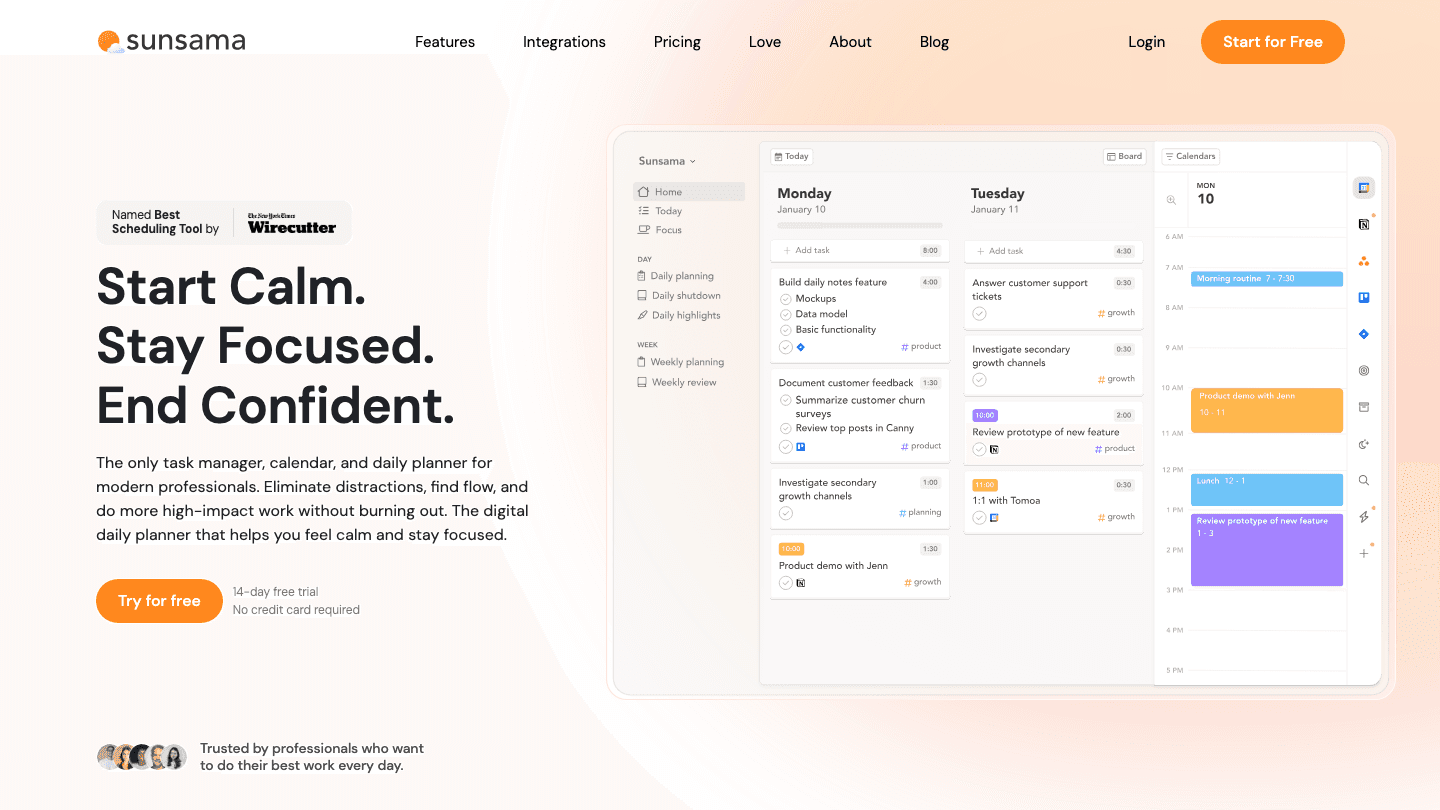
Sunsama takes a different approach. Instead of building the ultimate task inbox, it focuses on the ritual of planning your day. Each morning, you open Sunsama, review your tasks and meetings, and consciously decide what goes into today. That deliberate friction is the product. See the Sunsama review for the full picture.
Sunsama does sync with Google Calendar and can pull in tasks from tools like Asana, Linear, and GitHub. It does not natively sync with Google Tasks, but the approach is intentional: Sunsama is a daily planning layer rather than a task storage system. The price at $17/month (annual) reflects a tool built for deliberate knowledge workers rather than budget-conscious users.
Guided daily planning ritual with morning and evening routines
Pulls tasks from Asana, Linear, GitHub, and other tools
Google Calendar integration with time-blocking
AI-powered task estimation and channel-based focus mode
What Works
The daily planning ritual genuinely improves focus and follow-through
Great for people who have tried every task app and need an accountability structure
Beautiful, distraction-free interface
Limitations
No energy-aware scheduling
No native Google Tasks sync
Most expensive non-Motion option at $17-22/month
Pricing: $17/month (annual) or $22/month; 14-day free trial
Best for: Knowledge workers who want a daily planning ritual rather than a traditional task manager
Which Google Tasks App Is Right for You?
You want to stay in the Google ecosystem and get a better UI: Tasksboard is the obvious choice. It is fast, cheap, and keeps your tasks in Google Tasks.
Your productivity crashes at certain times of day: Lifestack is built for this. Energy-aware scheduling is not available anywhere else in this list. See the guide to ADHD to-do lists for context on why energy matters more than time for many people.
You have a heavy project backlog and lots of deadlines: Motion handles this better than any other tool here.
You want the best feature-to-price ratio: TickTick at $49.99/year includes kanban, calendar, Pomodoro, and habit tracking.
You need a free tool for a team: Todoist's free tier is the most useful one in this category.
You want to plan your day deliberately, not just track tasks: Sunsama's daily ritual approach works well if the inbox-first model has never clicked for you.
If your main frustration with Google Tasks is the interface, Tasksboard solves it directly. If the problem runs deeper, that you are struggling to actually do the tasks not just organize them, Lifestack's energy-aware approach is worth trying. The free task management apps guide covers more options if budget is the primary constraint.
FAQ
What is Tasksboard for Google Tasks?
Tasksboard is a web app that displays your Google Tasks in a full-screen kanban board. It syncs in real time with Google Tasks, so changes in Tasksboard appear in Google Tasks and vice versa. It is free to start, with paid plans starting at $4.79/month (annual).
Does Tasksboard replace Google Tasks?
No. Tasksboard uses your Google Tasks data as the backend. It adds a better interface on top, but your tasks remain stored in Google Tasks. You can continue using the Google Tasks sidebar in Gmail alongside Tasksboard.
Can I use Google Tasks with a kanban board?
Yes. Tasksboard is the most direct way to view Google Tasks as a kanban board. TickTick also offers kanban views, though it does not natively sync with Google Tasks.
What is the best free app for Google Tasks?
Tasksboard has the most generous free tier of apps that actually sync with Google Tasks. Todoist and TickTick also have good free tiers, though they do not natively sync Google Tasks data.
Which Google Tasks app is best for ADHD?
Lifestack is the best option for ADHD because it schedules tasks based on your energy level, not just your calendar. For people whose focus and output vary significantly throughout the day, that distinction matters. See the ADHD to-do list guide for strategies that work alongside any of these apps.
Is there an AI app that works with Google Tasks?
Lifestack integrates with Google Calendar and can be used alongside Google Tasks. It adds AI scheduling and energy awareness on top of your existing setup. Motion also has strong AI scheduling, though it does not natively pull from Google Tasks.
Google Tasks is free, fast, and built into Gmail. But its interface tops out at a bare-bones sidebar. If you have ever tried to manage a real project there, you know what happens: everything is a flat list, there is no calendar view, and the moment you have more than ten items, things get buried.
The search for a better Google Tasks experience often starts with Tasksboard, a web app that wraps Google Tasks in a full-screen kanban board. It is a smart upgrade. But Tasksboard is not the only way to get more out of Google Tasks. A handful of apps now sync with Google Tasks, replace it with something smarter, or offer functionality that the native sidebar simply cannot match.
We tested six of the top Google Tasks apps in 2026, looking at how well each one extends or replaces the native experience. We paid attention to AI scheduling, energy awareness, mobile quality, and whether the tool actually syncs data back to Google Tasks rather than silo-ing it. If you are exploring Google Tasks vs. Google Keep, this list will also help you decide which direction to take your task workflow.
Lifestack sits at the top not because it has the most features but because it does something none of these other tools do: it matches tasks to the time of day when you have the energy to do them. That is a different problem than "how do I see my tasks on a kanban board," and it is worth understanding the difference before you pick a tool.
Key Takeaways
Tasksboard is the best pure upgrade for Google Tasks, giving any task list a full-screen kanban board in under a minute
Lifestack goes further by adding AI scheduling that slots tasks into time blocks matched to your energy level, something Google Tasks cannot do alone
Motion and Sunsama are strong if you want AI planning, but neither uses energy data as a scheduling input
Quick Guide: Best Google Tasks Apps at a Glance
Lifestack - Best overall for AI scheduling and energy-aware planning, $9.99/month
Tasksboard - Best pure Google Tasks UI upgrade, kanban boards, free tier available
TickTick - Best feature depth for the price, $49.99/year
Motion - Best for auto-scheduling busy workloads, $19/month
Todoist - Best for teams who want simplicity, free tier available
Sunsama - Best for daily ritual-driven workers, $17/month (annual)
How We Evaluated
Google Tasks sync: Does it pull from and write back to Google Tasks?
Scheduling intelligence: Does it auto-place tasks on a calendar?
Energy awareness: Does it factor in your energy level when scheduling?
Mobile experience: iOS and Android quality
Pricing: Free tier availability and value for the price
1. Lifestack - Best Google Tasks App for Energy-Aware Scheduling
The only task app that schedules around your energy, not just your calendar.
Lifestack is an AI-powered calendar and task manager that does something the other apps on this list do not: it tracks your energy patterns and schedules tasks based on when you are actually capable of doing them. A focused deep-work block lands in your morning peak. Admin tasks fill your post-lunch valley. This is not a feature you configure once; Lifestack learns your patterns over time.
It connects to Google Calendar and syncs with your existing task systems, so you do not start from zero. For anyone who has tried task management apps for inconsistent energy levels, Lifestack is the most direct answer available. It was built for people who know they have high-output windows and want to stop wasting them on the wrong work.
The interface is clean and calendar-first. You can view tasks as time blocks on your calendar, drag them to reschedule, and let the AI refill gaps when meetings move. If you want to understand how energy-based planning works as a concept, the full breakdown on task management for inconsistent energy is worth reading before you sign up.
AI scheduling that matches tasks to your energy peaks and valleys
Google Calendar integration with two-way sync
iOS and Android apps with full offline support
Chrome extension for capturing tasks from anywhere
Learns your patterns over time without manual configuration
What Works
Energy-aware scheduling is a genuine differentiator, not a marketing label
Calendar-first view makes it easy to see your day at a glance
AI reschedules around meetings automatically
Limitations
No free tier; starts at $9.99/month
Does not offer a kanban view for Google Tasks specifically
Pricing: $9.99/month or $49.99/year (7-day free trial on annual plan)
Best for: People with variable energy who want their calendar to reflect when they can actually do deep work
2. Tasksboard - Best Full-Screen App for Google Tasks
The simplest way to give Google Tasks a kanban upgrade.
Tasksboard is the most direct answer to the "tasksboard for Google Tasks" search. It is a web app that connects to your Google account, pulls in your task lists, and displays them as a full-screen kanban board. Everything syncs in real time, so changes you make in Tasksboard show up in Google Tasks and vice versa.
The kanban view makes it easy to organize tasks across columns such as To Do, In Progress, and Done. You can drag and drop tasks, add labels, attach Google Drive files, and share lists with teammates. The free tier is generous, and the Pro upgrade at under $5/month is one of the most affordable power-ups in this category.
Full-screen kanban board backed by Google Tasks data
Real-time sync with Google Tasks, Gmail, and Google Calendar
Drag-and-drop task management with labels and subtasks
Team sharing via email or link
Export tasks to Google Sheets
What Works
Setup takes under two minutes via Google sign-in
Keeps your data in Google Tasks, so nothing is locked in a proprietary format
Pro tier is very affordable at $4.79/month (annual)
Limitations
No AI scheduling or energy awareness
Calendar view is basic compared to dedicated calendar apps
No native iOS or Android app; mobile access is via mobile web
Pricing: Free (unlimited tasks, 5 shared lists); Pro $4.79/month (billed annually); Team $4.99/user/month (billed annually)
Best for: Google Tasks users who want a kanban board without leaving the Google ecosystem
3. TickTick - Best Feature Set for the Price
Everything you could want from a task manager, at a fraction of the cost.
TickTick packs a remarkable number of features into a single app. You get kanban boards, calendar views, Pomodoro timers, habit tracking, and calendar integration, all for $49.99/year. It does not natively sync with Google Tasks the way Tasksboard does, but it covers so much ground that many users stop needing Google Tasks altogether.
The app works across iOS, Android, Web, Mac, and Windows, and the mobile experience is one of the best in this category. If you have ADHD or struggle with inconsistent task lists, the full TickTick for ADHD guide is worth reading alongside this one. For a deeper look at TickTick specifically, see our TickTick review.
Kanban, list, timeline, and calendar views
Built-in Pomodoro timer and habit tracker
Natural language input for fast task capture
Cross-platform: iOS, Android, Web, Mac, Windows
AI features on Premium tier
What Works
Best value for the feature set in this list
Mobile app is polished and fast
Great for users who want one app to handle tasks and habits
Limitations
No direct Google Tasks sync out of the box
No energy-aware scheduling
Pricing: Free; Premium $49.99/year
Best for: Users who want a full-featured task manager with kanban, calendar, and habit tracking in one place
4. Motion - Best for Auto-Scheduling Busy Workloads
AI that builds your calendar around your tasks, not the other way around.
Motion is a full AI scheduling platform. You add tasks with deadlines and time estimates, and Motion fills your calendar automatically, reshuffling blocks whenever meetings land. It is powerful for people with dense schedules and a constant backlog. For a detailed look, see the Motion calendar review.
The tradeoff is cost and complexity. Motion starts at $19/month per seat, which is steep compared to Tasksboard or TickTick. And the auto-scheduling algorithm, while impressive, does not use energy data, so it might schedule your hardest task at 2 PM on a Friday. It also has no direct Google Tasks sync, meaning you would need to maintain tasks inside Motion rather than your existing Google Tasks lists.
AI auto-scheduling fills your calendar based on task priority and deadlines
Projects, tasks, docs, and meeting notes in one workspace
Rescheduling happens automatically when meetings shift
iOS, Android, and desktop apps
What Works
Best pure auto-scheduling engine in this list
Handles complex project hierarchies well
AI integrations are extensive
Limitations
No energy awareness in scheduling decisions
No native Google Tasks sync
Pricey at $19/month per seat
Pricing: Pro AI $19/seat/month; Business AI $29/seat/month (33% off with annual billing)
Best for: Professionals with heavy project loads who want their entire calendar managed by AI
5. Todoist - Best for Simple Team Task Management
The classic to-do list app, now with AI and a generous free tier.
Todoist has been around long enough to be many people's default task manager. It is clean, fast, and works everywhere. The free tier is generous, and the Pro plan at $5/month (annual) is one of the most affordable paid options here. For a full breakdown, check the Todoist review.
Todoist does not natively sync with Google Tasks. You can connect it via Zapier or similar automation tools, but the integration is not built-in. The app does include an AI assistant on paid plans that can suggest due dates and prioritize tasks, though it does not schedule them on a calendar automatically. For users who want to compare it with similar tools, the TickTick vs. Todoist comparison goes deeper.
Natural language task entry with smart due date parsing
Shared projects and task delegation for teams
Integrations with over 80 apps including Slack, Google Calendar, and GitHub
Karma system for tracking productivity trends
What Works
Best free tier of any app in this list
Great for teams who need shared task lists without a steep learning curve
Works on every platform imaginable
Limitations
No energy-aware scheduling
No native Google Tasks sync
AI features are helpful but not calendar-integrated
Pricing: Free; Pro $5/month (annual) or $7/month; Business $8/month per user (annual)
Best for: Teams and individuals who want a reliable, low-friction to-do list with strong integrations
6. Sunsama - Best for Daily Ritual-Driven Workers
A daily planner for people who want structure, not just a task list.
Sunsama takes a different approach. Instead of building the ultimate task inbox, it focuses on the ritual of planning your day. Each morning, you open Sunsama, review your tasks and meetings, and consciously decide what goes into today. That deliberate friction is the product. See the Sunsama review for the full picture.
Sunsama does sync with Google Calendar and can pull in tasks from tools like Asana, Linear, and GitHub. It does not natively sync with Google Tasks, but the approach is intentional: Sunsama is a daily planning layer rather than a task storage system. The price at $17/month (annual) reflects a tool built for deliberate knowledge workers rather than budget-conscious users.
Guided daily planning ritual with morning and evening routines
Pulls tasks from Asana, Linear, GitHub, and other tools
Google Calendar integration with time-blocking
AI-powered task estimation and channel-based focus mode
What Works
The daily planning ritual genuinely improves focus and follow-through
Great for people who have tried every task app and need an accountability structure
Beautiful, distraction-free interface
Limitations
No energy-aware scheduling
No native Google Tasks sync
Most expensive non-Motion option at $17-22/month
Pricing: $17/month (annual) or $22/month; 14-day free trial
Best for: Knowledge workers who want a daily planning ritual rather than a traditional task manager
Which Google Tasks App Is Right for You?
You want to stay in the Google ecosystem and get a better UI: Tasksboard is the obvious choice. It is fast, cheap, and keeps your tasks in Google Tasks.
Your productivity crashes at certain times of day: Lifestack is built for this. Energy-aware scheduling is not available anywhere else in this list. See the guide to ADHD to-do lists for context on why energy matters more than time for many people.
You have a heavy project backlog and lots of deadlines: Motion handles this better than any other tool here.
You want the best feature-to-price ratio: TickTick at $49.99/year includes kanban, calendar, Pomodoro, and habit tracking.
You need a free tool for a team: Todoist's free tier is the most useful one in this category.
You want to plan your day deliberately, not just track tasks: Sunsama's daily ritual approach works well if the inbox-first model has never clicked for you.
If your main frustration with Google Tasks is the interface, Tasksboard solves it directly. If the problem runs deeper, that you are struggling to actually do the tasks not just organize them, Lifestack's energy-aware approach is worth trying. The free task management apps guide covers more options if budget is the primary constraint.
FAQ
What is Tasksboard for Google Tasks?
Tasksboard is a web app that displays your Google Tasks in a full-screen kanban board. It syncs in real time with Google Tasks, so changes in Tasksboard appear in Google Tasks and vice versa. It is free to start, with paid plans starting at $4.79/month (annual).
Does Tasksboard replace Google Tasks?
No. Tasksboard uses your Google Tasks data as the backend. It adds a better interface on top, but your tasks remain stored in Google Tasks. You can continue using the Google Tasks sidebar in Gmail alongside Tasksboard.
Can I use Google Tasks with a kanban board?
Yes. Tasksboard is the most direct way to view Google Tasks as a kanban board. TickTick also offers kanban views, though it does not natively sync with Google Tasks.
What is the best free app for Google Tasks?
Tasksboard has the most generous free tier of apps that actually sync with Google Tasks. Todoist and TickTick also have good free tiers, though they do not natively sync Google Tasks data.
Which Google Tasks app is best for ADHD?
Lifestack is the best option for ADHD because it schedules tasks based on your energy level, not just your calendar. For people whose focus and output vary significantly throughout the day, that distinction matters. See the ADHD to-do list guide for strategies that work alongside any of these apps.
Is there an AI app that works with Google Tasks?
Lifestack integrates with Google Calendar and can be used alongside Google Tasks. It adds AI scheduling and energy awareness on top of your existing setup. Motion also has strong AI scheduling, though it does not natively pull from Google Tasks.



FOLLOW ON
FOLLOW ON
FOLLOW ON



Copyright 2026 © Lifestack. All rights reserved
Copyright 2026 © Lifestack. All rights reserved

